
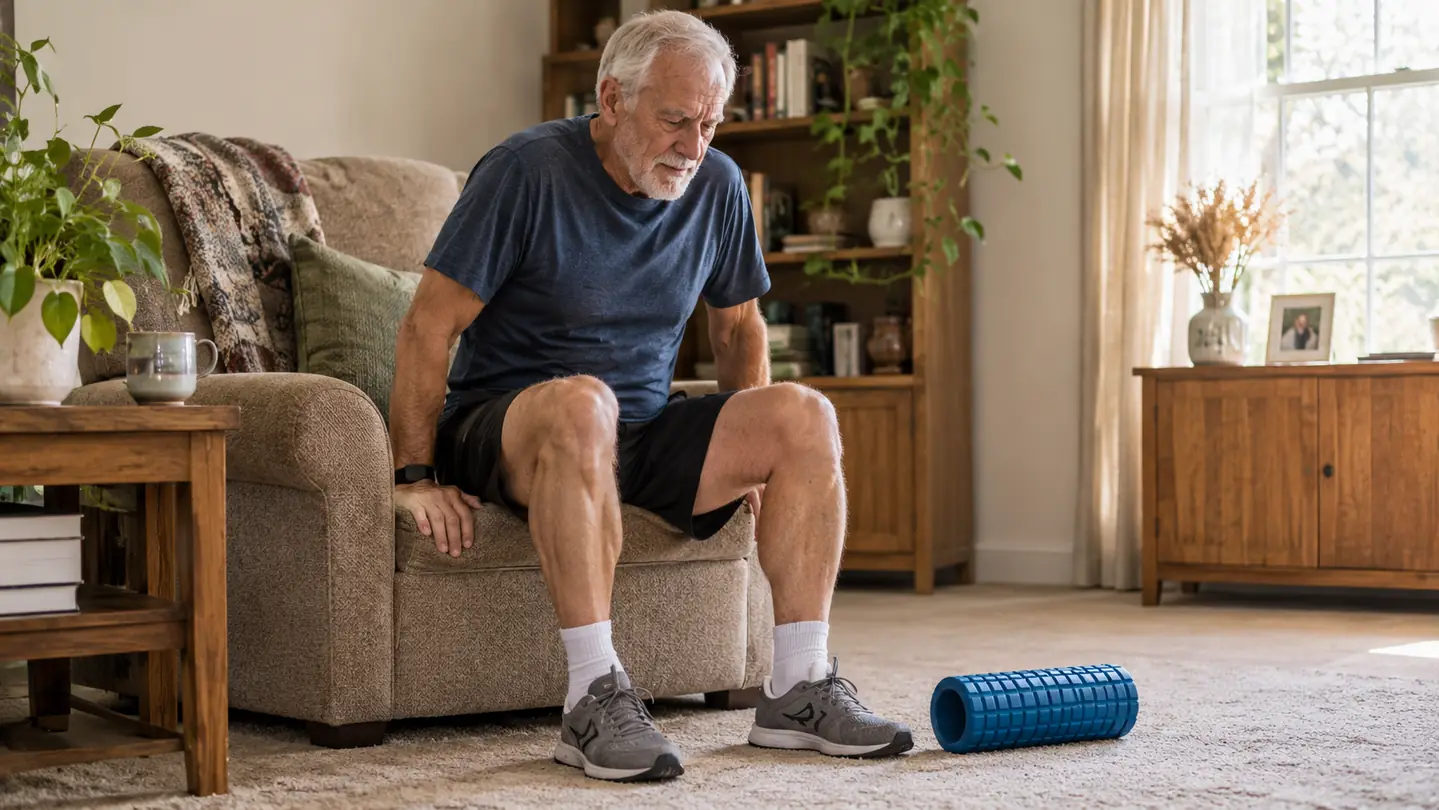
My back tells me the weather before the radio does. For years now, the first ten minutes of my morning have been the worst ten of the day: a low back that has to be talked into straightening, knees that need a moment before they will take my weight, and a general creak that makes the walk to the kitchen feel longer than the walk itself. I am 78, thirty-one years teaching shop behind me, and I do about twenty minutes of movement in the living room every morning after coffee. Four months ago I set the 321 STRONG massage roller beside my armchair to see whether it would earn its spot. It has not moved since.
Before I go further: I am not a doctor or a therapist, and this is not medical advice. My own doctor knows what I do in the morning, and I would tell you to have that same conversation before you start rolling anything. What follows is a plain log from one older man who used this thing daily for months, including the parts that annoyed me.
The Quick Verdict
A small, medium-density roller that made my morning stiff spell easier to work through. It will not fix a bad back, and the first week it will argue with you.
Amazon Check Today's Price →The roller that stayed by my armchair for four months
Small enough to keep in the room where you actually move, firm enough to do something. See the current price and the full listing on Amazon.
Amazon Check Today's Price on Amazon →How I've Used It
My routine has not changed much in three years. Coffee first, then twenty minutes of movement, then a short walk with Dot after lunch. The roller slid into the front half of that twenty minutes. I roll my calves, then the outside of each thigh, then, with my back against the wall in the garage, the muscles alongside my shoulder blades. Two to three minutes per area, slow, breathing the whole time. On the carpet in the living room, and on a rubber mat in the corner of the garage when the weather is decent enough to be out there.
The listing says the roller is meant for about twenty minutes of work after exercise, and again at 24 and 48 hours, and it points to research on recovery time. I cannot vouch for the research. I can tell you what a shorter version did for me: the stiff spell in the morning got shorter. In January I would give myself eleven or twelve minutes of moving around before I felt like a person. By April it was closer to six. Same roller, same carpet, same creaky man.
Two things I had to learn the slow way. Roll the muscle, not the joint. The first time I put weight on the roller with a knee bent under me, I knew about it for two days. And keep the pressure honest but not heroic. The first week I was bearing down as though the roller owed me money, and the soreness afterward was my own doing, not the tool's.
Cold mornings change the routine. When the garage is bitter I stay in the living room, stand with my back to the door frame, and work the muscles beside my shoulder blades by leaning in and rolling slowly. It is not elegant. It is effective, and it takes four minutes. The rest of the year the mat in the garage corner does the same job with more room to move around in.
What the Three Zones Actually Do
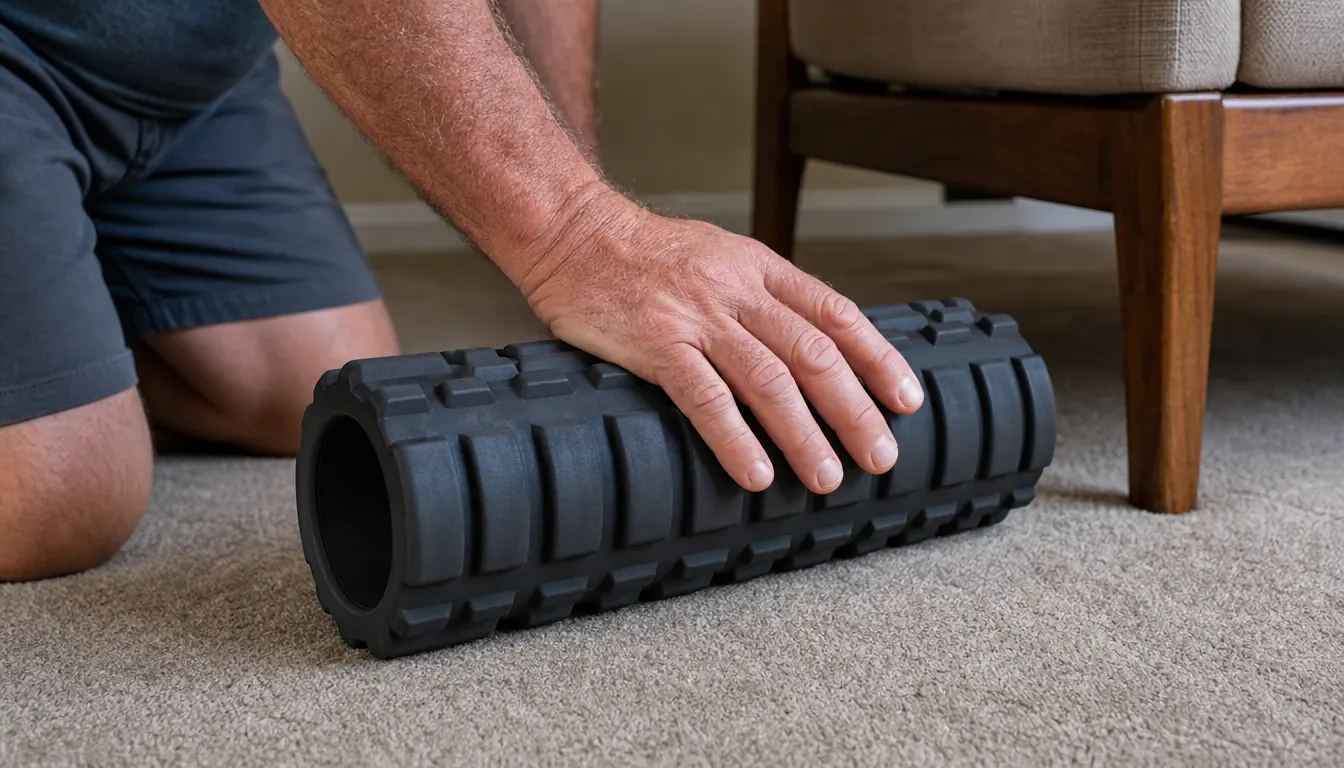
The 321 STRONG roller has three massage zones built along it, and the idea is that you rotate it so a different zone sits under the muscle. That gives you a way to change how much pressure you feel without changing how hard you lean into it. I use the mildest one on my calves, where the muscle is thin and the bone sits close to the surface, and a firmer one on the outside of the thigh, where I can take more. After a few weeks I stopped thinking about which zone was which and just turned it until it felt right.
Medium density is the part worth understanding before you buy. Soft rollers are comfortable and do very little. Hard rollers do plenty and hurt. This one sits where the listing says it sits: medium, firm enough that you feel the muscle give and forgiving enough that you can stay on it for a couple of minutes. It is 12.5 inches long and 5.25 inches across, and it weighs 8.64 ounces, which means I can pick it up off the carpet with one hand while holding the armchair with the other. At my age that last detail matters more than any specification on the page.
It is EVA foam over an EPP core, and the listing says it is free of BPA, formamide, lead, PVC and phthalates. I cannot test any of that from my living room. I can tell you it has no smell, which was not true of a foam mat I bought years ago and had to leave in the garage for a month before I could stand to be near it. There are also seven US patents listed on the product page, which tells you the three-zone layout is not something anyone can copy outright. Whether that matters to your back is a separate question.
The second half of the manufacturer's suggestion is to roll again at 24 and 48 hours. I have followed that loosely, mostly after the longer Saturday walk with Dot, when my calves are the loudest part of me. Ten minutes on a Saturday evening and again on Sunday is what actually happens in this house, and it is enough that Monday morning does not punish me on the stairs.
What It Feels Like on Old Knees and a Stiff Back
I want to be careful here, because knees are the part of me that complains loudest and they are also the part most easily made worse. I do not roll on the knee itself. I roll the calf below it and the thigh above it, and the knee benefits from the neighbors loosening up. Same with the back. I do not lie on the roller for my spine. I stand with my back to the wall in the garage and work the muscles beside the shoulder blades, which is where my stiffness actually lives after a morning of sitting.
The first week was not pleasant. Medium density on a body that has not been rolled in years feels like an argument. Day two I was tender in the calves. Day four the tenderness was gone and the muscles underneath felt different, looser, more willing. That is the whole of my evidence, and I am not going to dress it up as more than that. If I had quit on day two I would have told you it was too firm and never touched it again.
Balance is the thing nobody warns you about. Standing on one leg with the other on a roller is a skill, and at 78 it is a skill worth respecting. I keep one hand on the armchair the whole time in the living room, and one hand on the workbench in the garage. If you cannot do that safely, work seated or skip it and tell your doctor why. There is no prize for falling over in your own living room.
In January I needed eleven or twelve minutes of moving around before I felt like a person. By April it was closer to six.
How It Held Up Over Months
Four months of daily use, roughly five days a week, and the roller looks the same as the day it came out of the box. No flat spots, no crumbling at the edges, no soft place in the middle where my weight lands most often. The EPP core is doing its job. I have had foam things go soft on me inside a season, and this one has not.
Storage is the reason it stayed in my routine. It lives on the floor beside the armchair, tucked against the wall, and it takes up no more room than a pair of slippers. A tool that has to be fetched from a closet is a tool I stop using by the second week. That is not a knock on bigger rollers. It is an honest report on how a 78-year-old man actually behaves.
Dot has used it a handful of times, mostly on her calves after the morning walk, and she hands it back without complaint. She is not a convert and I am not going to pretend she is. Two people can look at the same piece of equipment and want different things from it, which is why I would tell you to think about what you actually want before you order.
What I Don't Like About It
It is short. Twelve and a half inches means one area at a time, and if you want to work a long stretch of muscle you do it in sections. For the whole back, lying lengthwise on a roller, I would want something longer. I knew that going in and I still think it is worth saying out loud.
It also comes with no guidance beyond the listing. There is no card in the box telling you which zone to use where, or how long to stay on a spot, or what to do when a calf protests. I worked that out from what my doctor told me and from going slowly. If you have never used a roller in your life, plan on spending the first week being more conservative than you think you need to be.
It rolls freely on carpet, which is what I want, and it slides a little on the rubber mat in the garage, so I brace it against the wall there. Small nuisance, easy fix, worth knowing before you try it on a hard floor.
And the honest limit: a roller loosens tissue. It does not build strength, it does not repair a joint, and it does not replace the walking and the standing up out of a chair that keep me upright. It is one small tool inside a routine, not the routine itself. The people I worry about are the ones who buy it expecting the second thing.
What I Liked
- Medium density you can actually stay on for a few minutes at a time
- Small and light at 8.64 ounces, so it lives where you use it
- Three zones let you change pressure without changing your lean
- Still firm and unmarked after four months of daily use
- No smell, no crumbling, nothing to assemble
Where It Falls Short
- 12.5 inches is short for working a long stretch of muscle
- The first week is genuinely uncomfortable
- No guidance in the box for a first-time user
- It will not replace stretching, walking or strength work
Who This Is For
This is for the person who already moves a little every day and wants something small to work the stiffness out before or after. Someone in their sixties, seventies or eighties who exercises at home, on carpet, in a living room or a garage corner. Someone who has been told by a doctor or a physical therapist that rolling is fine and who wants a medium-density tool rather than a soft one that does nothing. If that sounds like you, the density choice is the whole decision, and I set out the reasons in 10 Reasons a Medium-Density Foam Roller Suits Seniors.
You do not need to be athletic. You need a floor you can get up from, a chair or a wall to hold on to, and the patience to be bored for three minutes at a stretch. The 321 STRONG roller does not ask anything else of you.
If you are deciding between this and a handheld stick, that is a fair comparison and I put the two side by side in 321 STRONG Massage Roller vs Massage Stick. The short version: the stick is easier to use from a chair, the roller puts your own body weight to work and gets deeper for less effort.
Who Should Skip It
Skip it if you have an injury that is still healing, if you have had surgery recently, or if you have a condition that makes pressure on tissue a bad idea. Ask first. Skip it if getting down onto the floor and back up again is a project, because a good share of the useful work happens at floor level. Skip it if you want a device that does the work for you. There is nothing electric here. It is foam over a core and your own body weight, and it only does what you make it do.
Skip it, too, if you will not put it where you can reach it. The single biggest factor in whether this worked for me was that it sat beside the armchair where I drink my coffee. A roller in a closet is a roller you own and never use. That is true of every piece of home equipment I have ever bought, including two I will not name.
Four months in, it still has a spot by my chair
Medium density, three zones, small enough to keep in the room where you actually move. Check today's price and the full listing on Amazon.
Amazon Check Today's Price on Amazon →