
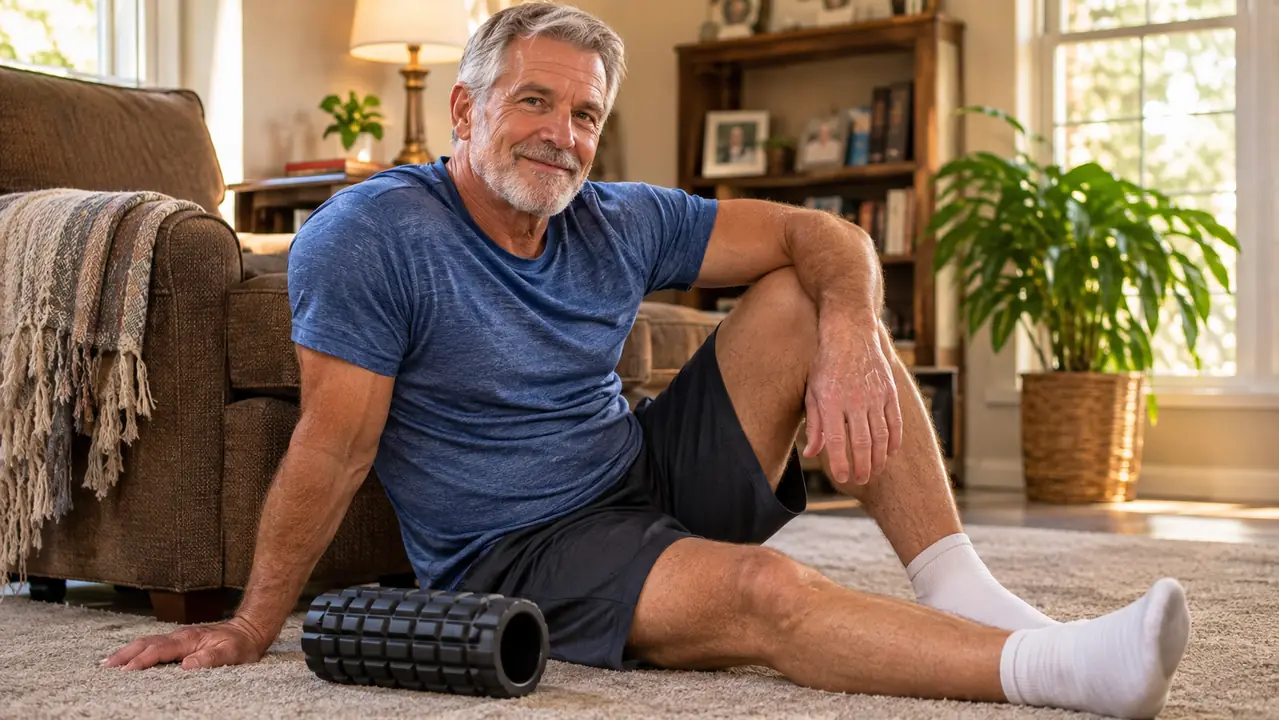
Short answer first, because you did not come here for a sermon. If the stiffness you carry is broad, across the small of your back, down the outside of your thighs, along the backs of your legs, the 321 STRONG three-zone massage roller does more for me than a stick ever did. If the stiffness is small and high, the knot under a shoulder blade, the tight band at the top of a calf, a massage stick reaches it easier and you can work it standing at the kitchen counter. One is a floor tool and one is a standing tool. That is the short of it. The rest of this page is why I landed there after months of using both, and which one I would hand to a friend my age.
I am 78, retired after thirty-one years teaching shop, and I live in a one-story ranch house in Wethersfield, Connecticut, with my wife Dot. My knees complain on stairs and in cold weather. My lower back is stiff for the first twenty minutes of every morning. My balance is good and I work to keep it that way. I do about twenty minutes of movement after coffee, a short walk after lunch, and a few quiet minutes of breathing and gratitude before bed. I have no interest in gear that needs a gym, a trainer, or a second person to hand me things. Both of these tools fit that life. They just fit different parts of it.
| 321 STRONG Massage Roller | A Massage Stick | |
|---|---|---|
| Best for | Broad areas: lower back, thighs, the full length of a calf | Small, reachable spots: between the shoulder blades, the top of a calf |
| Upper back reach | Needs you on the floor, plus some wriggling to get the angle | Reach over the shoulder and work it standing up |
| Pressure control | Set by how much body weight you give it, which caps how hard you can go | Set directly by both hands, so you can lean into one spot |
| Getting down and up | You kneel or sit on the carpet and get back up after, which is the real cost | Done standing or from a chair, with no floor involved |
| Coverage per stroke | The 5.25 inch diameter spreads work across a wide band of muscle | A narrow strip, so a whole thigh takes many passes |
| Simplicity | One molded piece of EVA foam over an EPP core, 8.64 ounces, no moving parts | Handles and joints that can loosen with age |
| Packing and storage | 12.5 inches long and 5.25 inches across, so it takes real space in a bag | Slim enough to slide into a suitcase pocket or a drawer |
| What other buyers report | 4.5 stars across more than 42,000 ratings | Varies by make, with nothing close to that volume in one place |
Where the 321 STRONG Roller Wins
The 5.25 inch diameter is the reason this one works on an older body. A wide surface spreads force across a whole muscle instead of digging into one spot, and that is the difference between a tool I reach for and a tool that makes me swear. I lie on the carpet, set the roller under my lower back, and let my own body weight decide the pressure. Nothing to grip. Nothing to hold up. When I want more, I give it more weight. When I want less, I take some back. My hands stay out of it, which matters, because my hands are the first thing to tire these days.
The three zones are the second reason. One piece of gear gives me a broad zone and two firmer ones, so I can turn it to change intensity without getting up to fetch something else. On a gentle morning I stay on the wide zone. On a morning when the outside of my thigh wants a real conversation, I rotate the roller and carry on. The whole thing weighs 8.64 ounces and measures 12.5 by 5.25 by 5.25 inches, one molded piece of EVA foam over an EPP core, with nothing to adjust, nothing to inflate, nothing to lose. It wipes clean with a damp cloth. That kind of simplicity is worth a lot at my age.
The listing notes that foam rolling for 20 minutes after exercise, and again at 24 and 48 hours, has been shown to reduce recovery time. I am not a laboratory and I cannot verify the study. What I can tell you is that twenty minutes on the carpet after my lunch walk is the first self-care habit I have kept for more than a month in years, and I think the reason is that the tool never gives me an excuse to quit. It sits beside the armchair where I can see it. It is heavier than a sock and lighter than a book. I pick it up without thinking about it.
Where a Massage Stick Wins
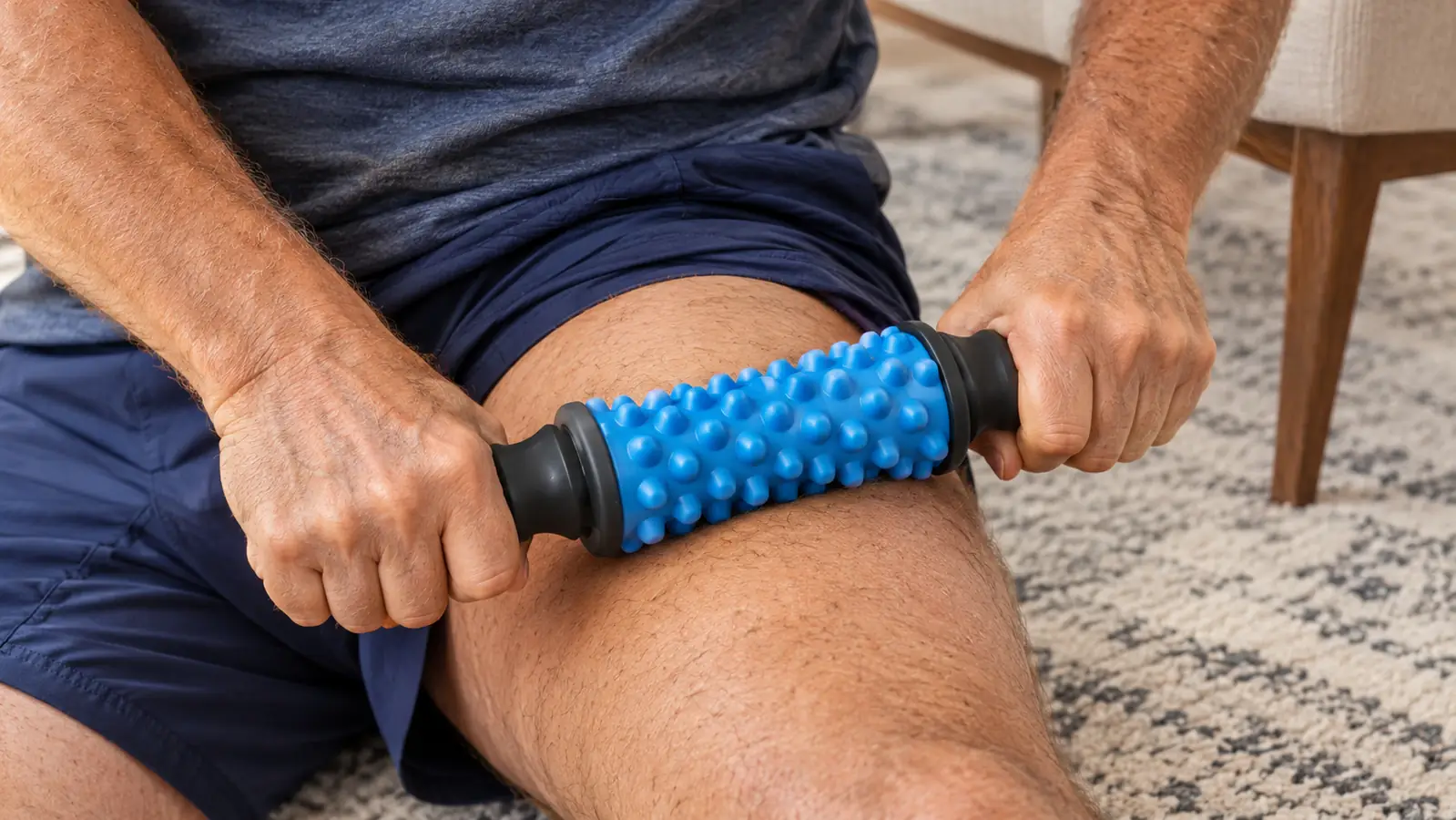
Reach. The spot that troubles me most sits between my shoulder blades, and no floor roller has ever gotten to it properly. To reach my upper back on the floor I have to bridge my hips and wiggle around, which is a circus act my lower back does not appreciate. With a stick I stand at the kitchen counter, reach over one shoulder, and I am on the spot in about thirty seconds. Dot does the same while the kettle heats. No carpet, no getting down, no getting back up. For a stiff upper back, that is the entire case, and it is a good one.
Direct pressure is the second thing. Both hands are on the handles, so I decide exactly how hard the pressure is and exactly where it lands. With the roller I am negotiating with gravity. That is fine for broad, sweeping work and it is not fine for one stubborn spot I want to lean into for ten seconds and then leave alone. The stick also asks nothing of my knees. Getting down onto the carpet and back up again is the real cost of floor work at 78, and on a cold morning that cost is high enough that I skip it entirely. A tool you skip is not a tool.
Where the stick loses is coverage. It works a narrow strip, so covering the whole length of a thigh takes patience and a great many strokes, and my shoulders get tired of the reaching before the leg does. It has handles and joints where the roller is one molded piece, and anything with joints can work loose over the years. It is also easy to press too hard with two good hands and no body weight to regulate you. I have done exactly that and felt it the next morning. The roller is harder to misuse, because your own weight is a natural governor on how much you can give it.
The part of your body that hurts most should pick the tool
If your back and thighs are the daily complaint, the three-zone 321 STRONG roller is the one that gets used in my house. Medium density, 8.64 ounces, one molded piece, no parts to lose. I keep mine beside the armchair so the twenty minutes happens before I talk myself out of it.
Amazon Check Today's Price on Amazon →Who Should Buy Which
Buy the roller if your stiffness is broad and low. Lower back, the outside of the thighs, the long muscles down the back of the leg, the calves. Buy it if you are comfortable getting down on a carpet and back up again, or if you have a sturdy chair to hold while you do. Buy it if you would rather let body weight set the pressure than trust your own hands. And buy it if you want one object by the chair that has nothing to adjust, nothing to charge, and nothing to assemble. That describes my house and my mornings, and after months of use it is still the piece I would replace first if it walked off.
Buy the stick if your trouble is high and small. Between the shoulder blades, the top of the shoulder, the upper back, the tight band just below the knee. Buy it if getting down to the floor is a negotiation with your knees, or if you would rather do this standing at the counter in the two minutes the kettle takes. Buy it if you want to lean hard into one spot and be done. It is the better tool for aim and the worse tool for coverage, and it asks almost nothing of your balance.
You do not have to make this a lifelong loyalty. Plenty of people keep both, and I understand why. The roller handles the floor work and the stick handles the shoulder blades, and between them they cover a whole body. If you are starting with one, start with the part that wakes you up at night. If it is your lower back, that is the roller. If it is the knot you can reach with your own thumb but cannot get enough leverage on, that is the stick. Nobody I know has ever regretted buying the tool for the spot that actually hurts.
How a Twenty Minute Morning Actually Goes
Coffee first. Then I put a cushion on the carpet, sit down beside the armchair, and slide the roller under my lower back. I breathe out and let my weight settle onto it. Three or four slow passes, then I move it to the outside of one thigh and work the length of it, then the other side. The medium density matters here. Something softer would do nothing and something harder would make me tense up against it, which defeats the purpose of lying down in the first place.
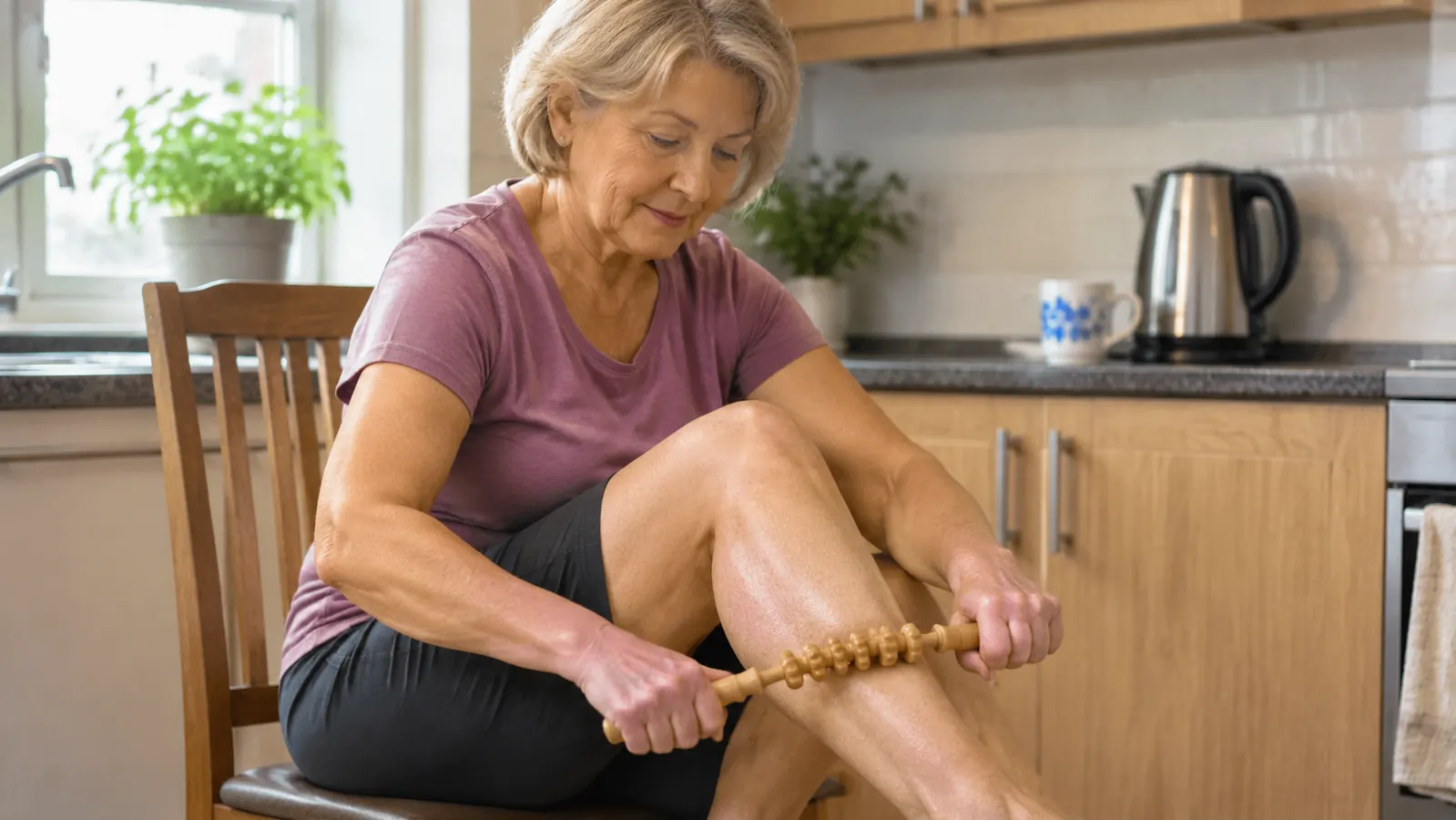
Then I stand up, using the armchair, and finish with the stick. Over the shoulder for the spot between the blades, then a seated pass along the top of each calf with my foot on a low stool. Two minutes, maybe three. That order works for me because the floor work loosens the big muscles and the standing work finishes the small ones, and because doing the hard part first means it actually gets done.
The whole thing takes about twenty minutes, which is the same twenty minutes I used to spend sitting in a chair reading about exercises I was not going to do. That is the honest comparison. Neither tool is dramatic. Nobody is going to congratulate you. But twenty minutes on the carpet with the roller and three minutes at the counter with the stick is the difference between a stiff morning and a manageable one for me, and it has held for months.
A Word About Starting Slow
Medium density is not soft. It has give, and it also has an opinion. My first week I gave it five minutes, not twenty, and I was glad of that the next day. If you have knee trouble, back trouble, a balance problem, or you take a blood thinner, talk to your doctor or your physical therapist before you start lying on a roller, and be specific about what you plan to do. I am a retired shop teacher with a stiff back, not a clinician, and nothing here should be taken as medical advice.
Two rules of my own. I do not roll directly over my spine or over my kneecaps, and I do not work a spot that is sharp. Ache is one thing and sharp is another, and sharp means stop and ask somebody who knows more than I do. Beyond that, the plan is small and steady. Five minutes becomes ten and ten becomes twenty, and the habit is worth more than any single session. That is the same way I treat my morning walk and my gratitude list.
Twenty minutes on the carpet beats an hour of meaning to
The roller sits by my armchair because the tool within reach is the tool that gets used. Three zones, medium density, 8.64 ounces, no parts to lose and nothing to charge. Read the reviews from people with knees like ours, then decide.
Amazon Check Today's Price on Amazon →