
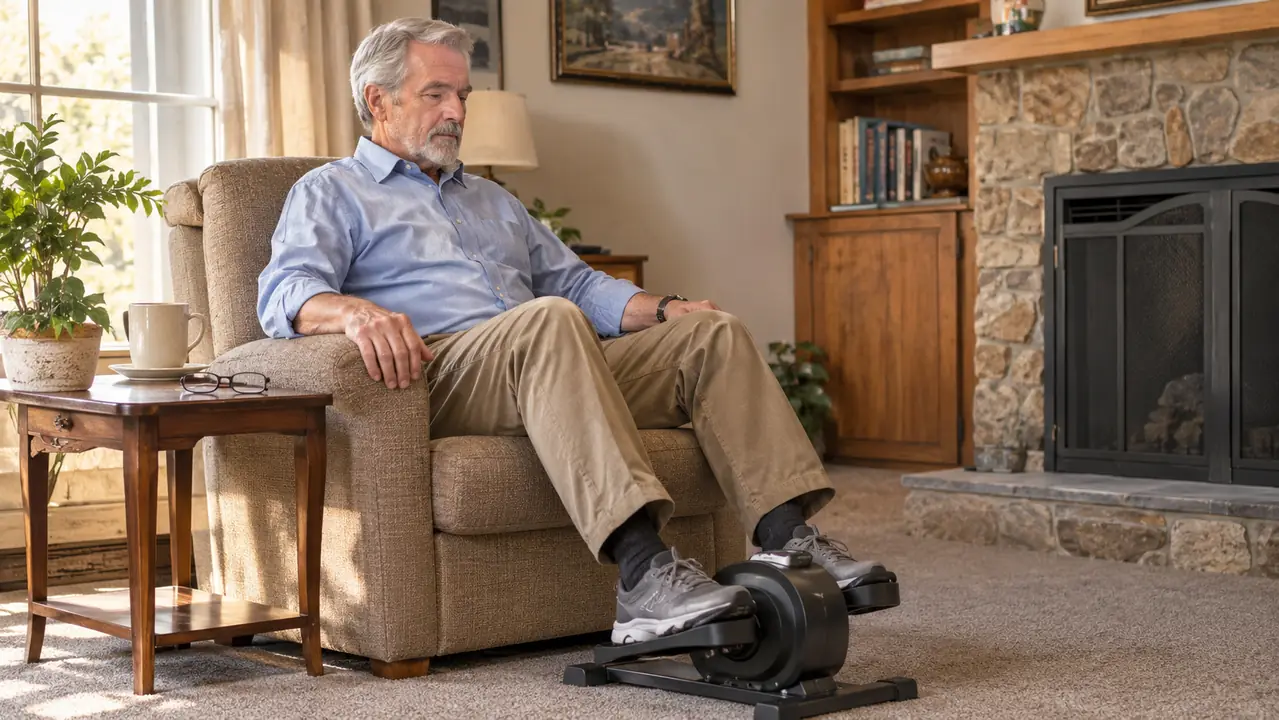
I bought the Cubii JR1 expecting to be talked at. Every catalog that lands in the mailbox and every morning television segment says the same easy thing, that a small pedal machine under the chair will loosen a stiff body, and after seventy-eight years I have learned to keep my wallet shut when a sentence sounds that simple. What I wanted was a straight answer. Does a man with knees that argue on stairs and a lower back that takes twenty minutes to arrive in the morning actually keep using one of these past the second week, or does it end up in the garage beside the exercise bike somebody gave us in 1998?
Two months in, the answer is yes, with qualifiers I never heard before I ordered. My name is Frank Kersey. I am 78, a retired high school shop teacher, and I do about twenty minutes of movement every morning after coffee in the living room of our one-story ranch house in Wethersfield, Connecticut. My wife Dot walks with me most afternoons. Neither of us is training for anything except staying out of trouble. So this is not a fitness review. It is a report from the armchair, and it covers the parts that work and the parts that do not.
The Quick Verdict
A sturdy little machine that earns its place beside the chair, provided you accept that it works your legs and not your heart, and that the tracking is done by hand, not by magic.
Amazon Check Today's Price →Two months in and it is still sitting by the armchair. That is the whole claim.
I will not tell you it rebuilt my knees. I will tell you it moved the morning stiffness out of my way, and I kept using it long after the new wore off.
Amazon Check Today's Price on Amazon →The Four Things Nobody Tells You Before You Order
First, it is heavier than the pictures suggest. The listing puts the Cubii JR1 at 25.4 pounds and 23.2 inches deep, and that matches what I carried in from the porch. Dot is 76 and she could not move it from the living room out to the garage on her own, and I would not ask her to try. Pick a home for it and leave it there. Mine sits at the end of the sofa on the carpet, angled toward the armchair, and it has not moved since the first week.
Second, it does not do what a walk does. Seated pedaling works the front of the thighs and the calves and keeps the hips moving, and that is worth something real. It is not a replacement for the after-lunch loop around the block. I made that mistake in week one, skipped my walk because I had already pedaled, and by Thursday my back told me what it thought of the trade. Now the machine is what I do before the walk, never instead of it.
Third, the resistance is manual. Nothing happens unless your legs make it happen, and the eight levels are something you set yourself rather than something the machine decides for you. There is no program that ramps up on its own while you are watching the news. I am glad of that. A machine that changes the rules on a 78-year-old knee without asking first is not a machine I want in my house.
Fourth, and this is the one that surprised me, the little screen and the phone app do not talk to each other. The LCD keeps your count while you pedal. The app is where you enter that count afterward, by hand, reading the numbers off the display. It is honest bookkeeping, not automatic bookkeeping. If you were expecting your numbers to appear on your phone on their own, you will be disappointed, and I would rather you hear that from me than find it out on a Tuesday night.
How I Have Used It, Week by Week
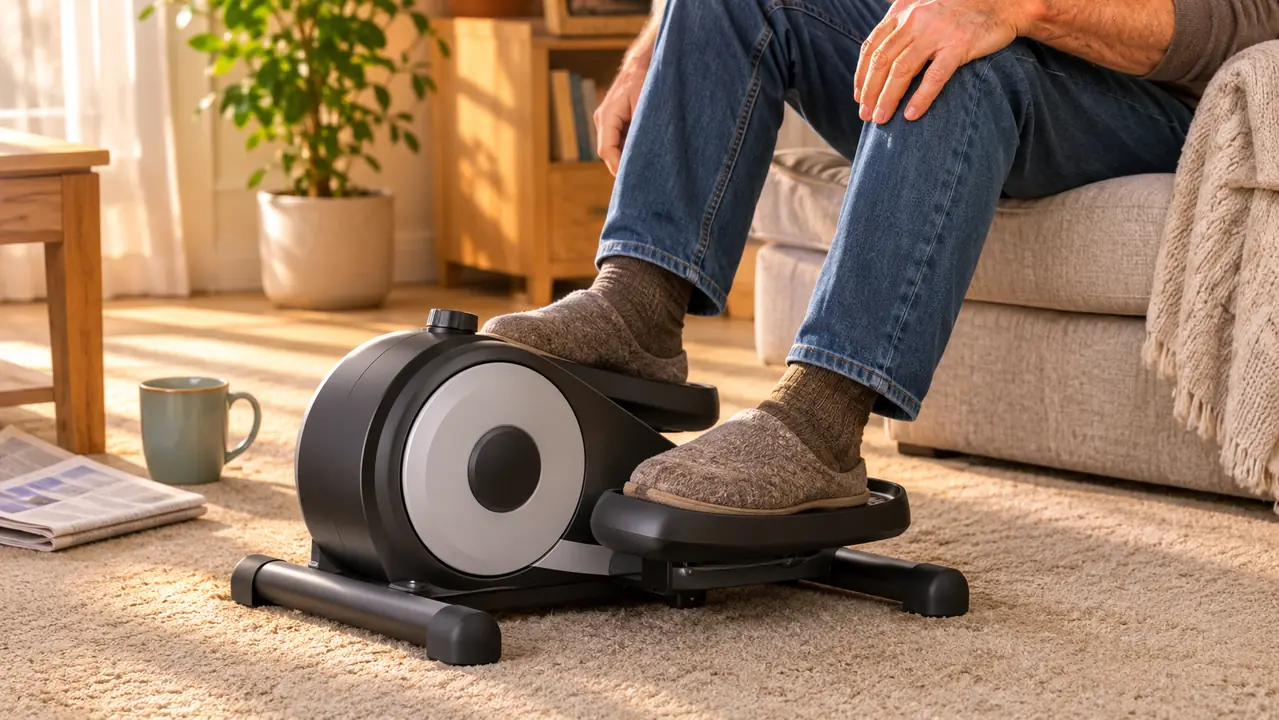
The unit measures 23.2 inches deep, 17.56 inches wide, and 10 inches tall. That height number matters more than you would guess. My armchair seat is roughly 18 inches off the floor, and the machine sits low enough that my knees come up at a comfortable angle instead of folding toward my chest. When I first set it in front of the recliner, my knees rode too high and after ten minutes my hip flexors complained. Sliding it six inches further out fixed the whole thing. That was the entire installation process, and it took one afternoon of fiddling and one cup of coffee.
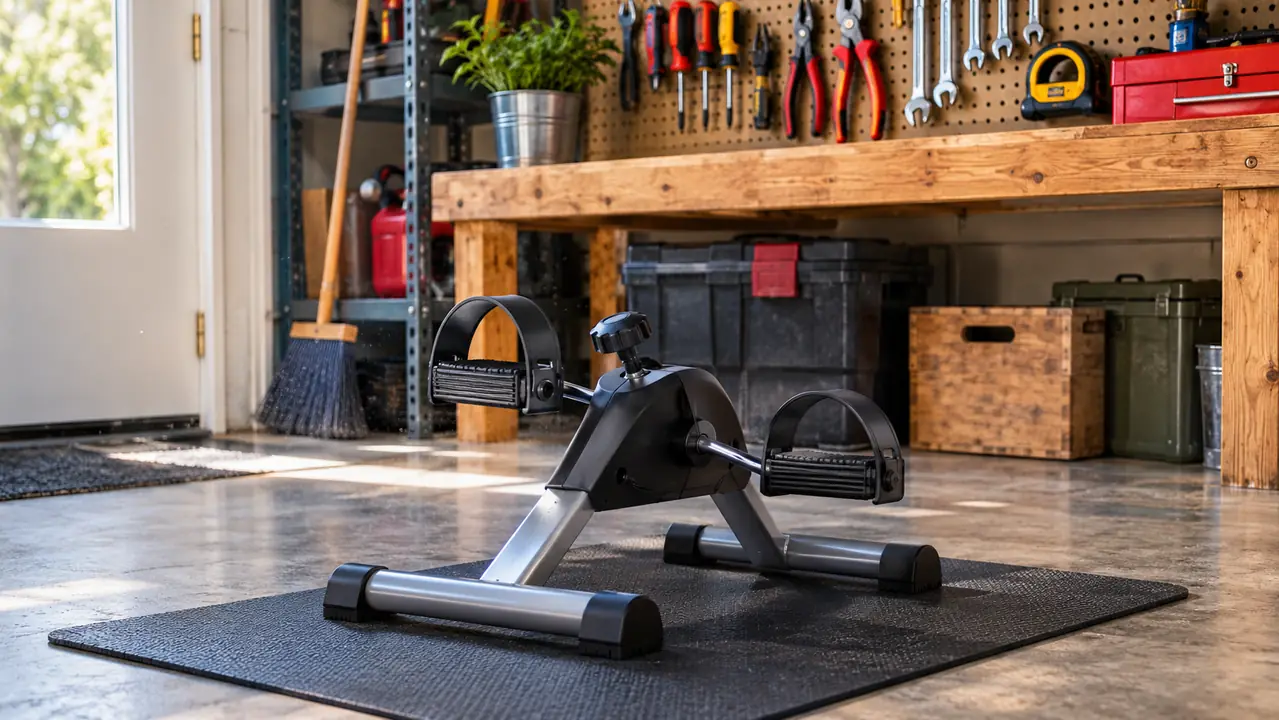
The carpet is a mixed blessing. On the living room rug the machine stays put, which is what you want, and the small amount of give under it is kinder on the heels. In the garage, where the floor is bare concrete, it wants to creep forward when I push hard at level six and above. A rubber mat underneath solved that in about four minutes. If you plan to use yours in a garage or a basement, plan on a mat. If you plan to use it on carpet, you already have what you need.
The listing sells it as an under-desk machine, and at 10 inches tall it does fit under my old shop desk, which has generous clearance. But I found I do not use it there. Pushing back from a desk to pedal and then pulling forward to type is more fuss than it is worth at my age, and I suspect that is true for most people who buy one meaning to work and pedal at the same time. If you truly plan to pedal while you work, measure your knee clearance before you order. If you plan to pedal in an armchair with a cup of coffee on the side table, you are the person this machine was built for.
I kept a tally for sixty-one days. The two days I skipped were the two days I had pushed the machine out of arm's reach the night before.
The Eight Resistance Levels, and What Each One Is Actually For
Level one is barely there. It is what I use for the first three or four minutes while the coffee is still going down and my knees are deciding whether they are on speaking terms with me that morning. Levels two and three are the everyday setting. I can pedal at three and hold a conversation with Dot, watch the morning news, or think about what I am going to do with the tomato plants. Level four is where I start to feel it across the front of the thighs, and where I stop talking for a while.
Levels five and six are my working sets. I do three minutes at six, back down to three for two minutes, and repeat that three times. That is my whole program, and with the easy start and the wind down it runs about twenty minutes. Level seven I use a minute at a time. Level eight I have used exactly four times. It is not a wall. It is a suggestion that you slow down and push. If you are stronger than I am, and plenty of people my age are, you will spend more time up there than I do.
What the levels are not is load. Pedaling at eight on a seated machine does not put weight through your bones the way standing and walking does, and it does nothing at all for balance. My physical therapist was plain about that when I asked her, and I will pass it along without pretending to be an expert. Seated work is one tool. Standing work is another. A body needs both, and what belongs in your particular week is a question for your doctor or your therapist, not for a catalog.
The Screen, the App, and the Bookkeeping Nobody Warned Me About
The LCD does what a bike computer does. It keeps your count as you go, including calories burned, and it is easy enough to read without my glasses if the light in the room is decent. I glance at it at the end, write the number on the pad by the telephone, and that is the whole ritual. I have never once needed to look at it in the middle of a session, and I doubt most people do.
The app is where the honest part of this review lives. Cubii built it so you can track your progress, but the data gets there because you type it in from the display. There is no automatic handoff. For me that turned out fine. Writing the number down is part of the habit now, the same way the gratitude list is part of my evening. But if you are the sort of person who wants the machine to do the record keeping, know now that it will not, and decide whether that bothers you before you order rather than after.
Where a written log earns its keep is the long view. After eight weeks I could look back and see that my average session had crept from eleven minutes up to twenty without my ever deciding to increase anything. That is the kind of progress an older body makes, slow and unremarkable day to day, and it is nearly invisible unless something is writing it down. The app will do that if you feed it. So will the spiral notebook in the kitchen drawer.
What My Knees and My Back Have to Say
I will not tell you this machine fixed anything, because it did not. My knees still complain on stairs and in cold weather. What changed is the shape of the morning. Before, I went from the bed to the coffee to the chair and my back stayed stiff until nearly ten o'clock. Now the twenty minutes on the pedals comes between the coffee and the chair, and by the time I sit down the stiffness has mostly moved along. That is not a cure. It is a schedule that happens to help, and I will take it.
The low impact matters more than I expected it to. There is no pounding and no jarring, nothing that sends a shock up through the heel the way a hard floor does. My knees do not pop on it the way they do on the first few steps of the stairs in the morning. I still take those stairs slowly and I still hold the rail. I am not recommending that anybody stop holding the rail.
One thing to watch: it is easy to sit too long. The motion is pleasant enough that I caught myself pedaling for forty minutes one Saturday while a ballgame ran, and my hip flexors were tight for the rest of the day. Twenty minutes is my limit now and I set a kitchen timer to enforce it. If you have a hip or a back that gives you grief, start shorter than you think you should, and talk to your doctor before you build any routine around it.
What I Liked
- Built to take a real push, with a 300 pound maximum weight recommendation that is not wishful thinking
- Eight manual resistance levels, so nothing changes under you without your say so
- Low impact underfoot, which matters on carpet in a small room with bad knees
- At 23.2 by 17.56 by 10 inches it lives beside an armchair without crowding the room
- Stays put on carpet, so it does not wander while you are using it
Where It Falls Short
- 25.4 pounds is heavier than the pictures suggest, so it does not move from room to room easily
- The app requires hand entry from the LCD, with no automatic tracking
- Seated pedaling does no work for balance or bone density
- It creeps forward on bare concrete unless you put a mat under it
Two Months In, Would I Buy It Again?
Yes, and without much agonizing. The test I use for any piece of equipment is whether it survives the third week, when the novelty is gone and the weather is bad and nobody is watching. This one survived because it asks almost nothing of me. No drive to a gym, no class schedule, no getting dressed for the weather. It sits where I already sit, and the only decision is whether to put my feet on it. At my age, removing that one small decision has been worth more than any feature on the box.
What I would change if I could is the record keeping. I would like the numbers to travel from the display to the app without my typing them, and I would like the thing to weigh ten pounds less so Dot could move it to the garage on a Saturday without waiting for me. Those are real complaints and I am not going to soften them. But they are the complaints of a man who kept using the machine, not the complaints of a man who parked it in the garage next to the exercise bike from 1998. That bike is still there. This is not.
Who This Is For
This is for the person who has stopped moving as much as they used to and wants a way back in that does not require weather, a car, or a membership card. If you have a sturdy chair, a little floor space, and twenty minutes in the morning, the Cubii JR1 fits into that life without rearranging it. It suits knees that dislike stairs, hips that stiffen after an hour in a chair, and anyone whose walking has shrunk to the distance from the kitchen to the mailbox. It also suits a couple, which I did not expect. Dot uses it three mornings a week now at level two while I am still at the coffee pot, and she has her own opinions about level four.
Who Should Skip It
Skip it if you are looking for a cardio workout or a way to replace walking, because it is neither. Skip it if you cannot lift 25 pounds, or if the room where it would live has no space beside a chair and nobody around to move it there for you. Skip it if you know in your heart that you will not keep a log by hand and you need the tracking to happen on its own. And skip it if you are hoping a machine will fix a knee, a hip, or a back, because it will not, and no honest seller should tell you otherwise. Before you spend anything on equipment, have the conversation with your doctor or your physical therapist about what your body should be doing. That conversation is free and it is worth more than any review, including this one.
If your mornings start stiff, start with twenty minutes and a chair you trust
It is not a cure and it is not a gym. It is the one piece of equipment in my house that I have used every week since it arrived, and that is the highest praise I know how to give.
Amazon Check Today's Price on Amazon →