

My knees have opinions. They file them on stairs, in cold weather, and roughly ten minutes after I get out of bed. So about a year ago I started doing twenty minutes of movement every morning after coffee, in the living room, on carpet, with a sturdy armchair within reach in case something went sideways. I am 78. I am not training for anything. I am trying to keep getting up off the floor by myself.
The first thing I bought was a set of Fit Simplify Resistance Loop Exercise Bands. Five flat latex loops, a carry bag, and an instruction booklet. I have used them most mornings since, plus a few sessions in the corner of the garage when the living room was occupied. This is what months of that actually looked like, including the parts I did not care for.
The Quick Verdict
Cheap, simple, and genuinely useful for an older body that needs light resistance and a lot of it. The heaviest band is more than my knees want, and the booklet is thinner than the bag implies. Still the set I reach for every morning.
Amazon Check Today's Price →Five bands, five strengths, one bag by the armchair
The set I have used most mornings for months. Light enough to start, heavy enough to keep working.
Amazon Check Today's Price on Amazon →How I've Used It
Every morning, after the coffee and before the walk. Twenty minutes, roughly. I keep the bag on the floor beside the armchair, which matters more than it sounds. If the bands lived in a closet upstairs I would use them twice a week. Objects you can see get used.
Before the bands, I tried two other things and both of them are sitting in the garage. The first was a set of tube bands with handles. The handles were the problem. You have to close your fist around a hard plastic grip, and by the third morning my thumbs ached more than my knees did. The second was a chair exercise DVD that Dot and I did twice. The woman leading it was pleasant, but the camera kept cutting away from the feet, and I spent more time trying to see what her legs were doing than actually doing it. The Fit Simplify loops won because there was nothing to grip and nothing to watch.
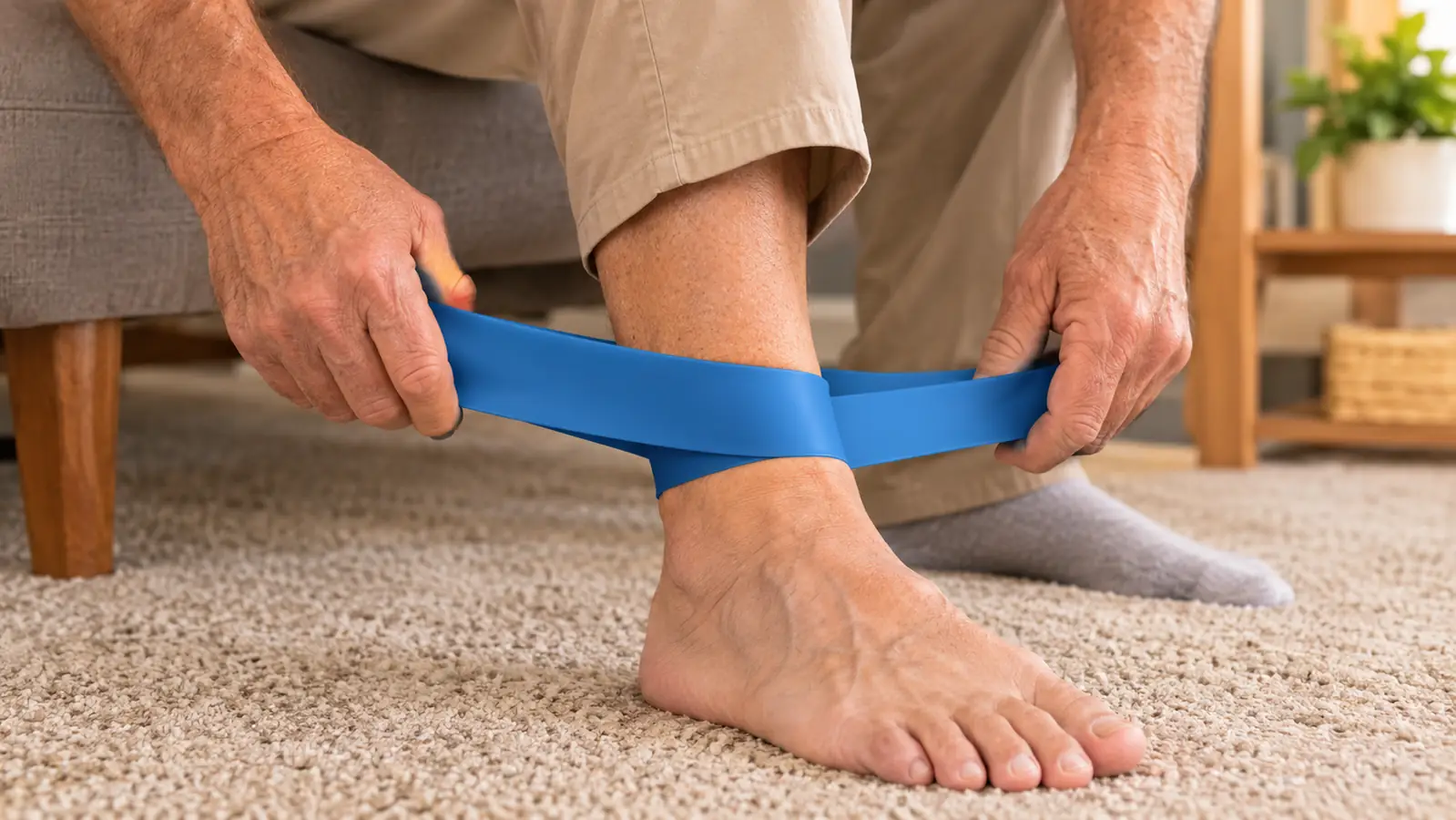
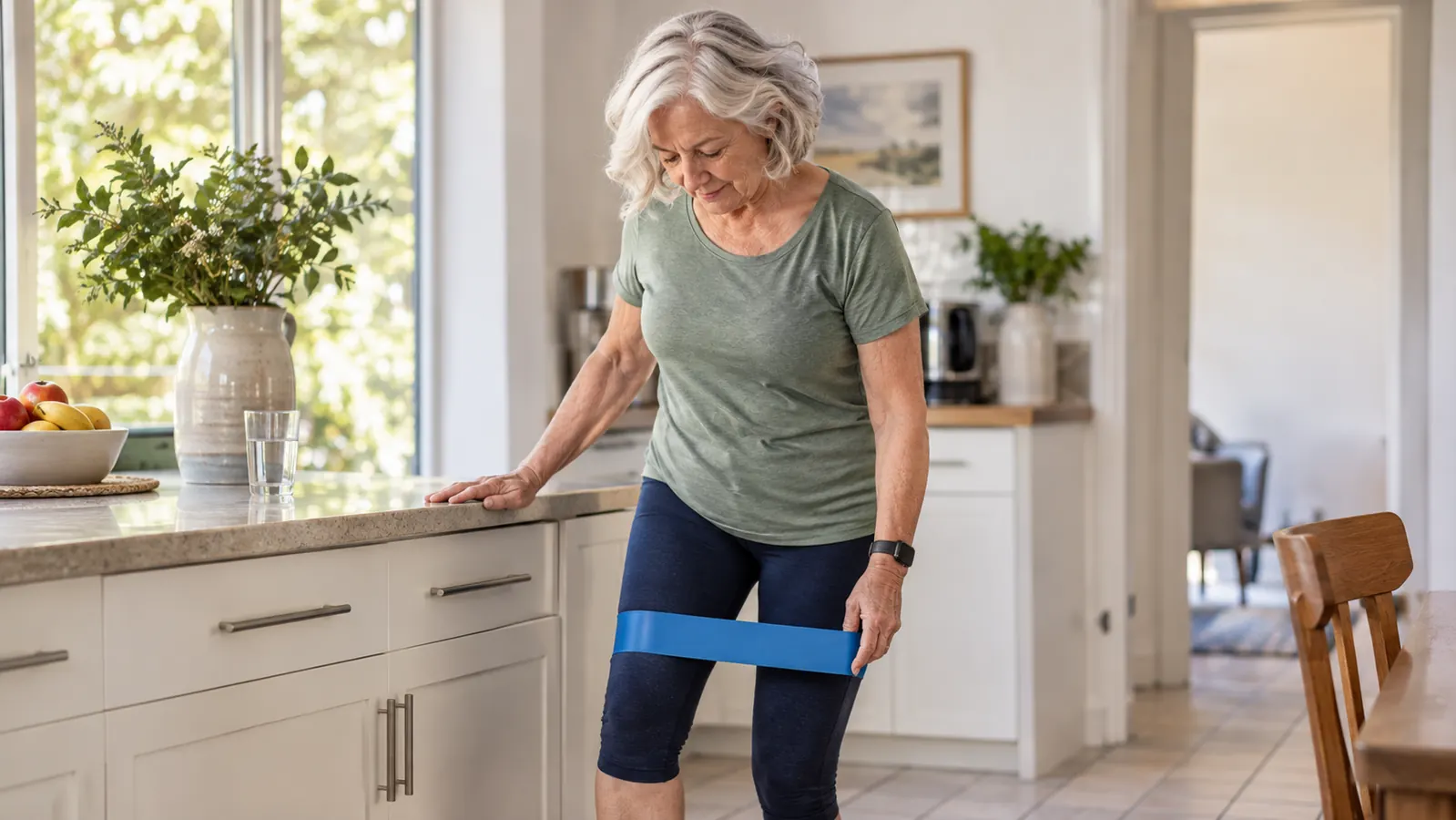
My routine is not complicated. Seated band work for the legs while I am still stiff. Some standing work at the kitchen counter where I can hold on with one hand. A few stretches at the end. The bands are the resistance in all of it, and the reason I use the loops rather than the tube bands is simple: there are no handles to grip. When your hands are arthritic in the mornings, a flat loop around the thigh or the ankle is one less thing to hold.
I keep a small notebook on the side table next to the armchair. The entry for the first morning reads: extra light band, seated leg press, eight repetitions each leg, stopped because my hip clicked. That is not a failure. That is a starting point, and a set of five bands is what let me find one on a Tuesday in February instead of waiting until I was ready for a gym.
The routine shifts with the seasons. In January I do nearly all of it seated, because the living room floor is cold and my lower back is not interested in getting down there. By April I am doing a few standing movements at the counter with one hand flat on the laminate. Same bag, same bands, different month.
What Five Bands Actually Get You
The set runs across five resistance levels, from extra light up through heavy, and the bands are the same 12 inch length with a 3 inch width and a quarter inch of thickness. Weight for the whole set is about 3.5 ounces, which is nothing. I have carried the bag in a coat pocket to my daughter's house and forgotten it was there.
Here is the practical problem with a set of five, and it took me a week to solve. The bands look identical in the bag. Same loop, same width, same thickness, same latex. Nothing is printed on them to tell you which is which, and in low morning light before my second cup of coffee I could not tell extra light from medium by eye. So I laid all five on the kitchen counter one Saturday, pulled each between my hands, and sorted them by feel from easiest to hardest. Then I wrote a number on each one with a permanent marker. That took ten minutes and has saved me from grabbing the wrong band every morning since.
Here is what I did not appreciate until I had used them a while. The steps between the levels are not even. The jump from extra light to light is gentle, and the jump from medium up to heavy is a different animal. The heavy band is stiff enough that I do not use it for anything near my knees. What I use it for is seated rowing and a couple of upper body movements where I want real resistance and my joints are not the limiting factor.
The mistake I made was thinking I should move up. About six weeks in, feeling pleased with myself, I did a whole session on the medium band. My right knee was slightly swollen that evening and grumbled for two days. Nothing dramatic, no doctor visit, but I went back to the light band for twelve days before trying the medium again, and that time I used it for one movement only instead of the whole session. The bands do not tell you when to move up. Your joints do, and they do not use words.
This matters for anyone over 65 buying a set like this. You will likely live in two of the five bands for months. The other three will sit in the bag. That is not a defect exactly, it is just the truth about how progression works in an older body, and nobody selling anything tells you that part.
You will likely live in two of the five bands for months. The other three will sit in the bag. That is the truth about progression in an older body, and nobody selling anything tells you that part.
How They Held Up Over Months
This is the part I actually wanted to know before I bought, and the reviews do not cover it well. Latex bands fail. They crack, they get tacky, they snap. I have had a cheap one let go mid-stretch and it felt like being flicked with a rubber hose.
I have a rough count, because I mark the calendar. I started in the last week of February and I am writing this in the fall, which puts me somewhere north of 180 mornings on the extra light and light bands. Those two have seen the most handling and they look the most used. There is a faint dullness to the surface, the way an old rubber glove goes dull, and the light band has a soft spot a few inches from one edge where I loop my foot every morning. It does not feel like a failure point. It feels like a pair of shoes that have been walked in.
No snaps. No visible cracks in the two light bands I use most. The lightest band has softened slightly, which is normal for latex that gets handled every day, and it now feels a shade lighter than the day it arrived. The heavy band, used less often, looks new.
The one scare I had was not the band's fault. Three or four months in, the loop slipped off my sock mid-set and snapped across the carpet. My heart went, but nothing broke. After that I stopped wearing smooth socks for the ankle work and started doing it barefoot on the carpet. Grip has been fine since.
What I do notice is tackiness. Latex picks up skin oil and dust, and after a few weeks the bands started to feel slightly sticky. I wipe them with a damp cloth every couple of weeks and let them air dry before they go back in the bag. That has kept them pleasant to handle. Storage changed in June, too. My garage corner gets hot by mid-morning in summer, and heat and sunlight are what kill latex, so I moved the bag inside to the living room shelf and it has lived there since.
The bag has held up fine. It is a simple drawstring pouch, unremarkable, still doing its job.
The Booklet, Honestly
The set comes with an illustrated instruction booklet, and this is where I am less impressed. It shows a fair number of exercises, and to its credit some of them are seated and gentle. But it is a general fitness booklet, not a booklet written for a 78-year-old with stiff knees. Several of the illustrated movements assume a hip hinge and a knee bend that I would not attempt without a physical therapist watching.
Two examples. The booklet shows a squat variation with the band above the knees and a fairly deep knee bend. I do the same band position from a chair, standing up and sitting down slowly, and that is enough for me. It also shows a hamstring movement lying on the floor with the band around one foot. Getting down to the floor and back up is its own project at my age, so I do that one standing with the band around my ankle and my hand on the back of the armchair. Same resistance, different starting position.
I used it as a menu of ideas rather than a program. I took maybe six movements from it, adapted them to a chair or a countertop, and ignored the rest. If you are new to this and unsure, that adaptation step is not optional. My honest advice is to bring the booklet to a physical therapist or a doctor and ask which five exercises are right for your body, rather than working through it front to back because it is printed in order.
The other thing worth saying is that it is paper, not a screen. That sounds small. But I can lay it flat on the counter with a coffee cup on the corner and read it without my glasses sliding down my nose, and I do not have to find a charger to look at a picture of a leg lift.
Where They Are Genuinely Good
The best thing about the Fit Simplify loops is that they let you add resistance without adding load to a joint. A dumbbell is gravity and gravity does not negotiate. A flat band pulls sideways, or diagonally, or in a direction your knee can tolerate. For the kind of work an older body needs, that is the whole point.
The second thing is the price of entry. This is an inexpensive set with more than 137,000 ratings at 4.5 stars, and it costs about what lunch out costs. If it turns out you hate it, you have not lost much. That is a real advantage over a machine or a gym membership, both of which require commitment before you know whether you will stick with it.
The third thing is that nothing about it feels like a production. No app, no screen, no subscription, no voice telling me to push harder. It is five pieces of latex in a bag. When I am done, I drop them in the bag and go for my walk.
What I Liked
- Five resistance levels means you can start genuinely light, which matters when you are beginning
- Flat loops need no grip strength, so sore hands are not a barrier
- 12 inch by 3 inch bands with a quarter inch thickness, easy to loop around an ankle or thigh
- Carry bag is small enough to pocket, so the set travels
- Inexpensive enough that trying it is not a real risk
- Held up for months of near-daily use with no snaps or cracks
Where It Falls Short
- The jump from medium to heavy is steep, so you may not use every band
- The booklet is a general fitness guide, not adapted for older or stiffer bodies
- Latex gets tacky with handling and needs wiping down
- Latex degrades with heat and sunlight, so garage storage in summer is a bad idea
- No printed resistance levels on the bands themselves, which I had to sort out by feel
Who This Is For
Adults over 65 who want to add light resistance work at home, in a small space, without equipment that needs assembling or a screen that needs charging. If you have a chair, a bit of carpet, and a countertop to hold, this set covers a lot of ground. It suits people who are already moving a little and want to keep moving, and people who have been told to do some strength work but have no idea where to start.
It also suits anyone whose hands bother them. The no-grip design is the single most practical thing about these bands for an older body.
Who Should Skip It
If you have a latex allergy, skip it. There is no version of this set that works for you. If you are looking for a structured program with progression built in, this is not that, and a physical therapist or a class designed for older adults will serve you better than a booklet and five loops.
And if you are already strong and lifting real weight, the heaviest band here will not challenge you for long. This is a set for keeping what you have and rebuilding a little, not for building serious strength.
One more thing, and I say it every time because it is true. Talk to your doctor or your physical therapist before you start something new, especially if you have knees like mine or a back that argues in the mornings. No band, at any price, substitutes for that conversation.
The set that lives beside my armchair
Five loops, five strengths, and no handles to grip on a stiff morning. Mine have held up for months of daily use.
Amazon Check Today's Price on Amazon →