
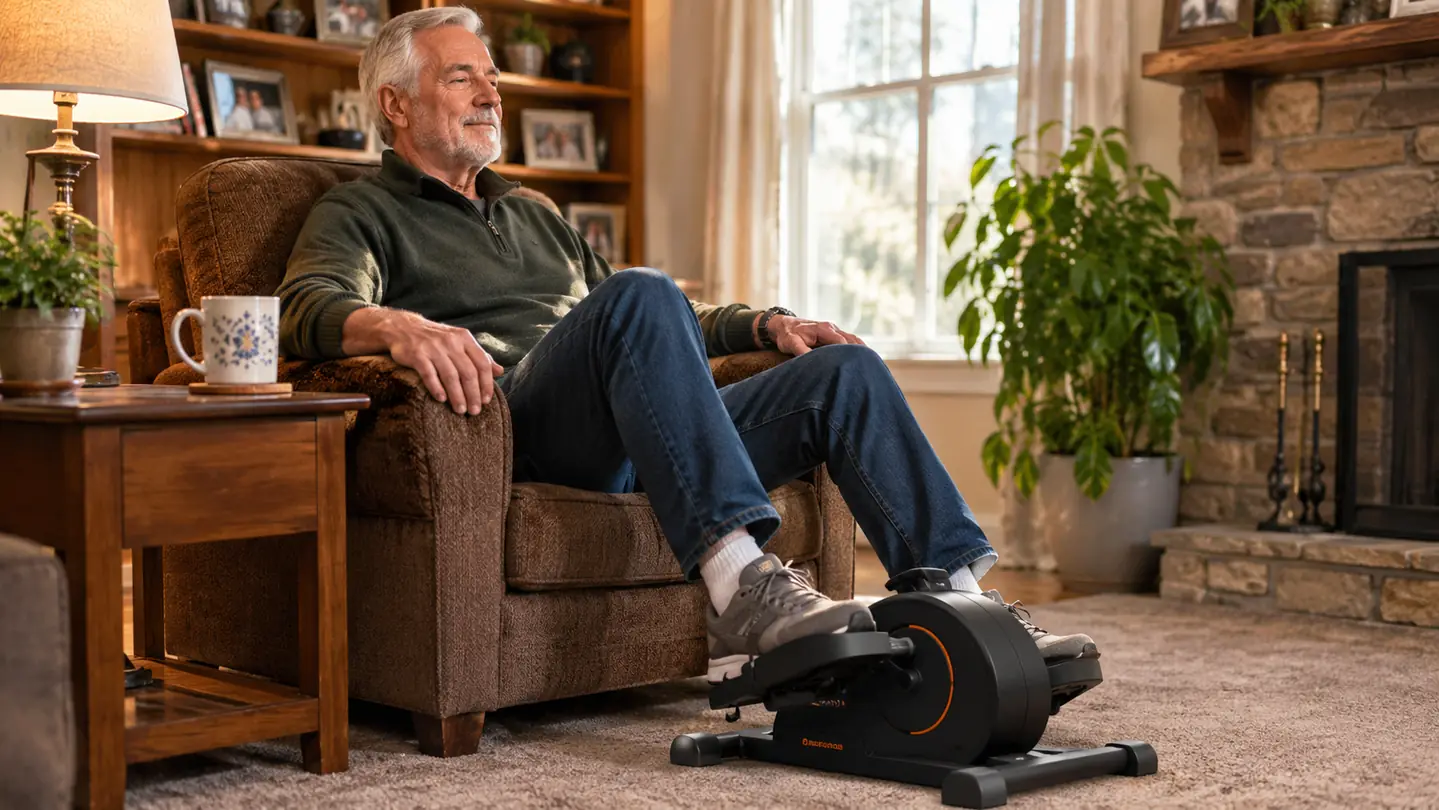
The chair is where my day goes. I am 78 years old, retired, and I live in a one-story ranch house in Wethersfield, Connecticut, and there is a sturdy armchair in my living room that has my name on it. Coffee, the paper, a second cup, the mail, the phone call with my brother. By ten in the morning I could feel how still I had been. My knees would complain when I stood, and my lower back needed a few steps to remember its job. Dot, my wife, walks with me most mornings, and that helps. But the hours in between, at the table and in the chair, were dead time. So I tried what most people try. A kitchen timer on the end table. Standing up every hour for a week. Walking to the mailbox for no reason at all. None of it stuck, because all of it was an interruption. What finally stuck was the opposite of an interruption. Something I could do without getting up.
That is what the Cubii JR1 under-desk elliptical is, and it is the first piece of equipment I have owned that asked nothing of my schedule. I am not a trainer and I will not pretend to be one. Talk to your doctor or your physical therapist before you start anything new, especially with knees like mine. What follows is what actually worked in my living room and in the corner of my garage, in five steps, without a gym voice.
The machine that made my armchair less of a trap
The Cubii JR1 sits on the floor in front of the chair I already use, and I pedal through the morning news. Eight manual resistance levels, a display that tracks what I did, and no reason to change out of my slippers.
Amazon Check Today's Price on Amazon →Step 1: Put It Where You Already Sit, Not Where Exercise Is Supposed to Live
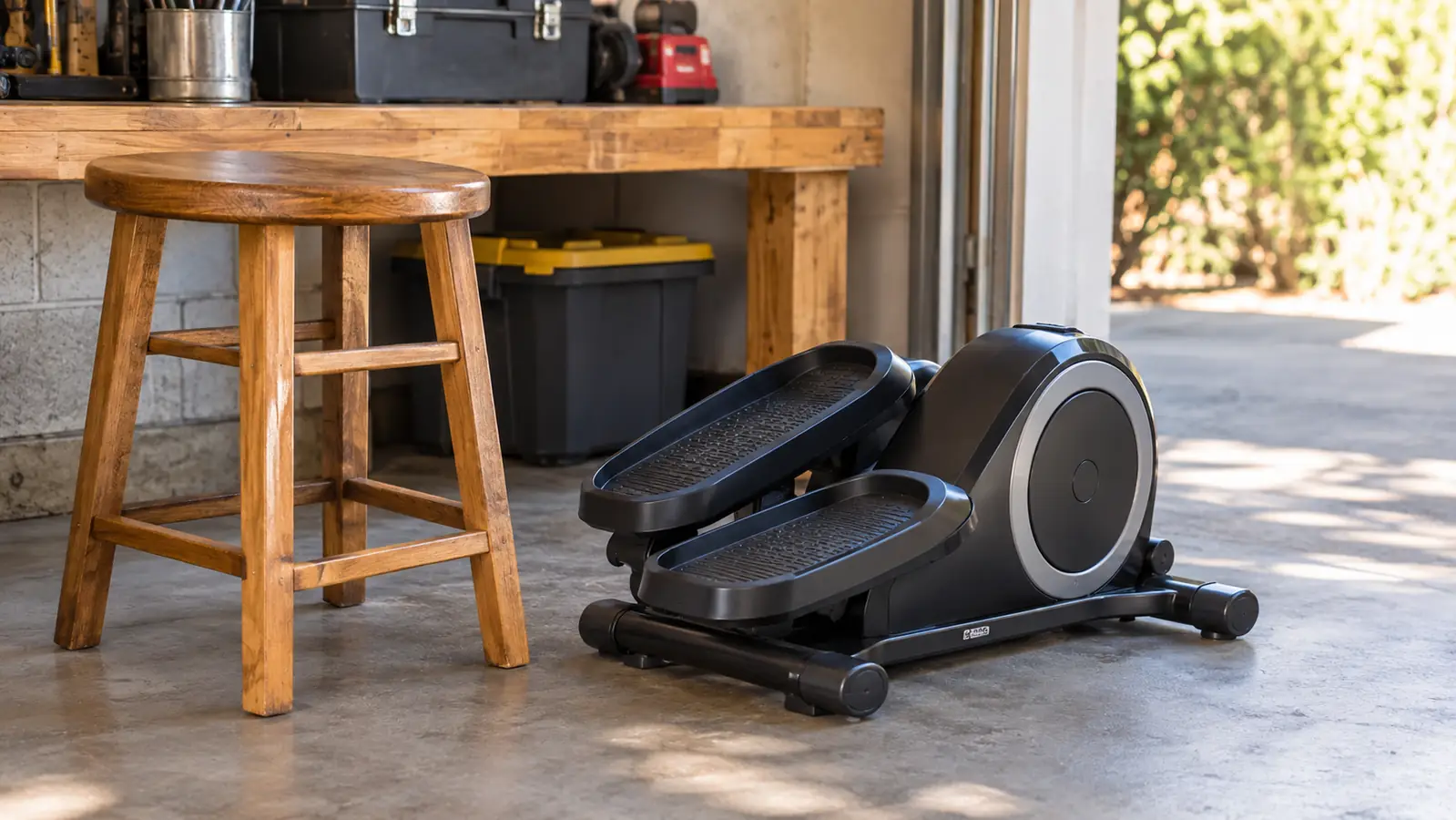
My first mistake was the garage. That is where exercise equipment goes, I figured, in the corner by the workbench, next to a stool I built years ago. It looked right. I used it twice in five days. The problem was not the machine, it was the walk to the garage. Any habit that starts with putting on shoes and crossing a cold floor is a habit that dies in February. So I moved it into the living room, on the carpet, in front of the armchair, right where my feet already land when I sit down. Now I trip over it in the good way. It sits in my line of sight during the evening news, and the news is on whether I like it or not.
One thing to know before you move it. It weighs 25.4 pounds and measures 23.2 inches deep, 17.56 wide, and 10 tall. That is light enough for me to slide across the carpet on my own, and small enough to tuck under the front edge of the chair when I am not using it. It is rated for up to 300 pounds, which is worth checking against your own situation. It runs on batteries, so there is no cord stretched across the floor for me to catch a foot on, and at my age that is not a small thing. I did not want a machine I had to store, because a machine in a closet is a machine I forget.
I keep a folded towel under the front edge, not because the machine needs one but because the carpet in that spot has a dip and I got tired of listening to it rock. Two minutes with a towel and it has not moved since. If your floors are hard you may not need that at all. The point of this step is not the towel. It is that the machine belongs where you already spend your evenings, not where you think a fit person would put it.
Step 2: Fix Your Chair Before You Touch the Resistance
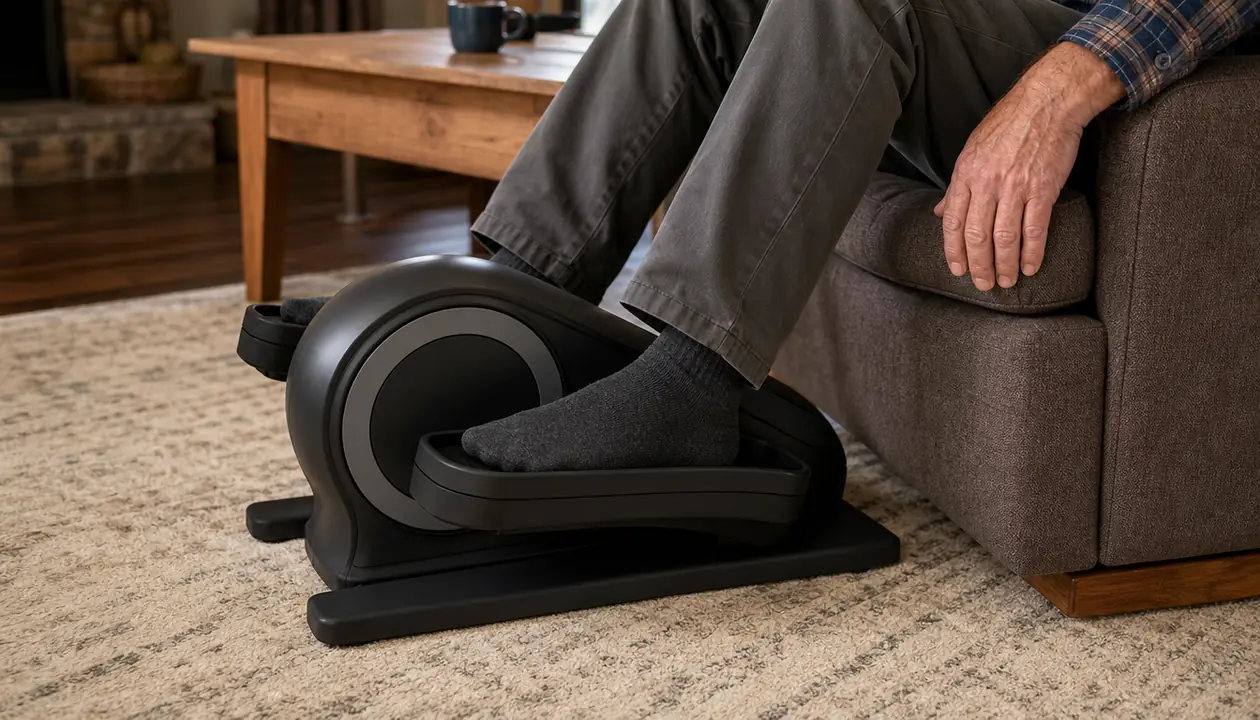
The first week my right knee ached and I blamed the machine. It was the chair. I had been sitting in a low slipper chair that made my knees climb up toward my chest, and pedaling from that position is like walking uphill in a hole. I moved to the sturdy armchair with a firm seat and a back I can lean against, and the ache was gone in three days. The rule I landed on: sit back against the backrest, feet flat on the pedals, knees staying at or below the height of your hips. If your knees are higher than your hips, either the chair is too low or the machine is too far forward.
Distance matters as much as height. Too close and my shins knock the front of the unit. Too far and I am reaching with my toes and my lower back starts to round. I nudged it forward about two inches at a time until my feet sat in the middle of the pedals with my heels down and my legs nearly straight at the far point of the stroke. The stride is 18 inches at most, so this is a small, flat oval and not a bicycle. Nobody is going to mistake it for a ride in the country. That is the whole point. It fits under a chair and it does not require me to change into anything.
Step 3: Start at One and Stay There Longer Than Feels Right
There are eight resistance levels on the JR1 and you change them by hand, which suits me because I do not want to learn a menu. I started at three because one felt like nothing at all. Two days later my knees were sore in a way that had nothing to do with progress and everything to do with too much, too soon. I went back to one and stayed there for a month. A month felt embarrassing. It turned out to be the smartest month of the whole experiment.
Here is the test I use, and I did not invent it. If you cannot carry on a normal conversation while you are doing it, you are working too hard for a daily habit. At resistance one I can talk to Dot, follow the news, and answer the phone. At four I cannot, and at four I also do not want to come back tomorrow. The level that lets you come back tomorrow is the right level.
That is not to say you never move up. After six weeks at one, I went to two for the last five minutes of a session. After another month I did the whole session at two. I am at three now for most mornings, and three is plenty. Eight is there if you want it. I have never wanted it. I am 78 and my goal is not fitness in the magazine sense. My goal is standing up out of that chair without making the noise.
Step 4: Build the Daily Ten Before You Build the Long Session
The mistake I have made with every exercise plan of my life is starting with the length I imagined instead of the length I would actually repeat. Thirty minutes sounds like a real workout. Ten minutes during the morning news is something I will do on a Tuesday in February with a cold. So I started with ten minutes, every weekday, no exceptions worth mentioning. After two weeks the ten minutes stopped being a decision. It became part of the coffee and the paper, the way the second cup did.
Then I added five. Then another five. Most mornings now I pedal for about twenty minutes, which matches the rest of my routine: twenty minutes of movement after coffee, a walk after lunch, a few quiet minutes before bed. On a morning when my knees are loud I do five minutes at resistance one and call it finished, and I count it, because the streak is worth more than the session. The only day I skip is a day I am sick, and I do not try to make it up later.
One practical note. Your legs will have an opinion the first week. Mine did, in the front of the thigh and behind the knee, a dull tiredness rather than a sharp pain. Dull and tired is fine. Sharp is your cue to stop and ask somebody who knows more than I do. I am not a doctor and I do not play one on the internet.
Step 5: Write Down What You Did, Not What You Meant to Do
The JR1 has a built-in LCD display that tracks the session, including calories burned, and there is a Cubii mobile app where you enter the numbers from the display by hand. I am not a phone man, so I keep a paper log on the end table: date, minutes, resistance level, and one word about how the knees felt. It takes fifteen seconds. It is the reason this habit survived where the others did not.
After six weeks the log told me something I would never have guessed from memory. My knees complained on the day after I pushed the resistance up, not on the day I did it. That one pattern changed how I schedule the harder mornings. Without the log I would have blamed the weather, the barometer, or the phase of the moon, which is what I usually blame.
If you would rather use the app than a notebook, that works too. The point is a record you will actually keep, in whatever form you will actually keep it. What you are looking for over a month or two is a pattern: which resistance levels and which lengths leave you feeling better the next morning instead of worse. That answer is different for a 78-year-old with cranky knees than it is for anyone else, and no article, this one included, can hand it to you.
Twenty minutes at resistance one, five days a week, has done more for my mornings than one heroic hour every January ever did.
What Else Helps
The Cubii is one tool in a small kit, not the whole kit. The walk after lunch with Dot does more for my mood than anything on this list, and it is free. Standing up during phone calls has helped my back more than any chair I have bought. I keep a glass of water on the end table so that fetching it is not the only reason I move. While the coffee brews I do heel raises at the kitchen counter, ten of them, holding on with one hand. Before bed there are a few minutes of slow breathing and a short gratitude list, which sounds soft until you have tried sleeping without it.
One more thing that helps and costs nothing: put the machine back in front of the chair when you finish, even if you are only leaving the room for a minute. The days I kicked it off to the side to get it out of the way were the days I did not use it. Out of the way is where habits go to die.
What all of it has in common is that none of it requires a change of clothes, a drive, or a decision. That is the part I got wrong for years. I thought movement had to be scheduled and serious to count. What actually counts is the thing you will still be doing in March. For me that turned out to be a small machine on the floor in front of the armchair and a ten minute window during the morning news. If your version looks different, good. Do your version. Check with your doctor first, write down what you did, and give it a month before you decide whether it is working.
The chair is going to be there either way
Mine has a Cubii JR1 on the floor in front of it. Eight manual resistance levels, an LCD display that tracks the session, and a corner of the living room it never leaves.
Amazon Check Today's Price on Amazon →