
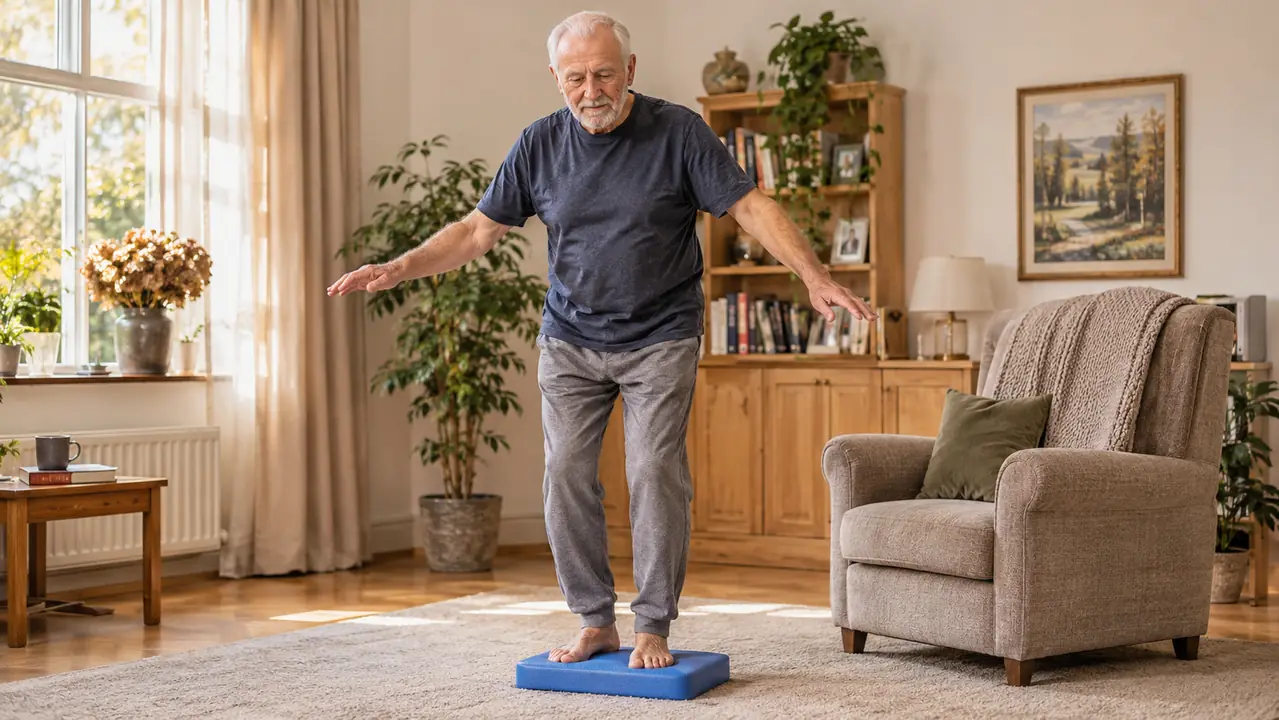
The first time I stood on the ProsourceFit Balance Pad, I lasted about nine seconds before I stepped off and put my hand on the armchair. I am 78, I have two knees that file complaints on stairs and in cold weather, and my lower back is stiff for the first hour of every morning. Nine seconds felt like a verdict.
That was eight months ago. I now stand on it for four minutes most mornings, right after coffee, in my living room in Wethersfield, Connecticut, with my wife Dot walking past me on her way to the kitchen. I bought the ProsourceFit pad because a physical therapist told my neighbor to stand on something wobbly while brushing his teeth, and I figured foam was cheaper than a gym I would never visit. Here is what eight months of daily use actually looks like, including the parts I do not love.
The Quick Verdict
A cheap, honest piece of foam that does one job well. It will not fix your balance for you, but it gives you a safe place to practice, and mine has not cracked, smelled, or slid once in eight months.
Amazon Check Today's Price →See the pad I stand on every morning before my second cup of coffee
Fifteen and a half inches long, twelve and three quarter inches wide, two and a quarter inches thick, twelve ounces. Small enough to keep beside the armchair instead of in a closet where you will forget it.
Amazon Check Today's Price on Amazon →How I've Used It
My routine is not complicated. About twenty minutes of movement every morning after coffee. Some days that is a short walk around the block with Dot. Some days it is chair squats and a few stretches on the living room carpet. Since February, most days start with four minutes on the ProsourceFit pad: two minutes with both feet, one minute with my weight shifted to the left, one minute shifted right.
I keep it in the living room, on the carpet, about two feet from my armchair. That placement matters more than I expected. When I stored it in the garage, I used it twice a week. When it sits where I drink my coffee, I use it six days out of seven. The pad is light enough, twelve ounces, that carrying it back and forth was never the problem. Remembering was the problem.
For the first two weeks I timed myself with the kitchen clock, and that was a mistake. I would glance up every twenty seconds and step off at the first wobble, which meant my sessions were closer to ninety seconds than four minutes. Then I stopped timing and started counting breaths instead: four slow breaths, then step off and reset. That turned the practice into something I could do without watching a clock, and it is what I still do now. Dot says I look like a man waiting for a bus. She is not wrong.
I have also used it as a knee pad, which is what the listing says it is for as much as anything else. When I get down on the carpet to do a few stretches, I put it under my knees. That is a small thing and it has saved me a fair amount of grumbling. Two and a quarter inches of foam under a bony knee is the difference between getting down on the floor and deciding not to bother.
What the Foam Actually Does
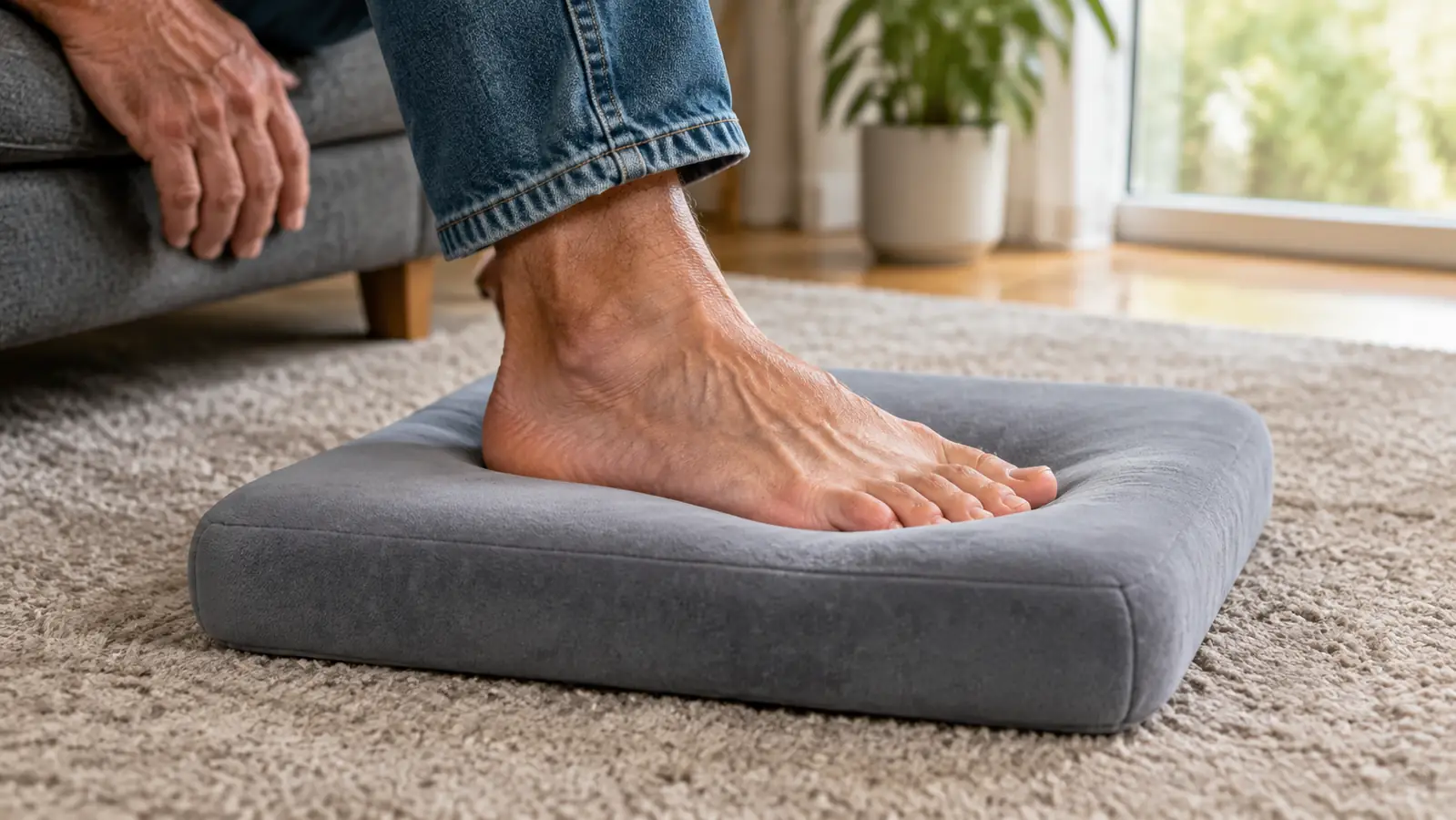
Here is the whole idea, and it is worth understanding before you buy. The ProsourceFit Balance Pad is a piece of thermoplastic elastomer foam, about the density of a stiff yoga block with some give to it. Standing on it makes the ground slightly unsteady. Your feet feel that unsteadiness and your ankles, knees and hips make tiny corrections to keep you upright. Those corrections are the exercise. That is the entire product. There is no app, no counter, no screen, nothing to charge.
What I noticed over the first month was not strength. It was awareness. I started noticing how I stood in the kitchen line at the pharmacy, how I shifted my weight when I reached for something on a high shelf. Some of that is probably just the attention you pay when you are deliberately practicing something. But the pad is what made me pay attention.
Somewhere around the sixth week, a Tuesday in late March, I stepped off the pad and walked to the kitchen and noticed I had not put a hand on the counter on the way. Nothing dramatic happened. There was no moment of triumph in the hallway. Just one fewer hand on one counter on one morning, and then a few more mornings like it over the following month. That is how this kind of thing goes at my age. You do not get a before and after photograph. You get a Tuesday.
The listing says the maximum weight recommendation is 340 kg, which is over seven hundred pounds. I am not going to test that. What I can tell you is that at my weight, with shoes off, the foam compresses maybe a quarter inch under my heel and springs back the moment I step off. Eight months in, it has not developed a permanent dent where I stand. No crumbling at the edges, either, which is more than I can say for a foam mat I owned years ago that shed little crumbs across the carpet until I threw it out.
The Surface, the Size, and the Small Annoyances
The ProsourceFit pad has a textured top surface. It is not sticky, exactly, but bare feet do not skate on it. I have used it in socks once, and once was enough. Socks on foam is like socks on a waxed floor. Barefoot or with a thin-soled shoe is the way.
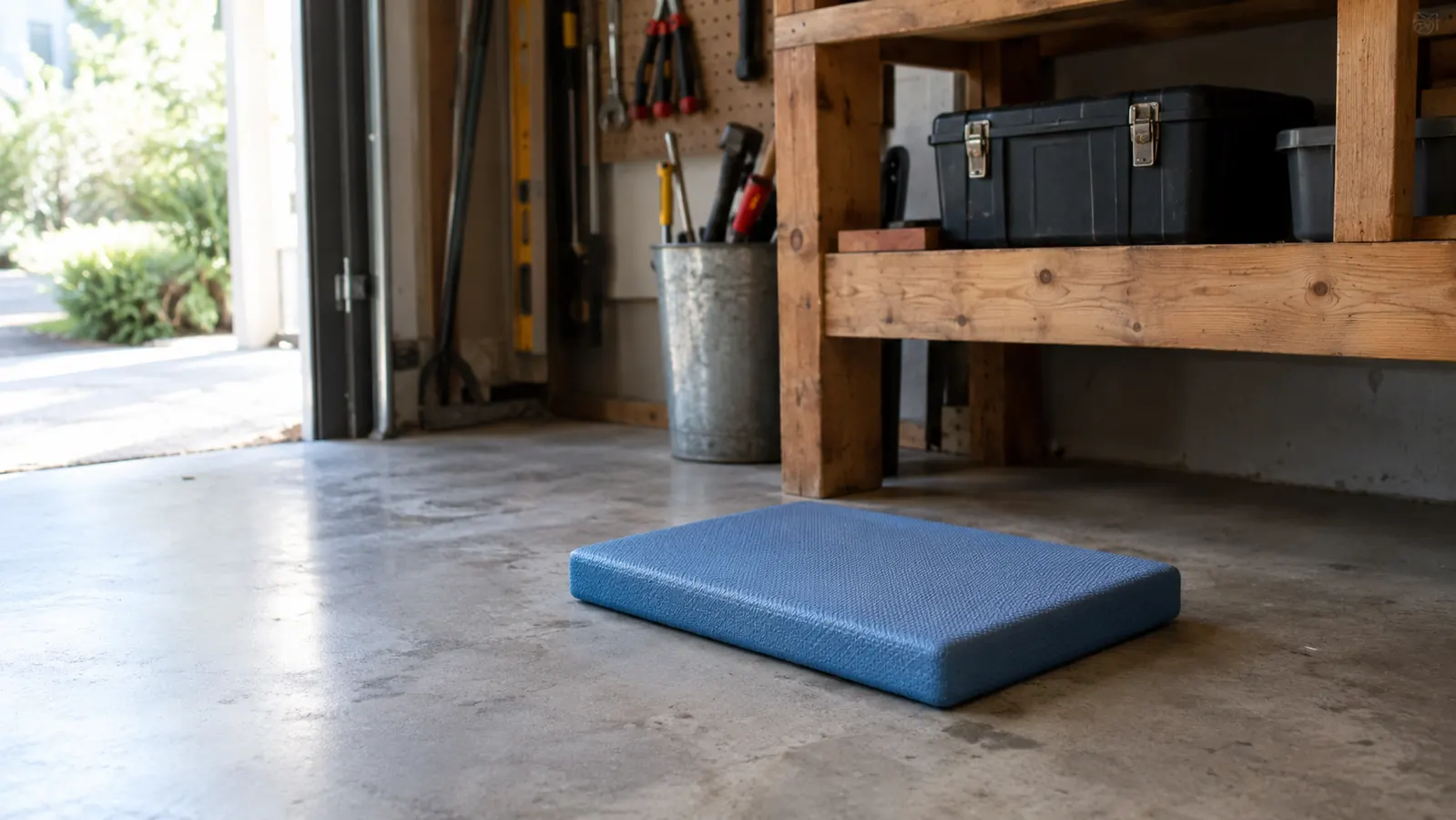
One thing I checked early and have checked every month since: does the pad stay where I put it? On the living room carpet it has not moved half an inch in eight months, which surprised me, because foam on carpet sounds like a recipe for a slow slide across the room. On the garage concrete it does creep a little when I lean, maybe an inch over a session, and I have learned to set it back against the leg of the workbench before I start. That is not a safety concern at the pace I go, but it is worth knowing if your floor is smooth and you tend to lean.
The dimensions are fifteen and a half inches long, twelve and three quarter inches wide, two and a quarter inches thick. That is a comfortable standing footprint for one person. It is not big enough for two feet wide apart in a sumo stance, and if you are doing lunges, the pad is going to feel narrow when your back foot comes off it. The listing mentions lunges and squats and planks. I would take that with a grain of salt for anyone over seventy. This is a standing and balancing tool first. Everything else is a bonus.
Two honest complaints. First, the pad has a slight give that I can feel in my arches after about three minutes, and by minute four my feet are ready to be done. That is not a defect. That is the product working. But it means my sessions are short by design, and if you imagined yourself standing on this for a twenty-minute phone call, think again. Second, the foam picks up carpet lint and the occasional thread from Dot's slippers tracking across the rug. A damp cloth takes it off in five seconds. Not a real problem, just a small one.
I lasted nine seconds the first morning. Eight months later I do four minutes, six days a week, and I have not once felt like I was going to fall.
The pad that lives beside my armchair, not in a closet
Thermoplastic elastomer foam, sweat-proof and easy to wipe down, with a limited lifetime warranty. Mine has taken eight months of bare feet and carpet lint and still looks like the day it arrived.
Amazon Check Today's Price on Amazon →What Held Up and What Didn't Over Eight Months
The foam has held up completely. No cracks, no flattening, no smell. I expected a rubbery odor the first week, the way new foam sometimes has, and there was nothing. The textured surface has not smoothed out or gone shiny where my feet land most. The edges are still square. If you are the kind of person who worries that a foam product will be a disappointment in six months, this one has not given me a reason.
One more note on the warranty, because I looked it up after the third month when I was still half expecting the foam to give out. Limited lifetime warranty. I have not had to use it and I do not know how the claim process works, so I will not pretend to vouch for it. I only mention it because a foam product that flattens in a year is a foam product you throw away, and this one has not given me a reason to test the paperwork.
What did not hold up was my original plan. I thought I would progress to one foot. I have not, and I am not sure I will. Standing on one foot on a foam pad at 78, in a living room, with no one spotting me, is a risk I do not need to take to get the benefit. The two-foot stand with deliberate weight shifts is enough for me, and I would rather do that for another eight months than get ambitious once and end up on the floor beside the armchair.
The garage is where I use it in the summer. I have a corner of the attached garage with an old mat down, and I will carry the pad out there when the weather is warm and do my standing work next to the workbench. Concrete under foam feels firmer and slightly less forgiving than carpet, and I noticed the difference in my ankles right away. Both surfaces work. Carpet is gentler. Concrete is more honest.
Where It Sits Compared With the Alternatives I Tried
Before this I tried a folded bath towel, which is not the same thing at all. A towel compresses into nothing and does not create any real instability, so you are just standing there feeling virtuous. I also considered a wobble board, the rigid kind with a pivot underneath. My neighbor has one. I stood on it once and got off quickly. A wobble board tips fast and it tips far, and for an older body that is a lot of correction all at once.
The foam pad is the middle ground. It is unstable enough that your feet have to work, and stable enough that you are never in real danger of going over. For someone in their seventies who wants to keep the balance they have, that middle ground is exactly right. If you are thirty-five and training for a sport, you would probably want something more demanding. Different job, different tool.
What I Liked
- Does the one thing it claims: creates a slightly unsteady surface under your feet
- Barefoot grip is genuinely good, no sliding even on carpet
- Twelve ounces, so it moves from living room to garage without a thought
- Doubles as a knee pad for floor stretches, which I use more than I expected
- No smell, no cracking, no flattening after eight months of daily use
- Wipes clean with a damp cloth
Where It Falls Short
- Four minutes is about the limit before your arches want off
- Not wide enough for lunges or a wide stance
- Socks are treacherous on it, barefoot only for me
- One-foot work is too risky for most people over seventy, which limits how far you can progress
Who This Is For
This is for the person who has noticed that standing on one foot to put on a sock has gotten harder, and who wants to do something about it at home, in short daily doses, without joining anything. It suits an older adult with a sturdy chair or counter within arm's reach, a carpeted or firm floor, and about four spare minutes a morning. It suits someone whose doctor or physical therapist has already said that practicing balance is a good idea.
It also suits the person who wants a knee pad for floor work and would rather buy one thing than two. I use it more often under my knees than I expected to, and that alone would have justified the shelf space.
And it suits the person who is realistic about what home exercise looks like. There is no program to follow, no subscription, no screen. It is foam. You stand on it. That is either refreshing or disappointing, depending on what you were hoping for.
Who Should Skip It
Skip it if you are not going to put it where you can see it. I am serious about this. The pad did nothing for me in the garage. It works because it sits beside my armchair and I walk past it six mornings out of seven. If it goes in a closet, it becomes a thing you own.
Skip it if you have a balance problem you have not had looked at. This is not a medical device and it is not a substitute for an assessment. I am not a doctor and I do not play one. Before I started standing on foam, I mentioned it to my own physician and got a shrug and a nod, which was the answer I needed. Get your own answer.
Skip it if you want something that measures, tracks, or coaches. There is none of that here. And skip it if your goal is serious strength work. This is a small daily practice, not a training system. It is the balance equivalent of my morning walk around the block: unremarkable, repeatable, and probably the reason I can still put my socks on standing up.
Four minutes a morning, beside the armchair, barefoot
The ProsourceFit Balance Pad has done its one job for eight months without a complaint. If you have been meaning to start, this is a small enough commitment that you might actually keep it.
Amazon Check Today's Price on Amazon →