
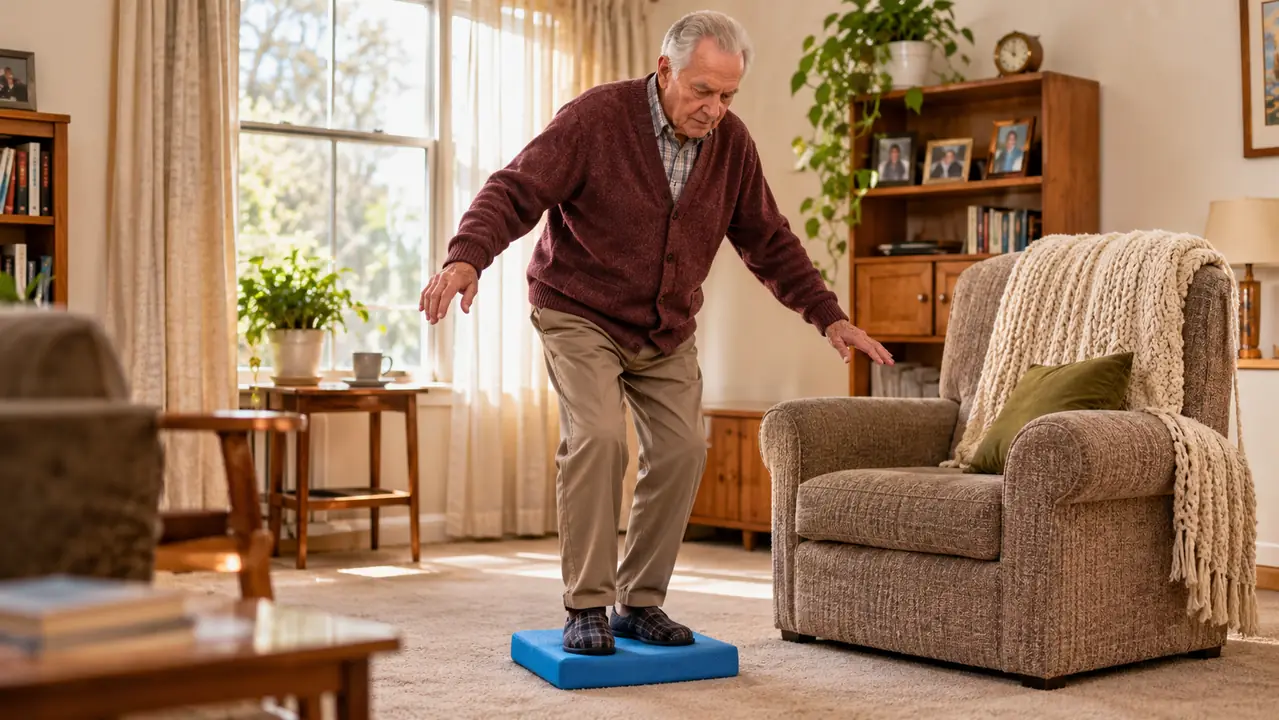
I keep a ProsourceFit balance pad beside my armchair and an old wobble board leaning against the garage wall, and they are not the same tool no matter what the fitness aisle suggests. One is a slab of foam you stand on. The other is a hard deck balanced on a pivot that wants to tip you off the moment you get careless. At 78, with two knees that complain on stairs and a lower back that needs ten minutes to loosen in the morning, that difference is the entire decision. Which one belongs in your living room depends on what you are actually trying to protect.
Short answer: for most adults past 65 who want steadier feet in the kitchen, the shower and the yard, the ProsourceFit pad is the more useful purchase. It is forgiving, it weighs 12 ounces, and it asks you to do one thing, which is stay upright. A wobble board is the better tool for a narrower group, meaning someone younger, someone working with a physical therapist, someone with a spotter and a specific reason to train ankle reaction speed. Neither one is dangerous in the right hands. One is a great deal less likely to put you on the floor in the wrong ones.
The Comparison, Row by Row
| ProsourceFit Balance Pad | Wobble Balance Board | |
|---|---|---|
| Surface under your foot | Cushioned TPE foam, non-slip and sweat-proof | Hard deck with no give to it |
| How hard it pushes you | Gentle. You feel the wobble mainly through the ankles | Sharp. The deck tips and your whole body answers |
| Foot and heel comfort | Foam spreads the pressure under the soles | Hard surface under a bare foot or a sock |
| What happens if you lose it | You wobble, correct, and step off 2.25 inches onto carpet | The deck tips and your weight goes with it |
| Ankle and core challenge | Modest, and sustainable as a daily habit | Real and fast, if your body can handle it |
| Use as a knee pad | Made for it, at 15.5 inches by 12.75 inches | Not what it is built for |
| Learning curve | About one morning with a hand on the chair | Weeks, and better with a spotter |
| Storage | 12 ounces, slides under a chair or a side table | Takes up permanent floor space |
| Room it needs while in use | About the size of a doorway mat | An arm's length of clear floor plus something solid to hold |
| Warranty | Limited lifetime warranty | Usually a short manufacturer warranty, if any |
| Best for | Steady feet, cranky knees, and a habit you will keep | Athletes and supervised rehab work |
How I Tested Both
My testing setup is not a lab. It is a carpeted living room with a sturdy armchair at one end, and a corner of the attached garage where I keep the things I do not want underfoot. I am 78, I taught high school shop for thirty years, and I have no business telling a college athlete what to do. What I can tell you is what happens to an older body across weeks of daily use, which is a different question and, for most of the people reading this, the more useful one.
I started with the pad four mornings a week, barefoot, one hand on the armchair for the first two weeks and no hand after that. The foam is 2.25 inches thick and the whole thing weighs 12 ounces, so it stays where I put it while I am standing on it and moves easily when I want it out of the way. TPE is the material, and it is the reason the surface holds under a sock instead of sliding. Fifteen minutes of standing and shifting my weight was plenty at the start. It still is, most days. I also measured the thing against my own doormat, because a listing page does not tell you whether an object will fit in your room. At 15.5 inches long and 12.75 inches wide it is wider than the doormat and shorter than the coffee table, and it slides into the gap between the armchair and the wall without me moving a stick of furniture. The first week I wore socks, which taught me nothing about my own feet. Barefoot from the second week on, the surface gripped and did not slide once, even on a morning in March when I had worked up a sweat just from standing there shifting my weight side to side.
The board is a different animal. Standing on a hard deck that pivots underneath you is a real skill, and the first time I tried it I had a hand on the door frame inside of four seconds. I do not stand on it without something solid within reach. I gave it three honest tries over two weeks in the garage, each one with the folding chair pulled up in front of me and both hands on the back of it. Twenty seconds was a good session at the start. It got to about forty by the end, and I could feel exactly which muscles were doing the work, mostly down the outside of the ankle and up into the hip. That is the appeal of the thing, and I understand it. If you are going to try one, talk to your doctor or your physical therapist first and keep both hands on a counter for the first few weeks. I mean that plainly. It is not a line I am required to write.
Where the ProsourceFit Balance Pad Wins
The pad wins on the thing that matters most to a body past 70, which is what happens when you get it wrong. A 2.25 inch piece of foam does not punish a lapse. You wobble, you correct, you step off onto carpet. There is no deck to tip and no pivot to catch, so a small mistake stays a small mistake. The non-slip TPE surface does not shoot out from under a sock, and the maximum weight recommendation of 340 kg tells you it will not crush or collapse under a grown adult. The limited lifetime warranty is the other half of that sentence. Somebody at ProsourceFit expects the thing to last. Mine has been on the floor since the spring and it has not flattened in the middle, which is more than I can say for the foam kneeling pad I bought at a hardware store years ago and threw out inside a season.
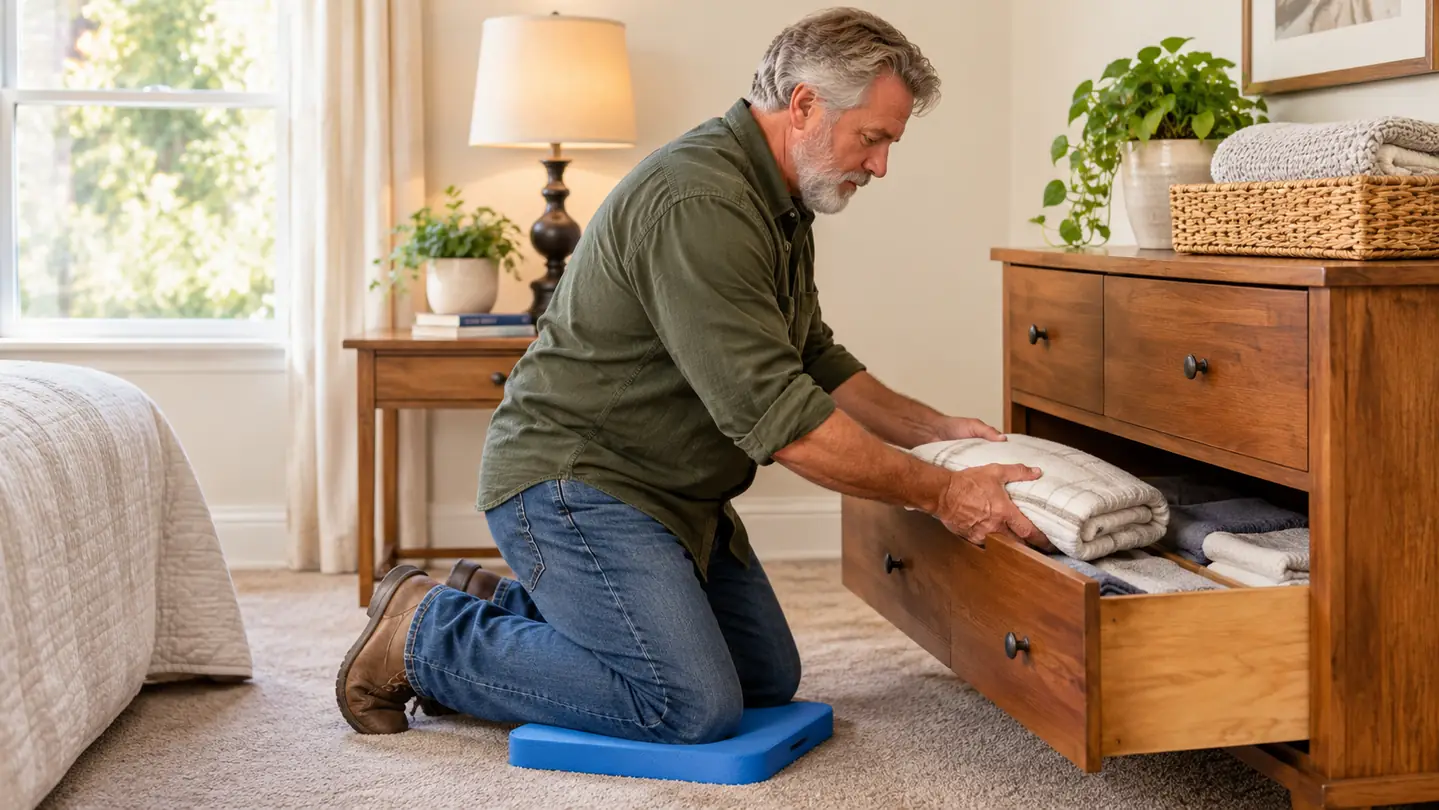
The second win is that it earns its place in the room. I kneel on it when I am sorting a bottom drawer, because 15.5 inches by 12.75 inches is big enough for both knees and the foam saves me from the hardwood. I stand on it while the coffee finishes brewing. That is the whole trick with a daily habit at my age. The tool has to be easy enough to reach for on a morning when you are not in the mood. A 12 ounce pad that lives under the armchair gets used. A board that lives in the garage does not. There is a third thing, smaller but real. It is easy to clean. I wipe it with a damp cloth every couple of weeks, and the sweat-proof surface does not hold a smell the way a fabric-covered thing would. In a house with one bathroom and a washing machine that is already busy, that matters more than it sounds.
You wobble, you correct, and you step off 2.25 inches onto carpet. A small mistake stays a small mistake.
Where a Wobble Balance Board Wins
I am not going to pretend the board is useless, because it is not. If your goal is ankle strength and reaction speed, a pivoting deck asks far more of you than foam ever will, and it asks it faster. Physical therapists use them for a reason. The unstable surface forces small corrections at the ankle and the hip that a cushioned pad softens and partly hides. A physical therapist I know socially, who has no product to sell me, put it about as well as anyone could: the foam teaches your body to notice, and the board teaches it to answer. If you have already spent a year on the pad and you want more, the board is the honest next step, not a replacement for it.
The board also gives you a way to see progress. There is a clear line between holding it five seconds with two hands on the counter and holding it thirty seconds with one finger. That feedback is motivating for the right person. It also demands clear floor, a clear head and a spotter when you are starting out, and it does not double as anything else. For me, in a one story ranch house with a wife who walks with me most mornings, that trade was not worth it. For a 55 year old with a therapist and a goal, it very well might be. The other point in the board's favor is simple enough. If your garage already has a clear square of floor, you are giving nothing up to use it, and a tool that is already standing there is a tool you will step onto.
The tool you will actually reach for beats the one that impresses you
The ProsourceFit pad sits by the armchair, weighs 12 ounces, and asks nothing of you but to stand on it for a few minutes. Mine gets used most mornings before the coffee is done.
Amazon Check Today's Price on Amazon →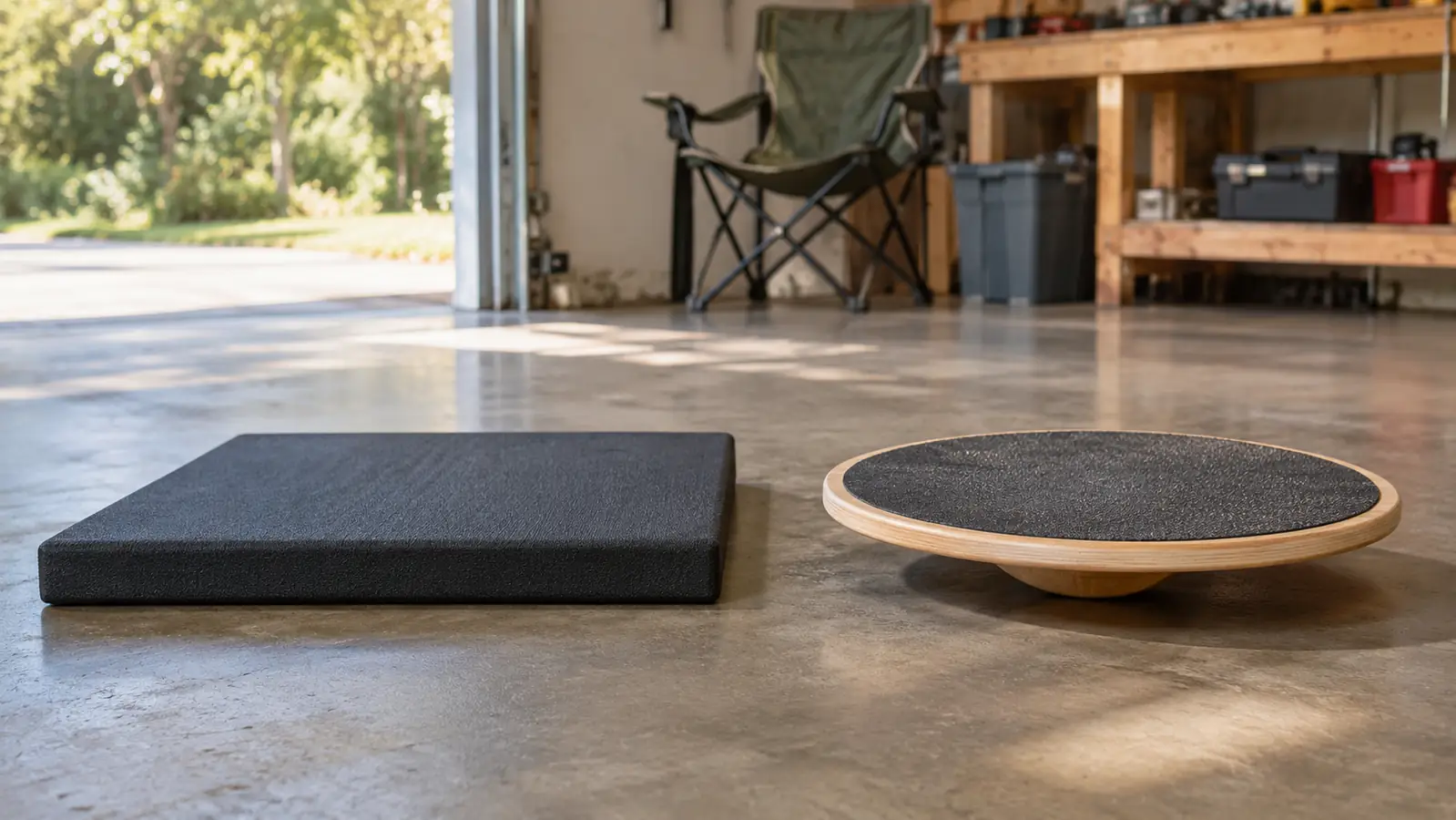
Three Things to Check Before You Stand on Either One
First, ask your doctor or your physical therapist. I say that in every piece I write and I will keep saying it, because balance work is exactly the kind of thing where a small unknown problem turns into a bad afternoon. Two knees that complain and a stiff back are one conversation. Dizziness, numbness in the feet or a recent fall are a different conversation, and it should happen before you buy anything at all.
Second, clear a space you can fall into without hitting anything. For the pad that means about the size of a doorway mat on carpet, with the armchair at your back. For the board it means an arm's length of clear floor and something solid to hold. I moved a side table out of my living room for two weeks and put it back once I knew where my feet were going.
Third, decide how much challenge you actually want. A pad is a daily habit tool. A board is a training tool. Those are different purchases with different failure modes, and the failure modes are the part nobody puts on the box.
What I Liked
- Forgiving surface, so a wobble stays a wobble
- Weighs 12 ounces and slides under a chair, which means it gets used
- Doubles as a knee pad at 15.5 inches by 12.75 inches
- Non-slip TPE holds under a sock or a bare foot
- Limited lifetime warranty
- Usable on day one with a hand on the armchair
Where It Falls Short
- Mild challenge, so it will not build ankle reaction speed on its own
- It sits underfoot while you use it, so it does not belong in a walkway
- One piece of foam does one job, and you still need other work for strength
- Easy to outgrow if you progress quickly
Who Should Buy Which
Buy the ProsourceFit pad if you are past 65, your knees or your back make you cautious, and your goal is to keep getting out of a chair and walking to the mailbox without thinking about it. Buy it if you want something you can use barefoot in the living room in the ten minutes before your coffee is ready. Buy it if you have had a scare or two and you want to do something steady about it rather than something dramatic. Buy it if you have already noticed that the thing you keep is the thing that is already within arm's reach.
Buy a wobble board instead if you are working with a physical therapist on ankle rehab, if you have a spotter, and if you have already built a base on something softer. Buy it if you are younger and training for a sport rather than protecting a hip. And if you are somewhere in the middle, do what I did. Start with the foam and leave the board in the garage until you have a reason to bring it out.
How I Actually Use It Most Mornings
My routine is not impressive. I set the pad on the carpet beside the armchair, stand on it with my feet about hip width apart, and shift my weight side to side for two minutes while the coffee drips. Then I stand on one foot for twenty or thirty seconds with two fingers on the chair, switch sides, and do it twice more. Then I step off and go get the coffee. Twenty minutes of movement in total, and the pad is maybe six of them. Dot walks with me after lunch and that is the rest of it. On a cold morning in February, when both knees are carrying on and the driveway is still icy, those six minutes are the whole day's exercise, and I would rather do six than none.
The part that matters is that I do it on the days I do not feel like it. A tool with a strap and a manual does not get used on those days. A 12 ounce pad that is already on the floor does. If you take one thing from an old shop teacher, take that.
Start with the foam. Keep the board in the garage until you need it.
The ProsourceFit pad is the version of this that fits a cautious body, a small living room, and a morning you are not in the mood for. Check with your doctor first, then give it two weeks.
Amazon Check Today's Price on Amazon →