

I put off buying ankle weights for two years. Not because of the money. Because I was sure I would strap them on once, decide they were a young person's tool, and let them sit in the garage next to the rowing machine my knees voted against. Then my morning routine hit a wall. I was walking, I was stretching, and I was still stiff in the lower back every single morning. What I needed was something small I could add to the twenty minutes I already spend on the living room carpet, not a whole new program. That turned out to be a pair of Sportneer adjustable ankle weights, and I have used them most mornings since.
Here is what I want to say up front, the way I would say it over the fence to a neighbor. Check with your doctor or your physical therapist before you start. I am 78, I have two knees that complain on stairs and in cold weather, and a back that takes ten minutes to wake up. I am a retired shop teacher, not a therapist, and what worked in my living room says nothing about your hips. What I can tell you is what changed for me and why the adjustable part turned out to matter more than I expected. Each weight goes from 1 to 5 pounds, the pair goes from 2 to 10, and the strap fits an ankle from 7.5 to 12.5 inches.
Start where your knees actually are today
The Sportneer pair runs from 1 to 5 pounds per weight by pulling out sand segments, so you can begin at the bottom of the range and stay there as long as your body wants.
Amazon See the Sportneer ankle weights on Amazon →Start at one pound, not ten
Most ankle weights I looked at came in one fixed size. You bought three pounds or five pounds and lived with it. The Sportneer pair works differently: each weight holds removable sand segments, so a single one runs 1, 2, 3, 4, or 5 pounds and the pair runs 2, 4, 6, 8, or 10. My first week was one pound per leg for ten minutes, three mornings. It did not feel heroic. It felt like something I could repeat, which is the only kind of exercise I have ever stuck with.
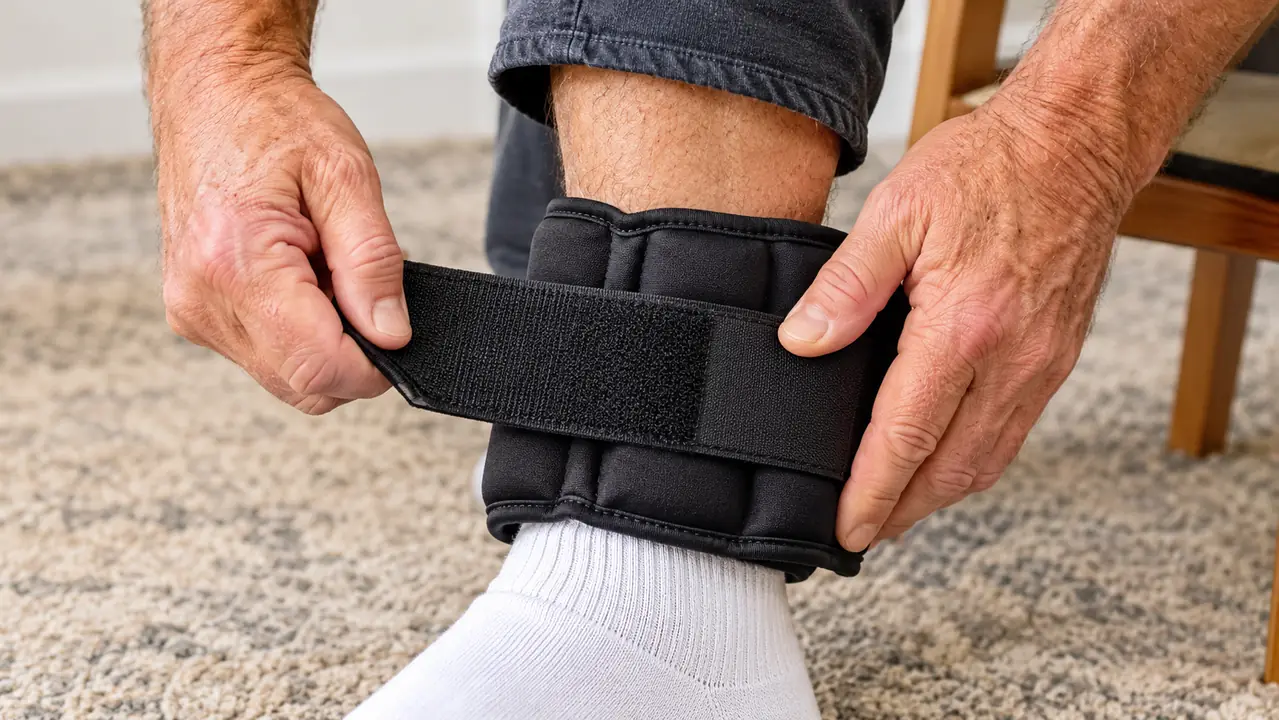
The strap holds through a full set of chair stands
The closure is hook and loop, the wide kind, and it sits above the ankle bone where it belongs. I have done forty chair stands in a row without once reaching down to re-fasten. On the first morning I had it too low and it rubbed. That was my error, not the strap's. I raised it a thumb's width and it has been quiet ever since. If a strap slips mid-set you stop the set, and stopping is how habits die.
One size range fits most of us, and the company tells you to measure
The listing says it fits an ankle from 7.5 to 12.5 inches, and it asks you to measure before you buy. Do that. I wrapped a cloth tape around the narrowest part above my ankle bone, wrote the number on the back of an envelope, and it landed comfortably inside the range. Dot measured hers the same morning before I ordered. If you fall outside those numbers, this is not your pair, and no amount of adjusting will fix it.
Your wrists can use them too
They are made for the ankle and the wrist, and the wrist part surprised me. I strap one on each wrist for the seated arm work I do in the armchair on rainy days, and five pounds across two wrists is plenty at 78. Do not go load for load with what you wear on your legs. Arms are smaller and the leverage is different. Start light, notice how your shoulders feel the next morning, and adjust from there rather than the other way around.
One pair covers two people
Dot walks with me most mornings and she is not going to wear what I wear. She uses two pounds per leg. I am at five on a good day and three on a stiff one. Same pair, different segments, no second purchase and no second hook in the closet. The segments pull out and push back in with a bit of grip work, maybe five seconds each. It is not elegant. It is fine, and it means the pair earns its shelf space twice over.

The same twenty minutes gets harder without getting longer
Twenty minutes is what I have. I am not adding a second session at 78, and I am not driving anywhere to do it. What the weights do is make the twenty minutes I already do count for more: the leg lifts, the side steps, the marching in place. Nothing on my schedule changed. The work did. I noticed it in the second week, climbing the three steps into the garage without the little pause I usually take at the bottom.
You can back off on a bad morning without quitting
Some mornings the knees are loud. Cold weather, a long day before, who knows. On those mornings I pull out two segments, drop to one pound per leg, and still do the twenty minutes. That is the difference between a habit and a program you abandon in February. The adjustable part is not a gadget feature to me. It is the reason I am still showing up in week six instead of explaining to Dot why the straps are in the garage.
The neoprene does not chew at a thin shin
The outside is neoprene with reinforced stitching and a sturdy trim, and it is moisture absorbing, which matters more than I expected in a Connecticut July. I have worn cheap straps that left a red line for an hour afterward. These do not. After six weeks of near daily use the stitching still looks new, the trim has not curled, and nothing has split or leaked sand into the carpet, which was my main worry before I ordered.
They live in the closet, not the garage
I have owned a rowing machine and a treadmill. Both became furniture. The Sportneer weights hang on a hook in the hall closet, and there is no driving, no class schedule, no membership card I will forget in a jacket pocket. The whole barrier between me and the twenty minutes is walking eleven feet to that closet. At my age the smaller the barrier, the more often the thing happens, and that is most of the battle.
They make the after-lunch walk count for something
Walking is on the manufacturer's list of recommended uses, along with the rehab and physical therapy work people do at home. I do not wear them on the outdoor walk, because an uneven sidewalk and a loaded ankle is a poor combination and I have no interest in a fall. I wear them for the indoor marching and the hallway laps, and the outdoor walk stays exactly as it was. That split has worked for me for six weeks without a single scare.
What I'd Skip
Three things I would skip if I were starting over. First, skip the fixed-weight pairs. A three-pound weight is three pounds forever, and you will either outgrow it or you will not be able to wear it on a bad morning. Second, skip stairs and outdoor pavement with these on. Uneven ground plus a loaded ankle is how people my age end up in a brace, and no twenty-minute session is worth that. Third, skip starting near the top of the range. The folks who hurt themselves with ankle weights are almost always the ones who began at the heaviest setting because it felt like the point. One thing I would not skip: the conversation with your doctor or physical therapist. That comes before the first strap, not after.
One pound per leg for ten minutes, three mornings a week, was the entire starting dose. Nothing about it was impressive. It is the first thing I have kept at for six weeks in years.
Six weeks in, it is still the first thing I reach for
Measure your ankle first, have the talk with your doctor, and start at one pound. The Sportneer pair will still be there when you are ready to add a segment.
Amazon Check the fit range on Amazon →