
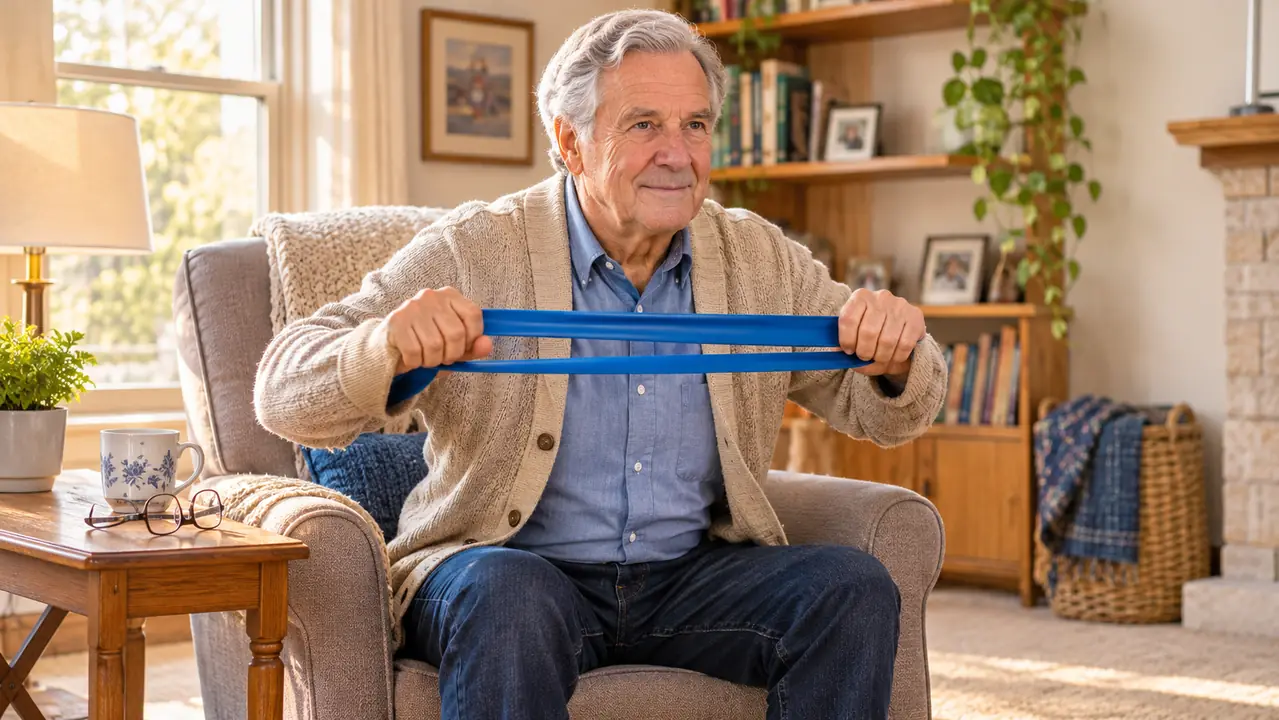
My knees file a complaint every time the weather turns cold, and my lower back takes a few minutes to agree to anything before coffee. So when I started exercising at home at 78, I did what a retired shop teacher does. I looked for the simplest tool that would do the job and not fall apart in a drawer. That turned out to be a set of loop bands, specifically the Fit Simplify Resistance Loop Exercise Bands, the five-band set with the little carry bag and the instruction booklet.
Here is the thing about getting stronger when you are past 70. You are not chasing a personal record. You are chasing the ability to get out of a low chair without using your arms, and to catch yourself if you trip on the step by the garage. Bands are good at that job because you can start with almost nothing and add a little at a time. Resistance does not need to be complicated to work. Check with your doctor or physical therapist before you start something new, the way I did, and then keep it dull and steady.
Start with the lightest band and a chair you already own
Five tensions, a booklet of illustrated movements, and a bag small enough to live in a drawer. Pick the extra light band, do six movements, and see how tomorrow feels.
Amazon Check Today's Price on Amazon →Five resistance levels mean you start where your body is today, not where it used to be
The Fit Simplify set comes with five bands at different tensions, from extra light on up to heavy. That matters more than it sounds. My first week, the extra light band was the only one I could use for a shoulder movement without my neck tightening up. A month later I was on the medium band for the same motion. If a set only came in one tension, I would have quit in three days, or worse, hurt myself trying to make one band behave like five. Start low. Stay low longer than you think you should.
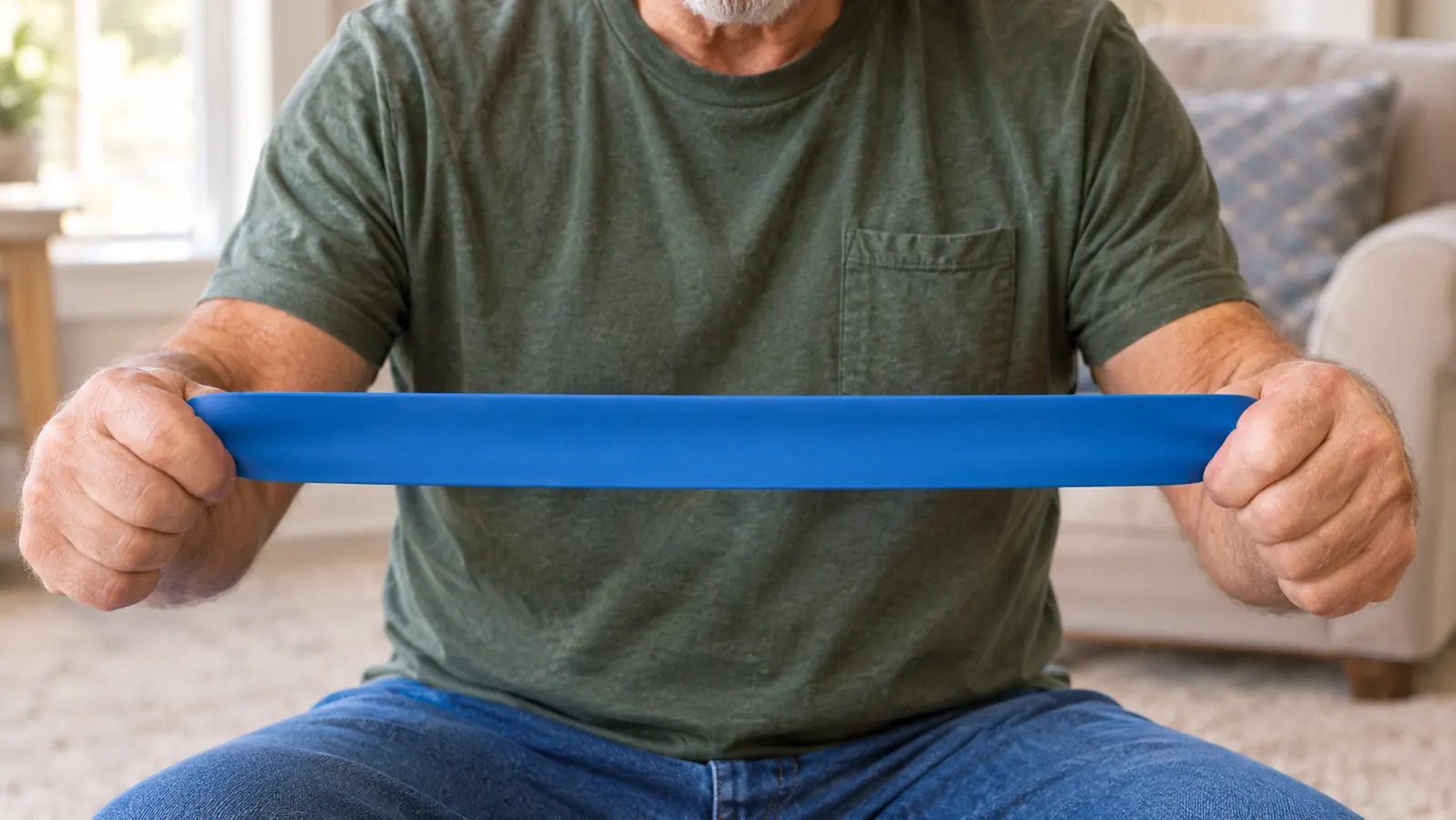
The loop shape works seated, standing, or leaning on a chair
You do not have to get down on the floor to use a loop band. I do most of my work seated on the edge of the armchair, band around my thighs or under one foot with the ends in my hands. Standing, I step on the band and press my arms overhead. On the carpet I use it for a gentle bridge when my back is having a good day. One piece of equipment, three positions, no bench and no spotter. For a man whose back needs a few minutes to agree to anything, that range is the whole point.
Three and a half ounces of latex beats a rack of dumbbells you will not lift
The entire set weighs 3.5 ounces. Compare that to a pair of five-pound dumbbells, which is 160 ounces and, in my garage, has spent four years doing nothing but holding down a shelf. When a tool is that light, you do not negotiate with yourself about whether to get it out. You pick it up. That is not a small thing at my age. The hardest part of exercising was never the exercise. It was starting.
The illustrated booklet answers the only question that actually matters
The box includes an instruction booklet with dozens of illustrated exercises. I taught shop for thirty years, so I say this with some authority. A picture of a person doing the movement correctly is worth three paragraphs of description. I propped the booklet against the sugar bowl the first week and worked through six movements until I knew them by heart. After that I did not need it. But in the beginning, having somebody tell me what to do with a loop of latex was the difference between a plan and a rubber band in a drawer.
You add tension without loading a knee
Bands push back harder the further you stretch them, and then they stop. Nothing hangs over your chest, and nothing drops on your foot when your hand gives out. The latex on these is a quarter inch thick and each band measures about 12 inches by 3 inches flat. For knees that complain on stairs and in cold weather, that means I can work the muscles around them without loading the joint the way a squat with weight would. I am not lifting anything. I am pushing against something that pushes back gently.
Your grip stops being the limiting factor
When your hands have lost some strength, a dumbbell becomes a test of your fingers rather than your hips. Bands take the hand out of the equation. I hook the band in my palm, close my fingers, and the resistance goes where I aim it. No chalk, no straps, and no dropping a weight on the carpet in front of Dot. If your hands are arthritic or just tired by mid-morning, that difference is worth more than any feature list on a box.
The carry bag makes the garage corner as useful as the living room
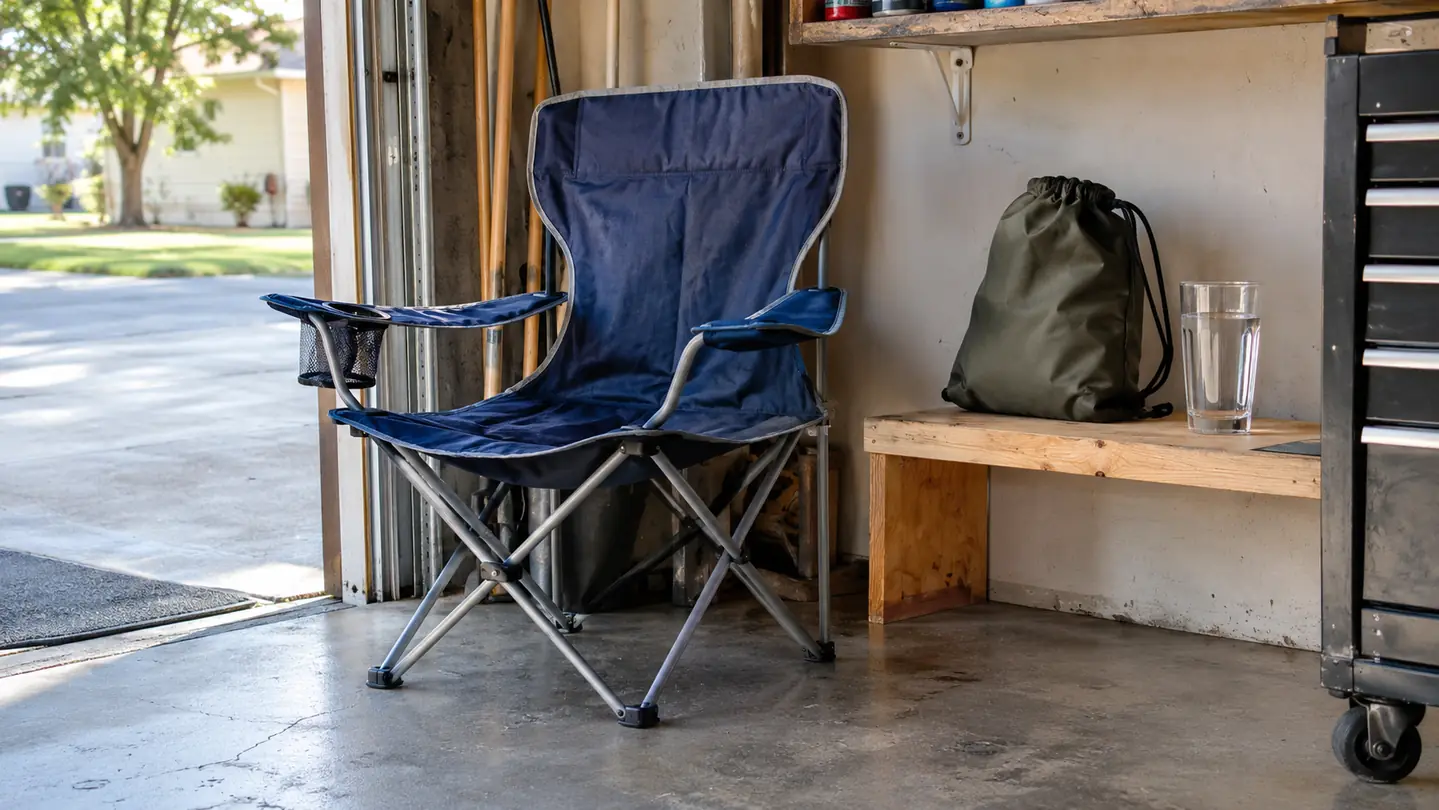
Every set comes with a small carry bag. I keep a couple of loops in the bag on a shelf out in the garage and the rest in a basket beside the armchair. In nice weather I take the bag out next to the open garage door and do the same movements with the light coming in. In January I do them in the living room with the news on. The tool does not care where it is, and because it travels easily, neither do I.
Twenty minutes counts as a real session at this stage, not a warm-up
My whole session runs about twenty minutes, five days a week, after coffee. Two movements for the hips, two for the shoulders, one for the back, one for balance. Bands let me move through that with no setup. There is no pin to move, no plate to load, no machine to wipe down. At my age the routine that survives is the one with the fewest steps between deciding and doing. Twenty minutes with a band is the work. It is not a warm-up for something fancier that I will never get around to.
Progress shows up in stairs, chairs, and grocery bags
Around week six I noticed I could get out of the low chair in the kitchen without pushing off with both hands. Then I noticed the stairs did not need a pause on the landing. Then I carried two bags of groceries in from the car in one trip. None of that is dramatic. All of it is the point. Dot walks with me after lunch and keeps her own band for her shoulders. We are not training for anything. We are buying ourselves a few more years of doing small things without help.
It lives next to the armchair, so you actually use it
The set sits in a basket beside my chair, which means I see it while I am drinking coffee and reading the paper. That is not an accident on my part. I have owned a treadmill. I have owned a gym membership I drove past twice a week without going in. Both of those lived in another room, and both lost. A band you can drape over the arm of the chair while you decide whether to use it wins because it never leaves your line of sight.
What I'd Skip
Skip the heaviest band for the first month. There is no prize for graduating early, and the extra heavy band will happily teach you a lesson about your lower back that you will feel for a week. Skip anything that takes more than a minute to set up, because you will not do it twice. Skip floor exercises if getting down and back up is a project of its own, since the same muscles can be worked from a chair with a loop around your thighs.
And skip working through pain. Discomfort that fades when you stop is one thing. A sharp catch in a knee, or a shoulder that keeps clicking for the rest of the day, is your body sending a message, and the message is stop. I keep a note on the kitchen counter of which band I used and for how many repetitions, because at 78 my memory is not the record keeper it once was. Skip starting any of this without a word with your doctor or physical therapist, especially if you have a replaced joint or take medication that changes your balance. That is not caution for its own sake. It is how you keep doing this in October.
Around week six I got out of the low kitchen chair without pushing off with both hands. That is not a personal record. That is the whole reason I started.
The band by the chair is the one that gets used
Two complaining knees, one stiff back, twenty minutes after coffee. That is the entire plan, and the Fit Simplify set is enough equipment to run it. Start lighter than you think you need, and give it six weeks before you judge it.
Amazon See the Fit Simplify set on Amazon →