
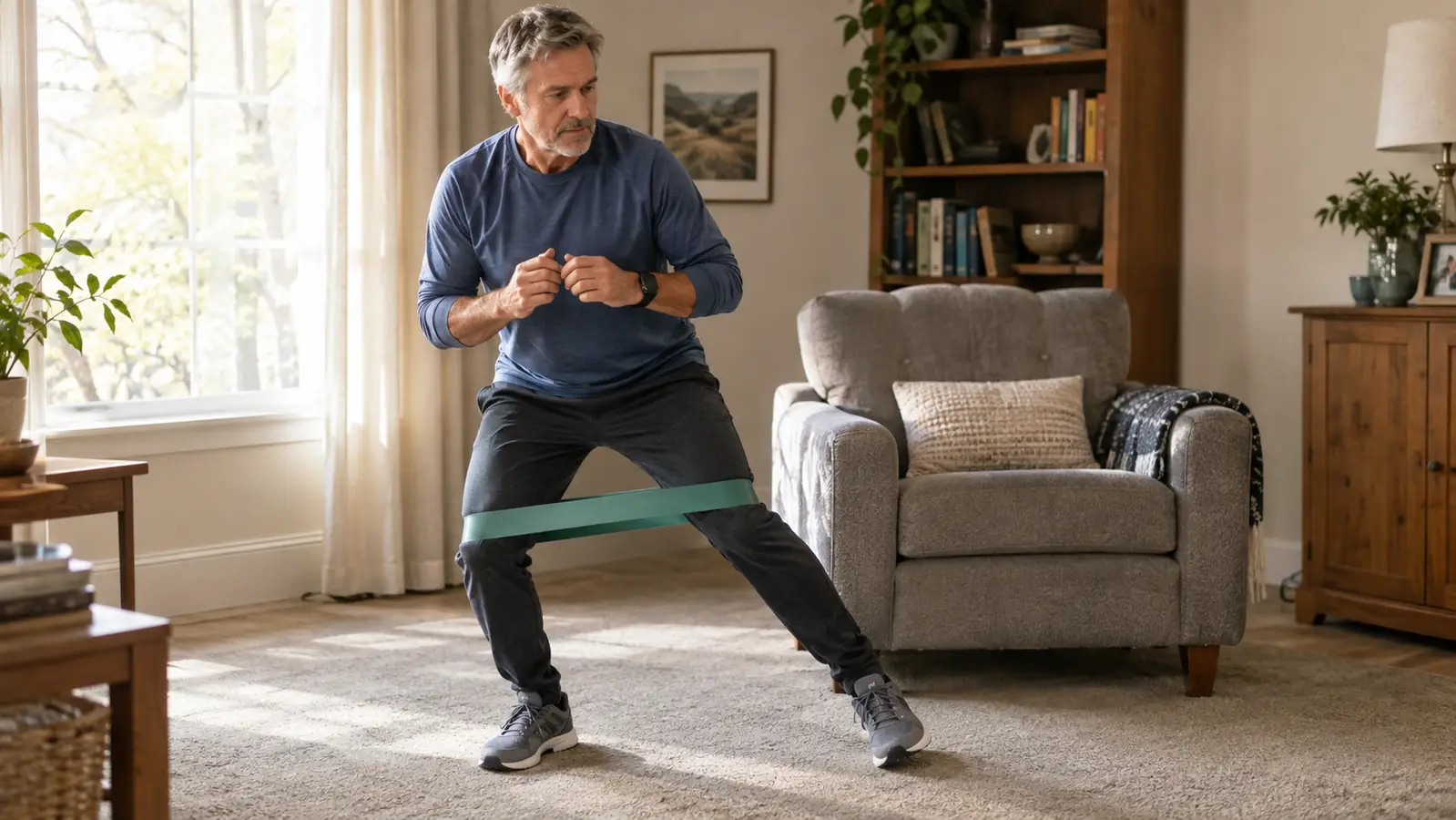
If you are past 65 and buying your first set of bands, the whole decision comes down to one question. Do you want a flat loop you can slide around your knees, or a tube with a handle at each end that you can pull? The Fit Simplify Resistance Loop Exercise Bands are the flat loop answer. Tube bands with handles are the other one. I am 78, I do about twenty minutes in my living room every morning after coffee, and I have used both kinds long enough to know which one I reach for on a stiff morning and which one I have to talk myself into.
The plain answer is that Fit Simplify wins for legs, hips and the muscles around your knees, and tube bands with handles win for pulling and pressing where your hands need something to hold. If your knees are what bother you on the stairs, get the loops. If your shoulders and upper back stiffen up by ten in the morning, get the tubes. If you can only buy one and you are starting from zero, get the loops, because leg and hip strength is where most of us lose ground first and fastest.
| Fit Simplify Loop Bands | Tube Bands With Handles | |
|---|---|---|
| Hip and leg work | A closed loop goes around both knees or both ankles, so the exercise is possible at all | Nothing to loop, so side steps and clamshells are off the table |
| Pulling and pressing | No grip point, so rows and chest presses are out | Handles plus a door anchor let you row and press against a fixed point |
| Grip comfort | A quarter inch of latex can bunch in a sore hand | A padded handle spreads the load across the palm |
| Changing resistance | Five levels in the set, and you swap bands to change it | Resistance changes by choking up on the handle or adding a second tube |
| Changing length | Fixed 12 inch loop, you change your stance instead | Hand position changes the working length of the band |
| Setup | Nothing to clip, anchor or check | Needs a door and a minute of setup |
| Travel | 3.5 ounces for the set, plus a carry bag | Bulkier, the handles take up the room |
| Learning the exercises | Illustrated instruction booklet comes in the box | Motion is familiar, but anchor placement takes a session to learn |
What Actually Shows Up at the Door
The Fit Simplify set is five flat latex loops in five resistance levels, and here is the detail nobody mentions: every one of them is the same size. Twelve inches long, three inches wide, a quarter inch thick. That sameness is the point. You do not hunt for the right band by feel. You pick the level, you step into it or loop it around your knees, and you start. The set arrives with a carry bag and an instruction booklet full of illustrated exercises, and the booklet turned out to be the part I used most in the first month.
Tube bands with handles are a different animal, and I mean that kindly. Instead of a closed loop you get a length of hollow rubber with a handle at each end, and most sets throw in a door anchor so you can pull against something that does not move. You grip, you pull, the tube stretches. There is no sliding it around your ankles and no stepping on it. It is a pulling tool, and a good one.
The first morning I opened the box I made a mistake worth passing along. I started with the heaviest band in the set because it looked the most serious, and I got through maybe six side steps before my hip told me plainly that this was a poor decision. The extra light one, which feels like almost nothing in your hand, was the right place to start. I stayed on it for the better part of a month before I moved up a level, and that slow start is the reason I am still doing this in March.
The difference in how they feel is not subtle. A flat loop sits against your skin and stays where you put it. A handle fixes your hand in one position and lets the rest of your arm hang loose. That single difference decides most of the exercises you can do with each, which is why the rest of this is mostly about matching the tool to the job rather than picking a favorite.
Where Fit Simplify Loop Bands Wins
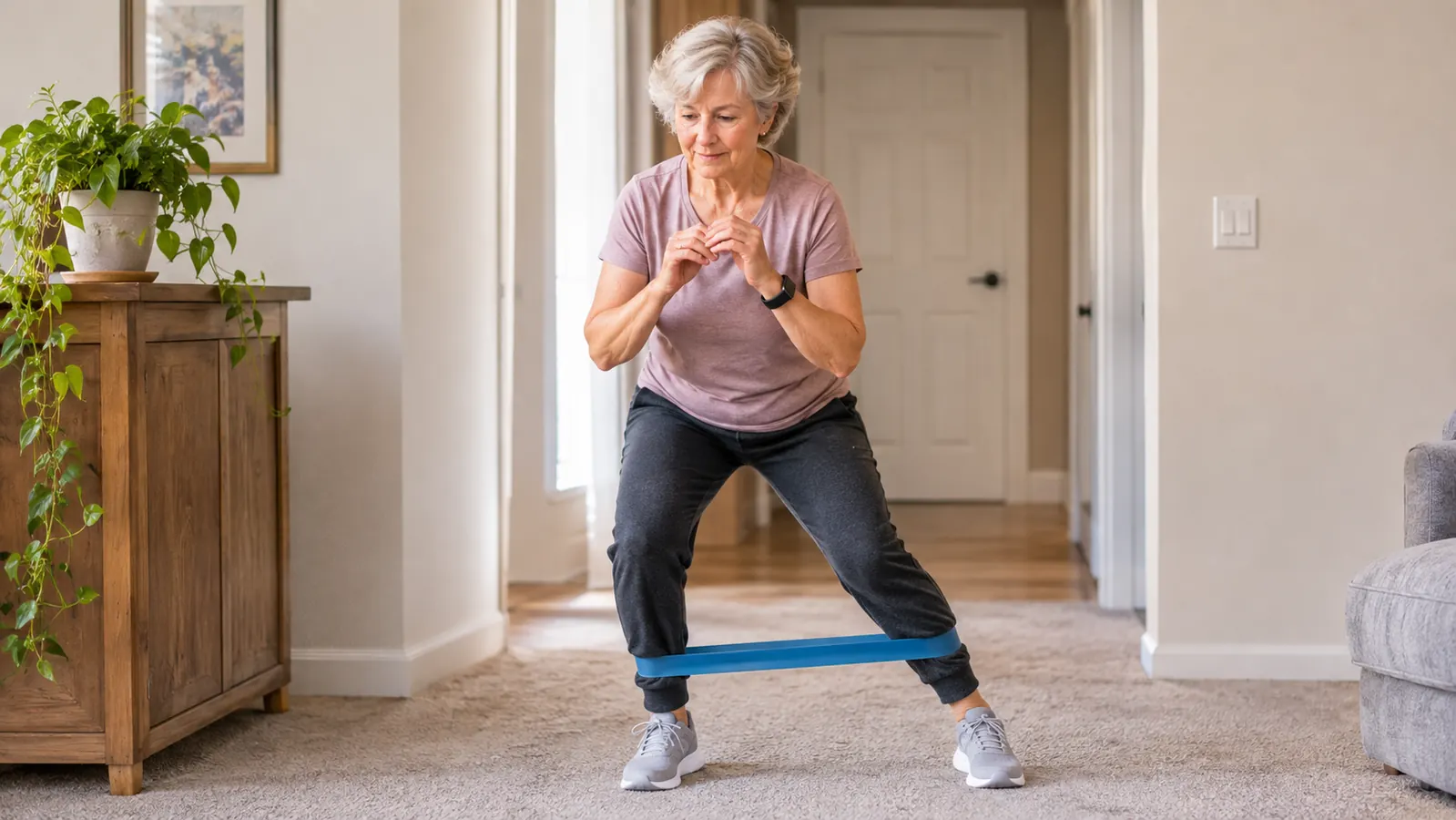
Legs and hips, without a fight. Looping a band around both knees and stepping sideways is the closest thing I have to a sure bet for the muscles that keep me steady on the stairs. The flat loop stays put while you move. A tube with handles cannot do that job at all, because there is nothing to loop around a leg. Same story for clamshells lying on the carpet, same for pressing a loop open against your thighs, same for a slow march with the band around your ankles. If your doctor or your physical therapist told you to strengthen your hips, the loop is the tool that does the exercise.
It travels, and it disappears. Five bands and the carry bag weigh 3.5 ounces together and take up less room than a paperback. There is also nothing to adjust, nothing to clip and nothing to anchor. The band is either around your knees or it is not. At my age the whole battle is doing the thing before I talk myself out of it, and fewer steps between the idea and the first repetition is a real feature, not a small one.
How it actually works in this house is that the extra light and light bands live in an old shoebox on the shelf by the garage door, where I walk past them twice a day, and the heavier three stay in the carry bag in the living room. Nothing gets put away in a drawer I have to open. That is less a feature of the band than a feature of my own memory, but a tool that is easy to leave out is a tool that gets used, and I have watched enough exercise equipment go into a closet to know the difference.
The one thing I would change is the level markings. Five bands look identical on the carpet until you pick one up, and the difference between extra light and light is not obvious at a glance. I marked mine with a permanent marker on the first day, one stripe for the lightest and so on up. Small complaint, and it cost me nothing to fix.
Where Tube Bands With Handles Win
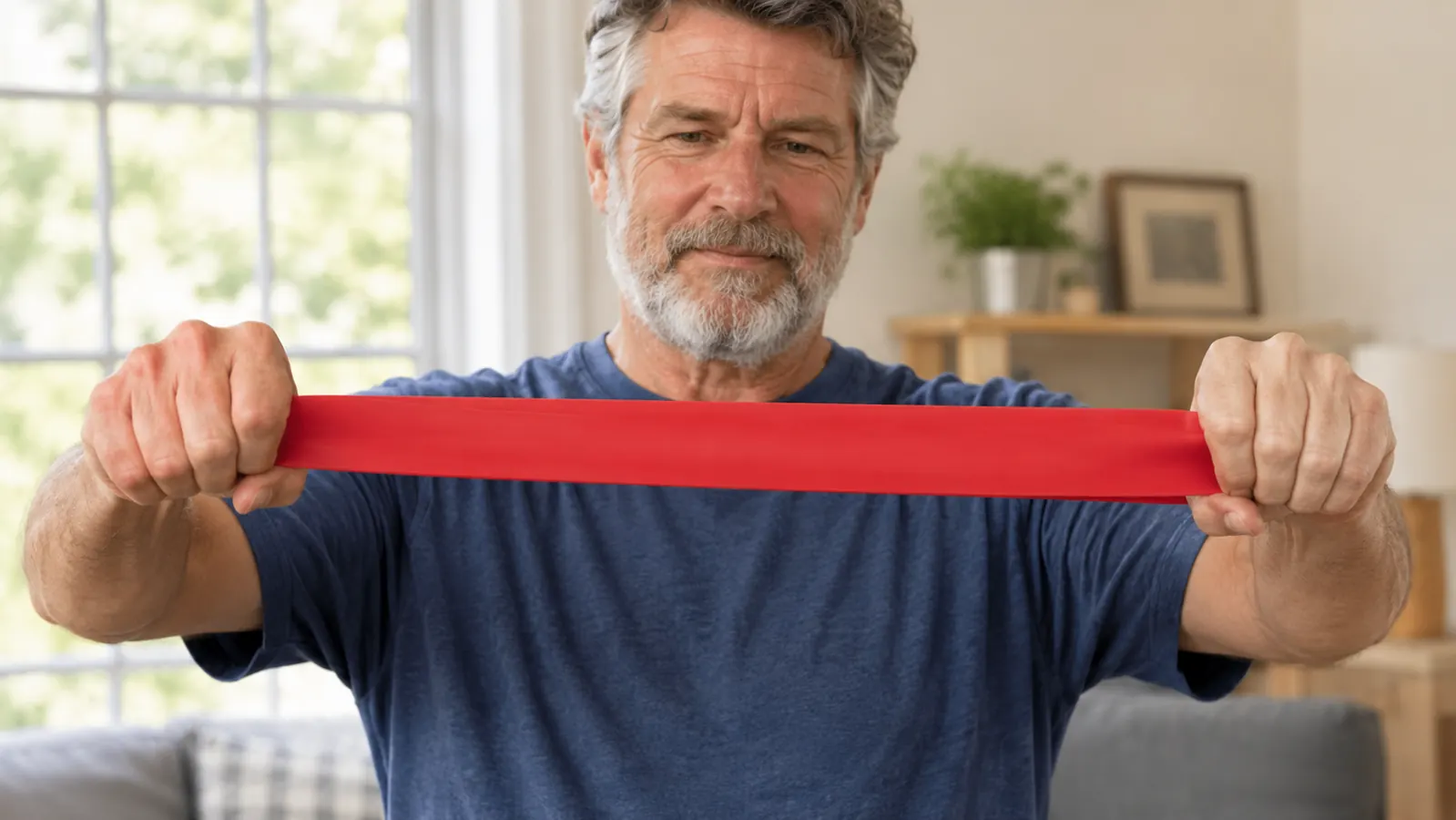
Pulling. This is not close. Rowing, pulling down, pressing forward, anything where your hands travel and the load comes from a fixed point, the handles win and the flat loop cannot compete. You anchor the tube to a door, you grip, you pull back toward your ribs. My upper back and shoulders stiffen up if I leave them alone, and the loops could not give me that work no matter how I arranged them. If you have a door and a spare minute, the tubes open up half the body the loops cannot reach.
Your grip. A padded handle is kinder to a hand with sore knuckles than a quarter inch of latex bunched in your fist. And you can cheat the length on a tube by choking up on the handle, which means one band covers more range than one fixed loop does. On a cold morning when everything is stiff, that bit of adjustability is often the difference between finishing the set and quitting halfway through it. Dot has said the same thing about her own hands, and she is not one to complain about a tool.
If the legs are the problem, start here
The Fit Simplify set covers five resistance levels in one small bag, with an illustrated booklet to show you where to begin. Loops around the knees, no anchors, no setup.
Amazon Check Today's Price on Amazon →Five bands and the carry bag weigh 3.5 ounces together and take up less room than a paperback. Mine rides in the bag in the corner of the garage.
The Living Room Test
My living room is carpet with a sturdy armchair at one end, and that chair is half the equipment. I hold the arm going down and coming up. Twenty minutes after coffee, then a walk with Dot, then the day starts. With the loops I can do the whole session without moving a stick of furniture: side steps, leg presses from the chair, clamshells on my side, a slow march with the band at my ankles. I remember a Tuesday in February when the garage was cold enough to be out of the question, and I did the entire session in the living room with my coffee still on the side table. No furniture moved, no door involved, no excuses available.
With the tubes I need a door, and the nearest one with a gap underneath is the hall closet, which means the session happens in a different room than the one I drink my coffee in. That sounds trivial. It was not trivial for the first two weeks. It also took me a while to notice the payoff, which came on the cellar stairs rather than during the exercise. Somewhere in the third week the ankle march stopped feeling like a negotiation and my footing going down those steps got quieter and surer. That is how this sort of work tends to show up, sideways and a few weeks late.
I want to be straight about the limits. Neither of these replaces the chair for balance work, and neither one is going to fix a knee. What they do is let you load your legs and your back a little at a time, at home, in the clothes you already have on. If you have not moved in a while, check with your doctor or your physical therapist before you start, and be honest with them about what you can actually do. I am not a therapist. I am a retired shop teacher who knows a good tool when the handle does not slip.
One piece of housekeeping. Latex does not last forever. Keep the loops out of a hot car and out of direct sun, and wipe them down once in a while with a damp cloth. Mine have held up because they go back in the bag instead of hanging on a hook by a window. That is not a rule anybody enforced on me, just what I have watched happen to rubber left in the light.
The Instruction Booklet, Honestly
The booklet is better than I expected and worse than a person. It has dozens of illustrated exercises, which is more than I will ever use, and the drawings are clear enough to follow without hunting for your reading glasses. What it cannot do is watch you and tell you that your back is rounding. For that I used the armchair, the hallway mirror, and one session with a physical therapist who straightened out my side step in about four minutes.
Tube bands carry their own learning curve, and I would say the same about them. Setting a door anchor correctly the first time took me a couple of tries, and I would not want to be guessing at it with a sore shoulder. Either way, budget one session to learn the movement properly before you make it part of a morning. It is cheaper than unlearning a bad habit in the spring.
What I Liked
- Five resistance levels in one set, all the same 12 by 3 inch size, so there is no hunting for the right band
- Loops around both knees or both ankles, which is the work that keeps hips and legs steady
- Carry bag and illustrated instruction booklet included
- 3.5 ounces for the set, so it lives in a drawer or a suitcase
- Nothing to clip, anchor or set up before you start
Where It Falls Short
- Nothing to grip, so pulling work for the back and shoulders is out
- Fixed length, you adjust with your stance rather than the band
- Latex can bunch and pinch a sore hand
- Latex wears out over time, especially in heat or sunlight
- The jump between one level and the next is not always the jump you want on a given morning
Who Should Buy Which
Buy the Fit Simplify loops if the work you have been told to do is in your legs, your hips, or the muscles around your knees. Buy them if you want one thing you can do in the living room without moving furniture, and if you want to find out whether you will keep at it before you spend more. Buy them if you travel, or if the whole set needs to live in a drawer and come out every morning without a production. One more point on that. If you are the sort of person who needs to see a thing to remember it, the loops are the forgiving choice, because they can sit on the arm of a chair and cost you nothing to look at. The tubes need a door and a minute of assembly, and a tool that needs assembly is a tool that waits until tomorrow.
Buy tube bands with handles if the work is in your back, shoulders or arms, and if you have a door you can anchor to without rearranging the house. Buy them if your hands are the problem and a padded handle decides whether you finish the set. And if you can manage it, buy both. The loops handle the bottom half of you, the tubes handle the top, and neither one is costly enough to agonize over. Both live in this house now and neither has sat unused for a week.
Start with the loops, add the tubes later
Five levels, a carry bag, and an illustrated booklet. If your knees complain on the stairs, this is the set I would hand you first.
Amazon Check Today's Price on Amazon →