
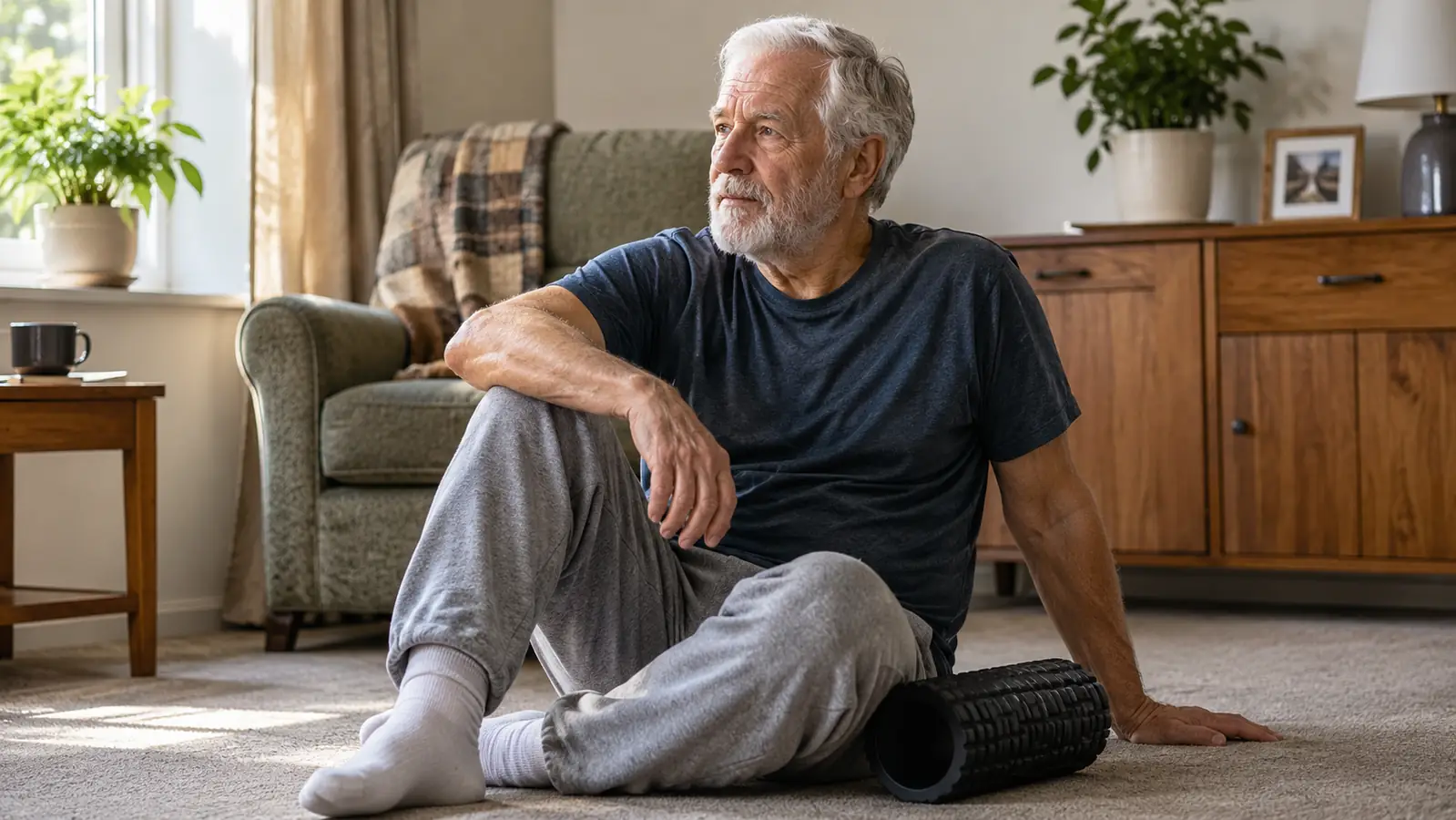
Here is the part that usually gets left out of a foam roller review: the roller is not the hard part. Putting your own weight on it is. I am 78 years old. I live in a one-story ranch house in Wethersfield, Connecticut, with my wife Dot, and my knees file formal complaints on stairs and in cold weather. My lower back is stiff every morning until roughly the second cup of coffee. So when the 321 STRONG three-zone roller arrived, I did what I always do. I put it on the carpet beside my armchair and used it most mornings for several weeks before I decided anything about it. It does real work on a stiff body. It also has limits the product page does not dwell on, and those limits are the entire reason I am writing this instead of just telling you it is wonderful.
The plain description: it is a foam roller, 12.5 inches long and 5.25 inches across, weighing 8.64 ounces. EVA foam over an EPP core, medium firmness, divided into three zones. That is the whole thing. No motor, no cord, nothing to charge, nothing to pair. What you are buying is a shape and a density, and both of those matter far more than most people expect when they order one off a screen.
The Quick Verdict
Honestly medium, well built, and easier on an older body than the thin rollers because it sits higher off the floor. It rewards slow work and punishes rushing. Worth it if you will actually use it four mornings a week.
Amazon Check Today's Price →The roller that lives by my armchair, not in the closet
Medium density, 5.25 inches across, 8.64 ounces, three zones. It is the one piece of gear this year I have not had to talk myself into using.
Amazon Check Today's Price on Amazon →The Short Version, Before the Details
I am not going to dress this up as a complicated purchase. A roller either gets used or it becomes an object you step over on the way to the kitchen. The 321 STRONG roller gets used in my house, and the reason is mostly that it is the right size and the right firmness for the body I actually have, not the body I had at fifty. That sounds like faint praise. It is not. Most of the gear I have bought since retiring got returned, given away, or shoved into the garage because it was built for somebody younger and stronger who does not exist.
What I will not tell you is that it fixed anything. It does not fix. It loosens. There is a difference, and if you are past seventy you probably already know it in your bones. Ten minutes on the carpet most mornings makes the first trip up my stairs feel less like a negotiation between me and my knees. That is the honest claim, and it is enough for me. If you are looking for a cure, this is foam. Foam is not a cure.
What Nobody Tells You About a Medium Density Roller
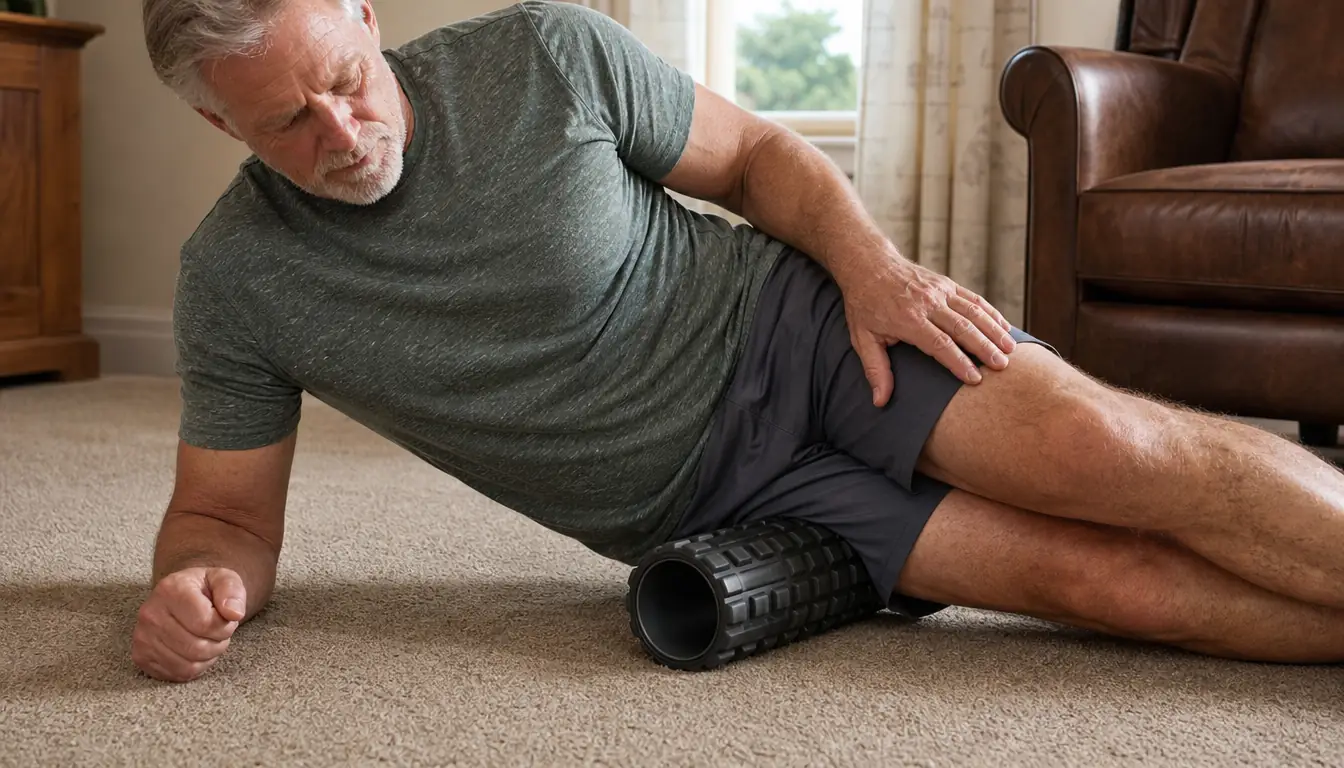
Medium density is a relative term, and nobody selling you one is required to define it. What it means here is that the foam gives under you. EVA foam over an EPP core does not feel like a rock and it does not feel like a pillow. Press your palm into it and you get a firm, springy surface that yields a little before it pushes back. That matters more the heavier you are, because a heavier body sinks further in and gets closer to the hard core underneath. At my weight, which has crept up some since I stopped teaching shop, medium is about right under my thighs and a shade firm on my lower back. If you are a big man, understand that medium will feel firmer to you than it does to me.
Before this roller, I tried three other things across one long winter, and two of them were a waste of a season. My nephew lent me a thin, hard roller from his gym bag, the kind that looks like a length of pipe. Lying on it felt like lying on a stair tread. It got into the muscle, all right, and it left my thigh sore to the touch for two days afterward. Then I tried a wooden rolling pin, which is too short to stay under a thigh and kept escaping sideways across the carpet. Then a tennis ball against the wall, fine for one knot in one spot and useless for the length of a leg. The 321 STRONG roller was the first one I could stay on for ten minutes without wanting to get up.
The second thing nobody tells you is about size. At 5.25 inches across, this roller sits higher off the floor than the thin gym rollers people are always demonstrating on television. That sounds like a small difference. It is not small. A taller roller means your hips and shoulders do not have to travel as far to keep contact with it, which is easier on stiff knees and a stiff shoulder, and it means less wobbling for a body that is not entirely certain of its balance on a carpet. The trade is real, though. It does not get into narrow spots as well. The strip between my shoulder blades is a place the thin roller handled better.
The third thing is the weight. 8.64 ounces is light. That matters twice, and both times are practical. It matters when you carry it from the living room out to the garage corner and back. It also matters when you are flat on your back with the roller underneath you and you want to shift it three inches to the left. A heavy roller fights you on that little move. This one does not, and small conveniences are what decide whether a thing gets used on a Tuesday in February.
At 5.25 inches across, this roller sits higher off the floor than the thin ones. That is easier on stiff knees, and harder on the spot between your shoulder blades.
The Three Zones, and What They Actually Feel Like
The roller is divided into three zones, and the idea is that you shift your weight from one to another to change how much pressure you get. On a carpet in a living room, that turns out to be simpler than the marketing makes it sound. You roll a little forward or back, you find the zone that suits the area you are working on, and you stay there. I did not need a chart. My thighs told me which zone they preferred within a minute, and they have not changed their minds since.
I keep the roller on the carpet next to the armchair Dot claims is mine, and I have a fixed order I go through. Right thigh outside, eight slow passes. Left thigh outside, eight slow passes. Then the front of the right thigh, four passes, then the front of the left. I count them out loud sometimes, which sounds foolish and keeps me from going too fast, and going too fast is the whole trouble with rolling. On the mornings when my back is the stiffer problem, I skip the thighs entirely and do the crossways drape instead, a minute and a half with my shoulder blades and hips on the floor, breathing out longer than I breathe in. Then I sit up with a hand on the chair arm and I am finished before the second cup of coffee goes cold.
My routine is unglamorous. I set the roller on the carpet, I lie on my side, and I work from the hip down to just above the knee. Slow, maybe eight passes, breathing out on each one. Then I switch sides. Then I sit up using the armchair, because getting up off a floor is its own exercise at my age and I would rather do it with a handhold than without one. Nothing about that sequence is impressive. It is the reason the roller is still in the living room.
The lower back I treat differently and more carefully. I do not roll directly over my spine. I set the roller crossways and let my middle back drape over it while my shoulder blades and hips stay on the floor, and I breathe there for a minute or two until something lets go. That is not a technique I invented, and it is not medical advice. It is what I was shown once and what my body tolerates. Before you take up anything new, especially on a back that has opinions, check with your own doctor or physical therapist. I mean that plainly. I am a retired shop teacher, not a clinician.
What It Does Not Do
It does not vibrate. It does not heat up. There is no display, no remote, and nothing to connect to a phone. If part of you was hoping for a device that does the work while you lie there, this is a piece of foam and the work is yours. I happen to think that is fine. The gear I have bought that promised to do the work for me is the gear collecting dust in the garage.
I did try the neck once, because my neck is where a lifetime of leaning over a band saw lives. I laid a rolled bath towel on the carpet, set the roller on top of it at an angle, and lowered my upper back onto it. What I got was a slow slide sideways and a twinge that took three days to settle. I have not tried it again. The message was clear enough: this is a tool for legs, hips, and the broad middle of the back. If the neck is your main complaint, a massage stick with a handle will serve you better. I say that as a man who wanted it to work everywhere and found out it does not.
It also does not replace anybody with a license. If you have a knee that gives way without warning, a hip that catches, or a back that has been getting worse rather than better, a roller is not the answer and a review from a retired shop teacher should not be your first stop. Go get looked at first, then come back and read about gear.
And it does not do much for the very top of the shoulders. There is no handle, so you cannot get any leverage up there, and the 5.25 inch diameter is too broad to work that small area anyway. The last limit is the honest one. Rolling is dull. Twenty minutes is a long time to lie on a carpet thinking about nothing, so I do it in two ten-minute pieces and I count breaths instead of minutes. That is not a flaw in the roller. It is a flaw in me, and probably in most of us.
What I Liked
- Medium density is genuinely medium: firm enough to work, soft enough to stay on for ten minutes
- 5.25 inches across means less wobble and less travel for stiff hips and shoulders
- 8.64 ounces, so it goes where you need it without a fight
- EVA foam over an EPP core has not gone soft or shiny after weeks on carpet
- Three zones let you change pressure without changing position much
- Long enough at 12.5 inches to work a thigh in one pass
Where It Falls Short
- Too wide for the narrow strip between the shoulder blades
- No handle, so the neck and upper shoulders are out of reach
- Medium firmness will feel too soft for a heavy body that wants deep pressure
- Rolling is dull work and the roller cannot make it less dull
- The three zones matter less in daily use than the product page suggests
Using It With Old Knees and a Stiff Back
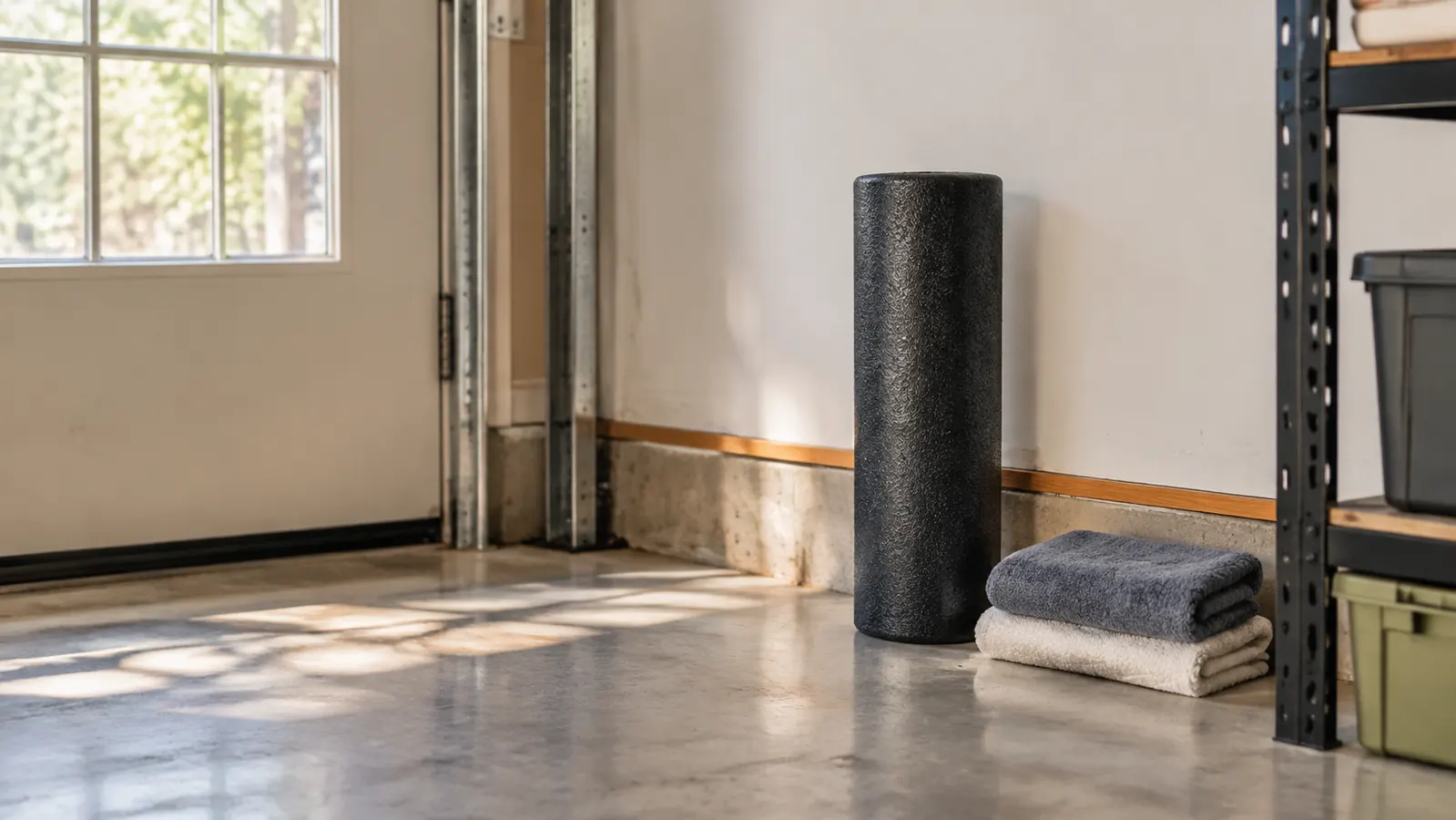
I use it in two places. The living room carpet is the forgiving one. Carpet gives a little underneath the roller, so the pressure comes on gradually and I can stay there longer. The corner of the attached garage has a bare concrete floor, and on concrete the same roller feels noticeably firmer because nothing underneath it is absorbing anything. I save the concrete for days when my thighs are asking for more and my back is not. That is a genuine difference and it costs nothing to know it before you start.
One warning is worth more than the rest of this article. Do not try a new floor on a bad day. I made that mistake in the kitchen one February morning, on the tile, because the light is better in there and I wanted to see what I was doing. Tile has no give in it at all. The same ten minutes that feels honest on carpet felt like being kicked in the thigh, and I was stiff for two days afterward. The carpet in the living room is the right surface for me. The concrete out back is for mornings when I want it firm and I am already warm from a walk. Tile is for standing on in socks, not for rolling.
The company points to twenty minutes after exercise, then again at 24 and 48 hours. I do not manage that schedule and I am not going to pretend I do. My version is ten minutes after my morning coffee and ten minutes after my walk, which is roughly the twenty minutes, just split and rearranged around a life. Small and steady beats ambitious and abandoned. That has been true of my gratitude list and it is true of foam rollers.
One more practical note for anyone with a body like mine. Keep a sturdy chair within arm's reach, keep your phone in your pocket, and do not try this for the first time on a day when your knees are already unhappy. The 321 STRONG roller is not going to injure you by existing, but the floor is the floor no matter what you set on it. Getting down and back up is the part nobody reviews, and it is the part that decides whether you keep going.
Who This Is For
This is for the adult past sixty-five who already moves a little and wants to keep moving, and who is willing to leave a roller on the floor where they can see it. It suits a body with general stiffness, a body that has been told to keep loose, a body that does better with a broad, forgiving surface than with something narrow and hard. It suits a house with carpet and a chair nearby. It suits someone patient enough to do ten dull minutes twice a day and not expect a transformation by Friday. If that is you, the 321 STRONG roller will earn the space it takes up.
Who Should Skip It
Skip it if you want deep, hard pressure and nothing less will do. Skip it if getting down onto a floor and back up is not safe for you today, because there is no version of this that happens standing. Skip it if you have an undiagnosed problem that is getting worse, and see somebody qualified instead. Skip it if you already own a thin roller you like and use. And skip it if you know in your gut you will use it twice and then walk around it for a year. I have a garage full of that kind of purchase and I would rather you not add to yours.
Buy it once, leave it on the floor, and use it on the dull mornings
Twelve and a half inches long, 5.25 inches across, 8.64 ounces, medium density, three zones. Nothing to charge and nothing to learn. The only requirement is that you actually get down there.
Amazon Check Today's Price on Amazon →