
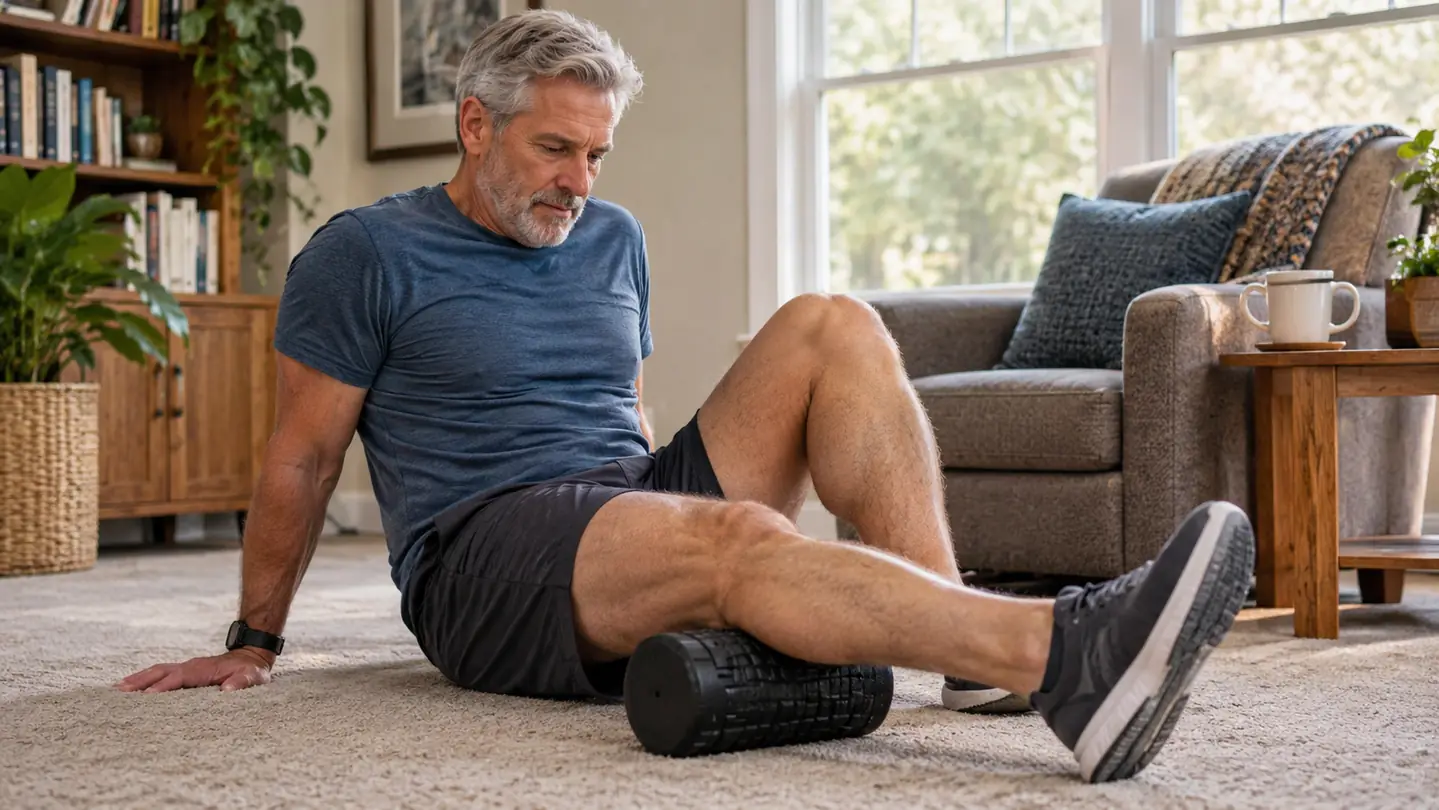
Stiffness has a way of arriving before you are fully awake. I am 78, I live in a one story ranch house in Wethersfield, Connecticut, and most mornings my lower back announces itself before my feet find my slippers. The basement stairs get a comment from both knees. For years I treated all of that as something to push through, which is how a retired shop teacher handles most things, and pushing through was exactly the wrong move. What has helped is small and dull and unglamorous: a few minutes with a foam roller before the day gets loud. The one that has stayed beside my armchair is the 321 STRONG three zone massage roller, and this is the routine I actually use, step by step, at a pace an older body can keep.
I am not a trainer and I do not play one on the internet. Check with your doctor or your physical therapist before you start rolling, especially if you have had a joint replacement, take a blood thinner, or are managing a diagnosis. What follows is what works for me and for Dot, my wife, who is 76 and walks with me most mornings and has her own opinions about my methods. The roller itself is modest: 12.5 inches long, 5.25 inches across, 8.64 ounces, medium density foam over a firmer core, with three zones that let you change the pressure without changing how hard you push. That last part is the whole reason it works for me.
The roller that lives beside my armchair
12.5 inches, 8.64 ounces, medium density foam over a firmer core, and three zones so you can change the pressure without leaning harder. It is the one I reach for before coffee, not after a workout.
Amazon Check Today's Price on Amazon →Step 1: Warm the Tissue Before You Roll
Cold tissue does not want to be pressed. If I roll a stiff calf the moment I swing my legs out of bed, it feels like a rope with a knot in it, and nothing good comes of that. So the first step is not the roller at all. It is five minutes of easy movement: a walk down the hallway and back, a warm shower, marching in place at the kitchen counter while the coffee finishes. By the time I sit down with the roller, the muscle has some give to it and the pressure feels like a conversation instead of an argument.
Dot does her version at the counter, holding the edge and doing ten slow heel raises while the kettle heats. She says it wakes up her ankles. I say it wakes up her opinions, but she is right about the ankles. The point is the same either way. You are not trying to stretch anything yet. You are raising the temperature a little and telling your legs that the day has started, which sounds like nonsense until you skip it once and feel the difference.
One caution here. If a muscle is swollen, hot to the touch, or bruised, skip the roller that day and call your doctor. Rolling is for stiffness and everyday soreness, not for an injury nobody has looked at. I made that mistake with my own knee a few winters back and lost a week of morning walks for it. A week of walks is worth more than any single rolling session.
Step 2: Set Up So the Floor Is Optional
The biggest reason people my age quit foam rolling is that getting down on the floor and back up again is its own workout, and a discouraging one. You do not have to do it. Most of what I roll, I roll from a sturdy armchair or standing against a wall. The living room carpet gives me a soft place to put a foot, and the chair has arms I can push off from, which matters more than any piece of equipment I have ever bought. The 321 STRONG roller sits on the carpet beside that chair and it does not travel far.
My setup is plain. The armchair, a folded towel on the carpet, the roller within reach, and the wall behind me for balance. In the garage corner I keep a second spot for standing calf work, one hand on the workbench. That is the entire gym. No mat, no strap, no video playing on a phone propped against a book. If I have to hunt for something, I will not do it, and a routine you actually do beats a better routine you skip.
Two safety notes I take seriously. Do not roll on a bed or a soft couch, because you will sink in and lose control of the pressure. And do not roll standing up with your eyes closed, or in socks on a smooth floor. I keep a pair of flat shoes by the garage door and my phone in my pocket in case Dot needs me. Small things, but they are the difference between a habit and an accident.
Step 3: Roll Slow, Breathe, and Stay Under a 6
Slow is the whole trick. I move the roller about an inch per second, which is slower than it sounds, and I breathe out on each pass. Thirty to sixty seconds on a spot is plenty. If I catch myself hurrying, I am usually pressing too hard to make up for it. A muscle does not relax because you attack it. It relaxes because you give it steady, boring pressure and enough time to decide you are not a threat.
I use a simple scale. A mild stretch is a 3. A good working pressure is a 5 or a 6. Anything that makes me hold my breath or curl my toes is a 7 or above, and that is too much. The old shop teacher in me wants to lean in and get it over with. That instinct has cost me more mornings than it has saved. Ease off, keep breathing, and come back to the same spot tomorrow.
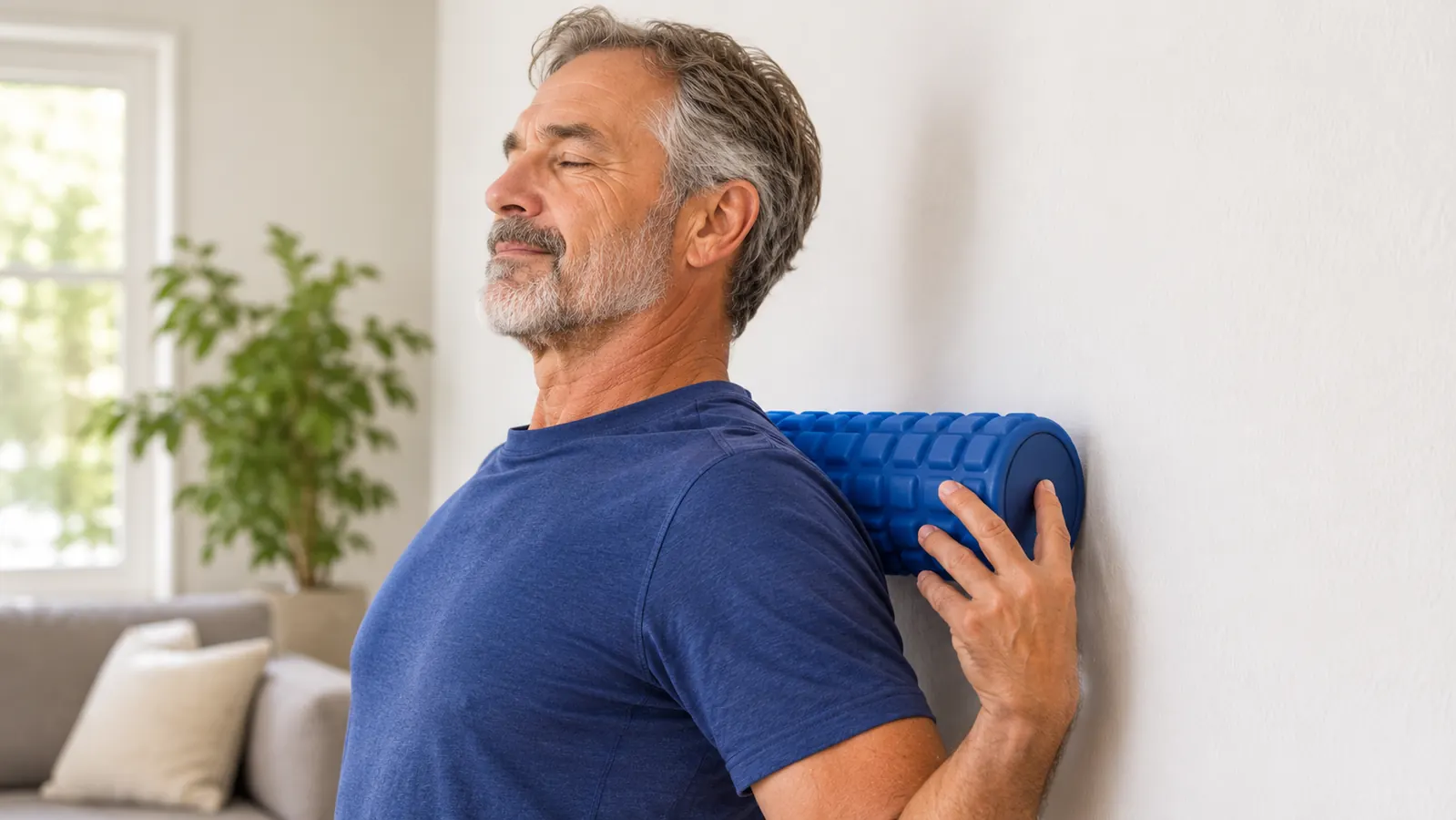
What I do not roll: the bony points, the front of the knee, the side of the knee, and the lower back itself. For the back, I put the roller against the wall and lean my upper back and shoulder blades into it while standing, which keeps my spine out of the picture. If a spot feels sharp rather than tight, I stop. Sharp is information. Tight is just stiffness, and stiffness responds to patience.

Step 4: Change Zones Instead of Pressing Harder
This is where the 321 STRONG roller earns its place by the chair. It has three zones along its length, and each one gives a different amount of pressure without you changing how hard you push. On a bad morning I rotate to the gentler zone and let the roller do the work. On a day when my calves are merely grumpy, I use the firmer zone and take my time. Medium density foam over a firmer core is a sensible combination for an older body, firm enough to reach the muscle and soft enough that it does not feel like a rolling pin.
My order is always the same. Calves first, seated, one leg at a time. Then the back of the thighs, still seated, working from just above the knee toward the hip. Then I stand and take the upper back against the wall, leaning in and rolling slowly from the shoulder blades down to the middle of the back, never on the spine itself. Last, I sit and roll the arch of each foot for twenty or thirty seconds, which has done more for my balance than any gadget I have bought.
The roller is 12.5 inches long and 8.64 ounces, so it moves from the chair to the wall to the garage without a second thought. That sounds like a small thing. It is not. The gear I use is the gear that is already where I need it. If the 321 STRONG lived in a closet upstairs, I would have quit three weeks in and gone back to complaining about my knees.
Step 5: Roll After the Walk, Then Again a Day Later
Timing matters more than duration. The listing for this roller points to research on rolling for about 20 minutes after exercise and again at 24 and 48 hours, with the idea that it shortens recovery. I will not pretend I do twenty minutes. I do six to eight, after my after lunch walk, then a shorter pass the next morning. But the spacing idea has held up for me. The second day is when my calves usually loosen, not the first.
So my week looks like this. A short roll after the walk on Monday, Wednesday, and Friday, and a lighter one on the other mornings if my back is talking. Saturday I skip it entirely and just walk. That skip day matters. A body that is always being worked on never gets to tell you how it is doing, and mine is not shy about telling me.
Finish with movement, not with the roller. Ten slow sit to stands from the armchair, a walk to the mailbox and back, a few shoulder rolls at the kitchen sink. And if something feels worse two days later rather than better, stop and get it looked at. That is not failure. That is paying attention, which is a skill I wish I had learned at forty instead of seventy.
Thirty seconds of slow pressure on a calf that has been tight for years does more for my morning walk than ten minutes of stretching it cold.
What Else Helps
The roller is one tool, not a cure. What has helped my stiffness as much as rolling is plain strength work two or three times a week: sit to stands, heel raises at the counter, a light band pull for the upper back, and standing on one foot while I wait for the coffee. None of it is impressive. All of it is why I can still get up off the floor when I drop something, and that is the test I care about.
The rest is unglamorous and it works. Water through the day, a real lunch, a walk after it, and a bedtime I keep even when a ballgame runs long. Ten minutes of heat on the back before rolling does more than any amount of leaning into the roller. And if a physical therapist has given you specific exercises, do those first and roll second. They know your body better than a retired shop teacher with a foam roller and an opinion.
Six minutes, a sturdy chair, and one roller
That is the whole routine. Warm up, set up where you will actually do it, roll slow, change zones instead of pressing harder, and come back the next day. Check with your doctor first, then give it two weeks of mornings before you decide anything.
Amazon Check Today's Price on Amazon →