
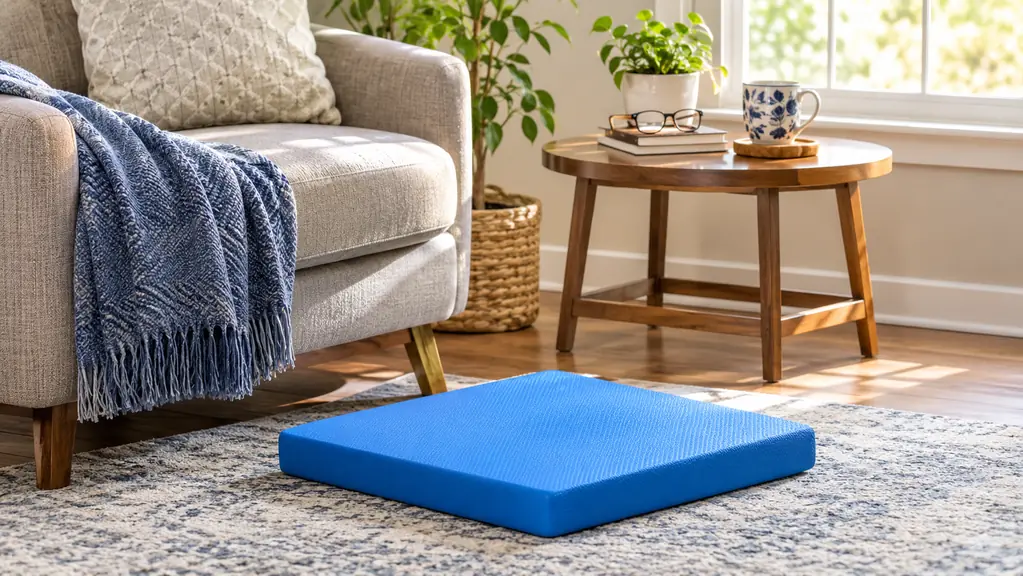
Standing on one leg while you brush your teeth sounds like a party trick until the morning you reach for the sink and feel your hip wobble. I am 78, I live in a one-story ranch house in Wethersfield, Connecticut, and I have two knees that complain on stairs and a lower back that needs a few minutes to agree with me in the morning. My balance is good, but good is not a gift. It is a thing I practice. The tool I use most is a ProsourceFit balance pad, a foam pad that measures 15.5 by 12.75 by 2.25 inches. It lives beside my armchair, and I stand on it for a few minutes every morning after coffee.
Before the pad, I tried the usual things. I stood on one foot at the kitchen sink and counted. I walked heel to toe down the hallway. I held the counter and shifted my weight from side to side. Those are fine starts, and I still do them. But the floor is forgiving. It gives you nothing to push against and nothing to correct. The pad is different. It is an unstable surface, which is the polite way of saying it makes your ankles and hips have a conversation they would rather avoid. That conversation is the point. A stable floor lets you coast. The pad asks for small corrections, and small corrections are what keep you upright when the world does not go as planned.
The pad I keep beside the armchair, not in the garage
The ProsourceFit balance pad is 15.5 by 12.75 by 2.25 inches, weighs 12 ounces, and is made of TPE that the listing calls sweat-proof and slip-resistant. I keep mine on the carpet beside my reading chair so I have no excuse to skip it.
Amazon Check Today's Price on Amazon →Before you step on anything, have the talk with your doctor or physical therapist. I am not giving medical advice and I will not pretend this pad is a treatment. Tell them you plan to practice standing balance at home, ask what to watch for, and ask whether a foam surface is appropriate for your feet, knees, and hips. Then clear a space. I use the living room carpet and keep a sturdy armchair at my right hand. I also keep a counter within reach in the garage. No pets, no toys on the floor, no phone in my hand. Bare feet work best for me. If your feet are cold, wear a thin sock with a grip sole, not a loose slipper.
Step 1: Set the Pad Where You Will Actually Use It
Put the pad where you will walk past it in your socks or bare feet. For me that is the living room, between the coffee table and the armchair I have owned since the Clinton administration. The carpet there is low-pile. The pad does not slide when I step on it, but I still press it with my hand the first time each week. If you have bare hardwood, test it before you trust it. A pad that slides is worse than no pad at all.
The pad is 15.5 inches long, 12.75 inches wide, and 2.25 inches thick. That is big enough for both feet with a little room to spare and small enough to tuck beside a chair. I do not leave it in the middle of the floor. Dot would trip on it, and I would hear about it. I store it upright against the side table and set it down when I am ready. The whole setup takes five seconds, which matters. If a routine takes five minutes to arrange, I will skip it.
Keep a sturdy chair or counter within reach of your right hand. Not a folding chair, not a rolling stool, not the edge of a sofa. Something that will not move when you lean on it. I use the armchair in the living room and the workbench in the garage. The workbench is a better height for me when I practice one-legged standing, but the living room is where I actually am in the morning. Pick the room you use. The best equipment is the equipment you do not have to go find.
Step 2: Stand With Both Feet and Find Your Center
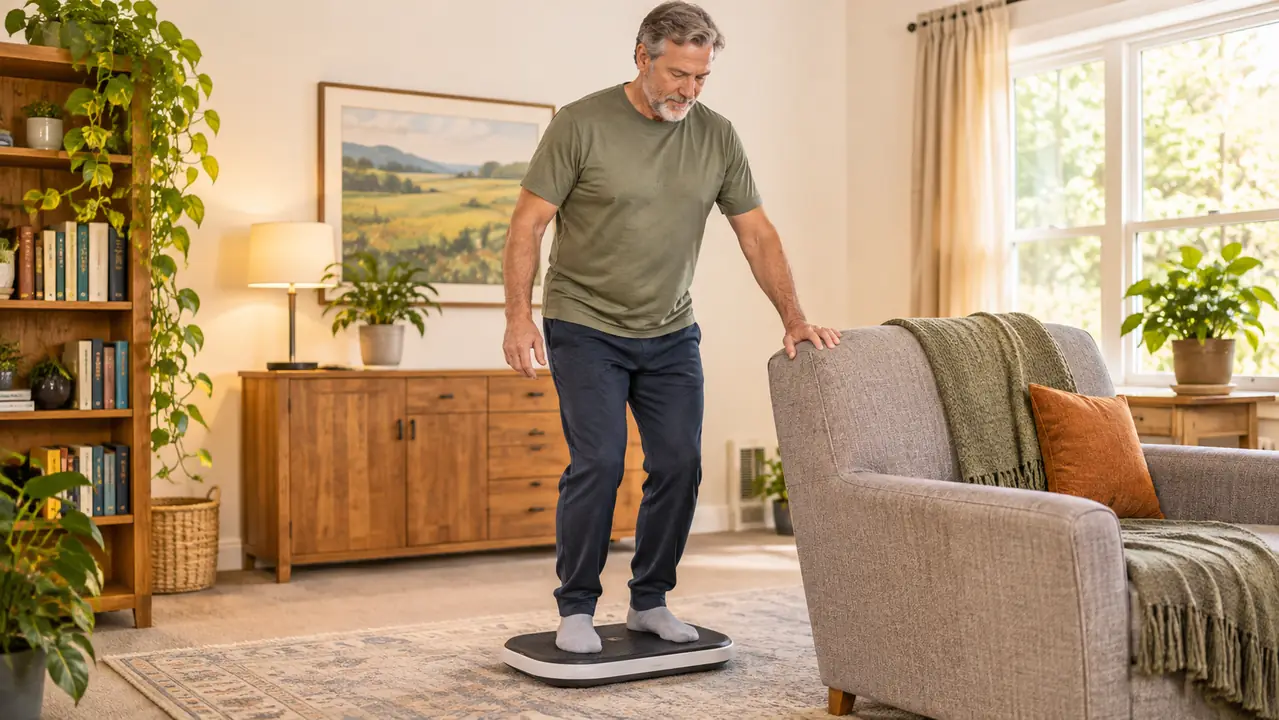
Stand with both feet on the pad, about shoulder width apart. Let your arms hang. Put one hand on the chair back if you need it. I needed two hands for the first two weeks. The pad will give a little under your weight. That is normal. Do not lock your knees. Do not hold your breath. Let the foam settle and feel where your weight lands. For me it lands too far forward when I am rushed and too far back when I am tired. Finding that out is the first bit of progress.
Now find your center. Feel the pressure under your big toe, your little toe, and your heel. Rock slowly from one to the other, then come back to the middle. Stand there for 30 seconds. That is the whole set. I use the clock on the stove, not a phone, because a phone in my hand turns a balance exercise into a reading session. If 30 seconds feels like a long time, good. It should. You are asking your ankles and hips to do a small job they have been delegating to the floor for years.
Do not fight the wobble. If the pad tips you a little to the left, let your ankle correct it. If you feel like you are tipping far enough that you need to grab, grab the chair back and step off. There is no prize for staying on until you fall. The ProsourceFit pad is a training tool, not a test. I learned more from stepping off after 20 shaky seconds than from white-knuckling my way to a minute and feeling sore the next day.
Step 3: Add Small Movements Before You Add Time
Once 30 seconds with both feet feels boring, add movement before you add time. Keep both feet on the pad and turn your head slowly to the right, then to the left. Five times each way. Then look up at the ceiling and down at your feet. Then reach your free hand toward the counter, not to grab it, just to reach. Each movement changes where your weight sits, and your body has to catch up. That is the work.
Dot counts beside me sometimes. She stands on the floor and does the same head turns. We look like two old people watching a slow tennis match in our own living room, which is exactly what we are. The counting helps because it keeps me from rushing. Slow is the point. If I turn my head fast, I can feel my hip lag behind. If I turn it slowly, I can feel the correction happen. Slow gives you information.
Keep your eyes open. I know some routines ask you to close them. I do not, and I would not start without a physical therapist in the room. Closing your eyes takes away the sense you are using to stay upright, and at 78 I want more information, not less. If you feel dizzy at any point, stop and sit down. Dizziness is not a challenge to push through. It is a message.
Step 4: Progress to One-Legged Standing at the Counter
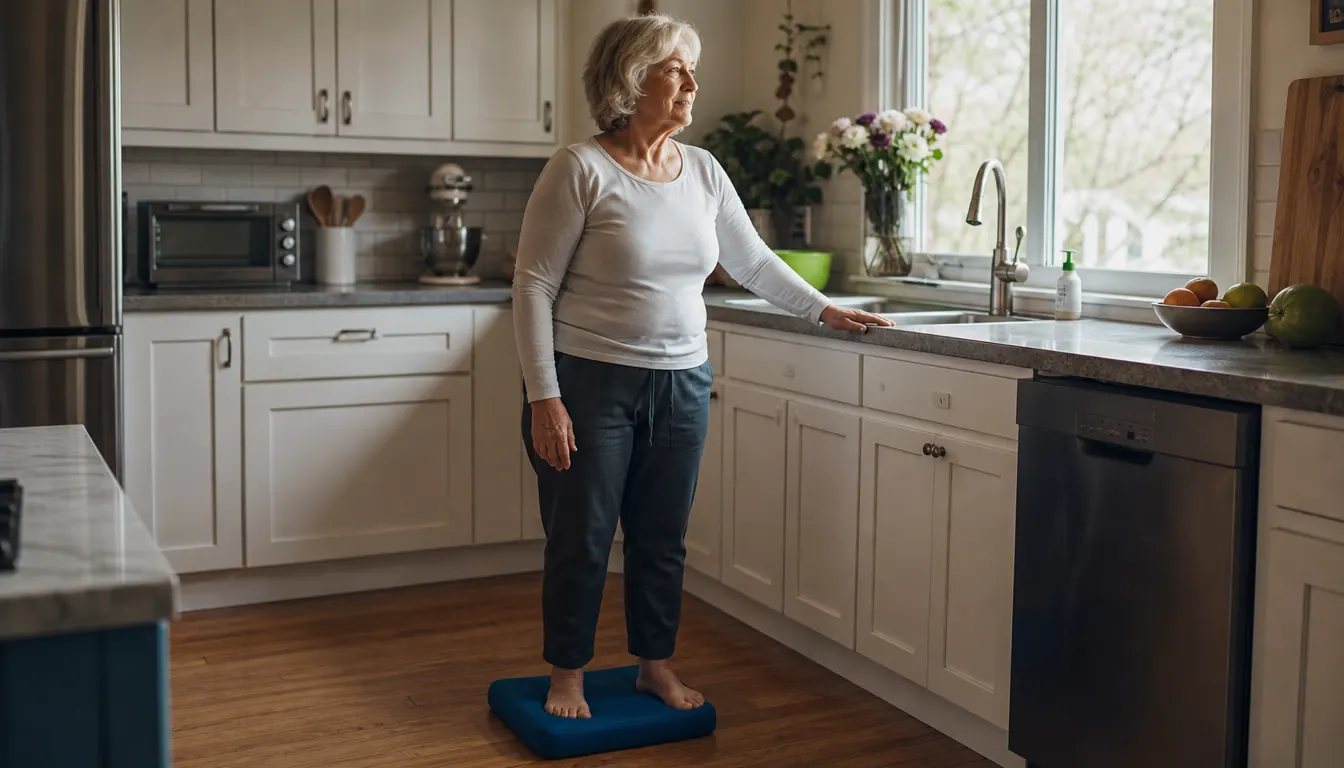
When both feet and the head turns feel steady, try one foot on the pad and the other foot hovering just off the edge. Keep one hand on the counter or chair back. Start with 10 seconds. Switch sides. The ProsourceFit pad makes this harder than the floor because the surface gives. That is the reason to use it. You are not adding difficulty for the sake of difficulty. You are asking your standing leg to do the work it would do if you stepped off a curb or reached for a can on a high shelf.
The 2.25 inch height matters here. It is enough to feel like a small step and not so high that you have to climb onto it. I set the pad beside the garage workbench for this drill because the workbench is the right height for my hand. The living room armchair works too, but the counter gives me a straighter line to hold. Use what you have. A kitchen counter and a stable chair are enough.
Keep your eyes on a spot on the wall. Pick something that does not move, like a light switch or a picture frame. Ten seconds on each side is a good start. If you cannot do 10 seconds without grabbing, go back to both feet for a week. That is not failure. That is calibration. I spent three weeks on both feet before I tried one. My left knee is the noisy one, and it needed the extra time. Yours may not. Listen to it.
Step 5: Make It a Daily Habit and Track What Changes
Make the pad part of a routine you already have. I do it after coffee, before I read the paper. Five to eight minutes is plenty. My whole morning movement session is about 20 minutes, and the pad is one slice of it. The rest is walking, chair squats, and a few heel raises at the counter. If you try to do 30 minutes on the pad, you will hate it and quit. Small and daily beats long and occasional. That is true for coffee, and it is true for balance.
Keep a simple record. A calendar on the refrigerator is enough. I write B for both feet, M for movements, and O for one-legged. I also write the seconds, like 30 or 45. Once a week I look back. The record is not for your doctor, though you can bring it. It is for you. Progress in balance is slow and quiet. Without a record, you will forget that 30 seconds used to feel like a long time.
What changes is not a circus trick. You catch yourself on the stair without grabbing the rail. You stand up from the armchair without pushing off. You put on your pants standing up, which I could not do two years ago without a wall nearby. Dot noticed she could stand at the stove longer before her back complained. Those are the wins. The pad did not do that by itself. The daily practice did. The pad just made the practice honest.
What Else Helps
Walking is still the best thing I do for my balance. Dot and I walk after lunch, weather permitting, and we take the long way around the block when the sidewalks are clear. Chair squats help too. Stand up from a sturdy chair without using your hands, five times, then rest. Heel raises at the kitchen counter, ten at a time. Standing on one foot at the sink while you rinse a dish. None of this requires equipment. The ProsourceFit pad is one tool in a small kit, not the whole kit.
If you want more challenge later, a balance board is the next step up, but it is a bigger step than it looks. I have compared the two, and the short version is that the pad is more forgiving for older joints. The board moves under you in a way the pad does not. Start with the pad. Stay with the pad for a few months. If you get bored, add time or add head turns before you add hardware. Boredom is a good sign. It means the basic drill has become easy enough to be useful.
The pad does not make you steady. It makes you pay attention, and paying attention is the whole exercise.
Start where your hand can find the chair
The ProsourceFit balance pad is 15.5 by 12.75 by 2.25 inches, weighs 12 ounces, and comes with a limited lifetime warranty. The listing puts the maximum weight recommendation at 340 kg. Mine lives beside the armchair. That is the whole setup.
Amazon Check Today's Price on Amazon →