
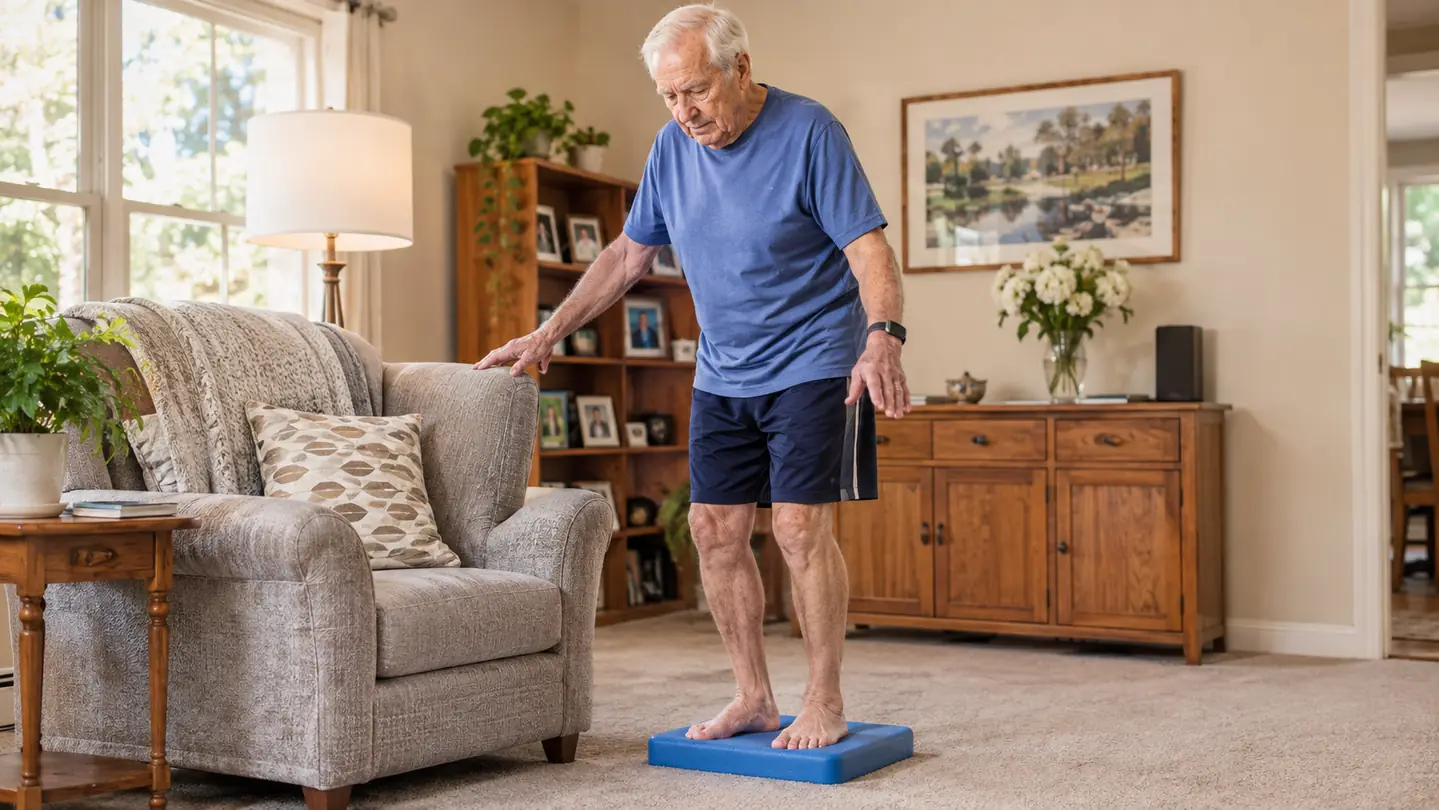
I have a simple test for any piece of home exercise gear, and it is not a kind test. I ask whether I will still be using it in February. Most things fail. A set of resistance bands with a door anchor failed. A folding step failed. A foam roller lasted eleven days before it slid under the sofa and stayed there. So when the ProsourceFit balance pad arrived and I could pick it up with two fingers, I filed it under probably not. Twelve ounces, the listing says. I own coffee mugs heavier than that.
I was wrong, and I want to be specific about the wrongness, because foam is easy to overpraise and easier to dismiss. The ProsourceFit Exercise Balance Pad is a slab of TPE foam, 15.5 inches long, 12.75 inches wide and 2.25 inches thick. It does two jobs well, and it does them in a way a 78-year-old body notices on the first morning. That is the review in one breath. The useful part is in the details, so here are the details, including the ones that made me put it in the corner for a week.
The Quick Verdict
A genuinely useful two-job tool: unstable enough to make your ankles work, thick enough to save your knees on the floor. Not a balance cure, and not built for plush carpet or wide stances.
Amazon Check Today's Price →The One Piece of Balance Gear That Never Made It to the Garage Shelf
15.5 by 12.75 inches, 2.25 inches of TPE foam, 12 ounces. It lives next to my armchair and it gets stepped on every single morning.
Amazon Check Today's Price on Amazon →What Nobody Tells You About Standing on Foam
The pitch for a balance pad is that it improves your balance. That is technically true and practically useless as a description, because it does not tell you what the first week actually feels like. Here is what it feels like. You step on with both feet and your ankles begin making small corrections you did not ask them to make. Your toes grip. Your hips shift a quarter inch. Nothing dramatic happens. But your body is suddenly having a conversation it was not having on the carpet.
That conversation is the product. The foam compresses unevenly under your weight, so no two seconds are identical, and your feet, ankles and hips spend the whole time quietly adjusting. Carpet has already agreed with you. The pad is negotiating.
Now the part the listing does not say and I think it should. The pad is soft enough that you will trust it before you have earned that trust. My first morning I stepped on with both feet and thought, well, this is nothing at all. By the fourth morning I tried a single leg stand and lasted about six seconds before I put my foot back down and laughed at myself. Six seconds. I have been walking on these legs for seven decades and I could not hold one of them off the floor for six seconds on a two-inch piece of foam.
That is not a complaint about the pad. That is the pad doing its job. But nobody tells you the difficulty arrives faster than you expect, and if you are 65 or older and you live alone, that difference matters. You want the armchair within reach for the first dozen sessions. I am not being cautious for the sake of appearances. I am being accurate about what happened in my living room.
The other thing nobody mentions is that the softness cuts both ways. Because the foam gives, it forgives a sloppy landing. That is good for stiff knees. It also means you can be sloppy for weeks without noticing, standing with your weight in the wrong place, and still feel like you are doing the work. I fixed that by slowing down and paying attention to where my weight sat on each foot. The pad did not fix it. My attention did.
How I Have Used It, and Where
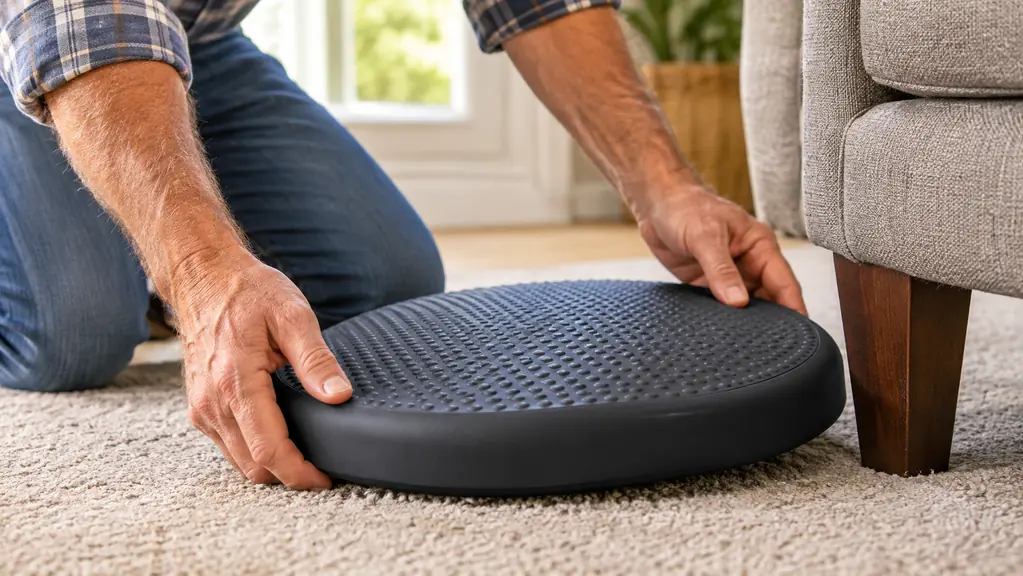
My routine runs about twenty minutes every morning after coffee. Dot walks with me most afternoons, but the morning work is mine and it happens in the living room on low pile carpet, next to a sturdy armchair I have owned since the Clinton administration. The balance pad lives on the floor beside that chair. It has not moved to the garage shelf, which for my money is the highest compliment home gear can receive.
The standing work is plain. Both feet, about shoulder width, two minutes while the coffee finishes brewing. Then a single leg stand holding the chair back with two fingers, then one finger, then trying to let go entirely. Then the same thing with my eyes closed, which is a different animal altogether and I do not recommend starting there. Standing with your eyes closed on foam will teach you humility in a hurry.
The kneeling work happens in the garage corner, where I keep a small mat and do a few floor exercises for my lower back. Two knees that complain on stairs and in cold weather do not enjoy kneeling on concrete, and the garage floor is concrete. The pad is 2.25 inches thick, which is the difference between a set of floor exercises I will do and a set I will skip. I put it under my knees, do the work, and stand up. That is the least glamorous use of the product and it is the one I would replace first if it ever wore out.
I have also parked it on the seat of a kitchen chair on mornings when my back is stiff, which is not what it is for, which works fine, and which I mention only because somebody reading this is going to try it anyway. It has held its shape through all of that. No flattening in the middle, no cracking at the edges, no smell after the first few days. A faint new-foam smell hung around for about a week and then it was gone.
The Two and a Quarter Inches Are the Whole Story
You can buy a balance pad that is half an inch thick and you can buy one that is considerably thicker. The ProsourceFit pad sits at 2.25 inches, and that number is doing more work than any other figure on the page. Too thin and the foam barely compresses, so you get almost no instability and you might as well stand on a folded towel. Too thick and the wobble gets genuinely risky for an older body with stiff ankles.
At 2.25 inches I can feel the surface give under my heel without ever feeling like I am standing on a mattress. The edges are rounded, and that is worth knowing before you buy. Rounded edges mean foot placement matters more than you would guess on the first few tries. Get a foot half off the edge and the pad tilts and you will notice immediately. It is not dangerous. It is just not the place to be careless.
The material is TPE, thermoplastic elastomer, which the listing describes as sweat proof and slip resistant. My morning work is not the kind of workout that produces a heavy sweat, so I cannot speak to that end of it. I can tell you it has not slid on low pile carpet whether I am barefoot or in socks, and it has not slid on the concrete in the garage either. It does collect lint and dust, because anything with grip collects lint and dust. A damp cloth handles it in five seconds.
The size is 15.5 by 12.75 inches. That is wide enough for a shoulder width stance and, to my surprise, wide enough for both knees side by side, and I am not a small man. It is not wide enough for a long split stance. Put your back foot into a stride and it will be on the carpet, not on the pad. If split squats are your main interest, plan around that.
What It Will Not Do
A balance pad is not a balance cure. If your balance has gotten worse over the last year, a piece of foam is not going to reverse that, and anyone who tells you otherwise is selling something. What the pad does is give you a place to practice, in your own living room, in socks, for four minutes, without driving anywhere. Practice is the thing that helps. The pad is only the venue.
It will not replace a physical therapist, and I would be doing you a disservice to hint that it could. If you have had a fall, or numbness in your feet, or you get dizzy when you stand up, talk to your doctor or your physical therapist before you stand on anything unstable, this included. That is not a line I am tacking onto the end. It is the most useful sentence in this article.
It also does not work well on thick plush carpet. My living room is a low pile and the pad sits on it fine. In the bedroom, where Dot picked out something that feels like a bath mat, the pad goes soft underneath and the whole effect changes. Hard floor or low pile is where this thing makes sense. That is a limitation of the surface, not of the pad, but you are the one who has to live with it.
And it will not give you progression. It is one density, one thickness, one setting. Once your body adapts, and mine took about five weeks, the pad stops being challenging in the same way. You can add difficulty by narrowing your stance, closing your eyes, or standing on one leg. The pad itself has nothing more to offer. That is worth knowing before you expect it to carry you for a year.
The pad is 2.25 inches thick, and that is the difference between a set of floor exercises I will do and a set I will skip. Half the reason I still own it has nothing to do with balance.
The Small Things That Decide Whether You Keep It
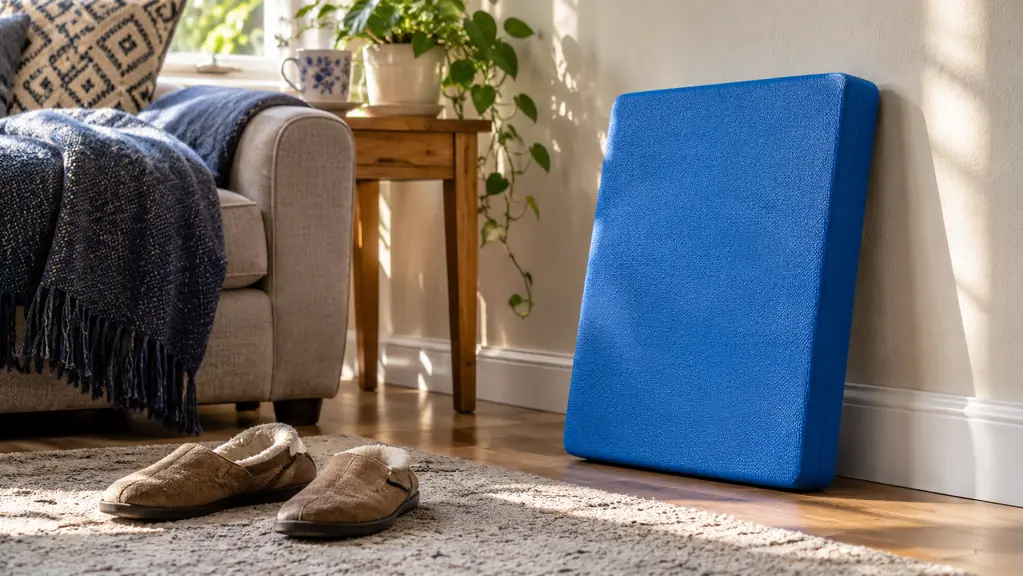
Twelve ounces. That number matters more than it sounds like it should. Gear that weighs nothing is gear you will actually move. I carry the pad from the living room to the garage corner and back without thinking about it, which means it gets used in both places instead of living in one spot and being forgotten. Anything I have to unclip, unfold or assemble gets left where it sits.
The warranty is listed as a limited lifetime warranty, which for a slab of foam is a strange and pleasant thing to read. I have no idea how a claim on foam would actually go and I hope not to find out. What I can report is a few months of daily use with the pad still flat, still grippy, and still doing what it did in week one.
Cleaning is a damp cloth and let it dry. That is the entire maintenance routine. If you are the sort of person who wants equipment that requires nothing from you, this is that equipment.
What I Liked
- 2.25 inches is enough instability to be useful without feeling precarious for stiff ankles
- Doubles as a knee pad, which is why mine gets used on the garage floor every week
- 12 ounces and no setup, so it actually moves between rooms instead of being forgotten
- Grippy on low pile carpet and on concrete, barefoot or in socks
- Has not cracked, flattened or compressed in the middle after months of daily standing
Where It Falls Short
- One density, so there is no way to make it harder once your body adapts
- Rounded edges punish careless foot placement for the first week or two
- Goes soft and loses its effect on thick plush carpet
- Too small for a long split stance or a wide stance
- Picks up lint and dust and needs a wipe down more often than you would guess
Who This Is For
This is for the person who wants to work on balance at home, in bare feet or socks, for a few minutes a day, without a gym membership or a machine that needs assembling. It is for someone who has a sturdy chair or a kitchen counter within arm's reach and a floor that is not wall to wall shag. If that describes your living room, this pad will earn its place beside the chair.
It is also for anyone whose knees object to kneeling on a hard floor. That second group is bigger than the marketing suggests. Half the reason I still have this pad is not balance at all. It is that a set of floor exercises stopped being something I dread and became something I just do, because there is 2.25 inches of foam between my kneecaps and the concrete.
Who Should Skip It
Skip it if you have had a recent fall, if your doctor has told you to avoid unstable surfaces, or if you cannot get down to the floor and back up without help. Skip it if your balance trouble comes with dizziness, because dizziness is a different problem and foam will not help you solve it. Ask first. I mean that plainly.
Skip it if you are already comfortable standing on one leg with your eyes closed and you want a real challenge. You want a rocker board or a wobble board, not a pad. And skip it if you were hoping this would be the thing that fixes your balance on its own. It is a surface. You are the one doing the work, and the work is the part that counts.
What I Would Tell You at My Kitchen Table
I would tell you to put the pad next to a chair you trust, take your shoes off, and stand on it for two minutes while the coffee brews. That is the whole beginning. Do not start with one leg. Do not start with your eyes closed. Give it a week of plain two-minute stands before you ask anything more of your ankles, because the difficulty will arrive on its own schedule and it arrives faster than you think.
I would tell you that the reason the ProsourceFit pad stays in my living room is not that it is impressive. It is that it is easy. Easy is what survives February, and February is where most home exercise gear goes to die.
And I would tell you the thing I tell myself on the mornings when standing on foam feels a little silly. The small corrections your ankles make on a soft surface are the same corrections that keep you upright when the sidewalk shifts under you in the dark. You are not training for the pad. You are training for the driveway.
Check with your doctor or your physical therapist before you start, especially if you have had a fall or you have trouble feeling your feet. I am a retired shop teacher with two complaining knees and a stiff back in the mornings. I am not a medical professional, and I would much rather you ask than guess.
Two Minutes a Morning, Beside a Chair You Trust
The ProsourceFit balance pad is 2.25 inches of TPE foam that has not left my living room floor since the day it arrived. Start with both feet and a week of patience.
Amazon Check Today's Price on Amazon →