

Five flat rubber bands in a little cloth bag. That was my honest first thought when the Fit Simplify loop band set arrived at the house, and I want to start there because most write-ups about these things skip straight to the praise. I am 78 years old. My knees complain on the stairs and in cold weather, my lower back is stiff for the first hour of every morning, and my balance is something I work at rather than something I take for granted. I did not need a gym membership. I needed a few small tools I could keep in the living room and reach for after coffee. These bands became one of them, though not quite in the way the packaging promises.
The short version is this. I use the Fit Simplify bands almost every morning now, about twenty minutes on the carpet beside my armchair, and I would buy them again. There are also three things I wish someone had told me before I opened the bag, and one of them is a genuine safety matter for a person my age. That is the rest of this article. If you want the summary and nothing else: they are well made, they are useful, and they are not the complete kit the product page implies.
The Quick Verdict
Five latex loop bands that do the small daily work well, as long as you understand you are buying a bag of bands rather than a program, and you check each one for nicks before you pull.
Amazon Check Today's Price →The Set That Lives Beside My Armchair
Five resistance levels, a carry bag, and an illustrated booklet. If your version of daily movement is small, indoors, and on your own schedule, this is a reasonable place to start.
Amazon Check Today's Price on Amazon →How I Actually Use Them, Day to Day
My routine is not impressive and that is on purpose. After coffee I spend about twenty minutes in the living room. The carpet is not plush, which matters more than you would think, because a band on a slick floor creeps and a band on carpet stays where you put it. I have a sturdy armchair that serves as an anchor and also as something to grab if I lose my balance. Then a short walk after lunch with my wife Dot, weather permitting, and a few quiet minutes of breathing before bed. The bands belong to the first part of that day, not the walk.
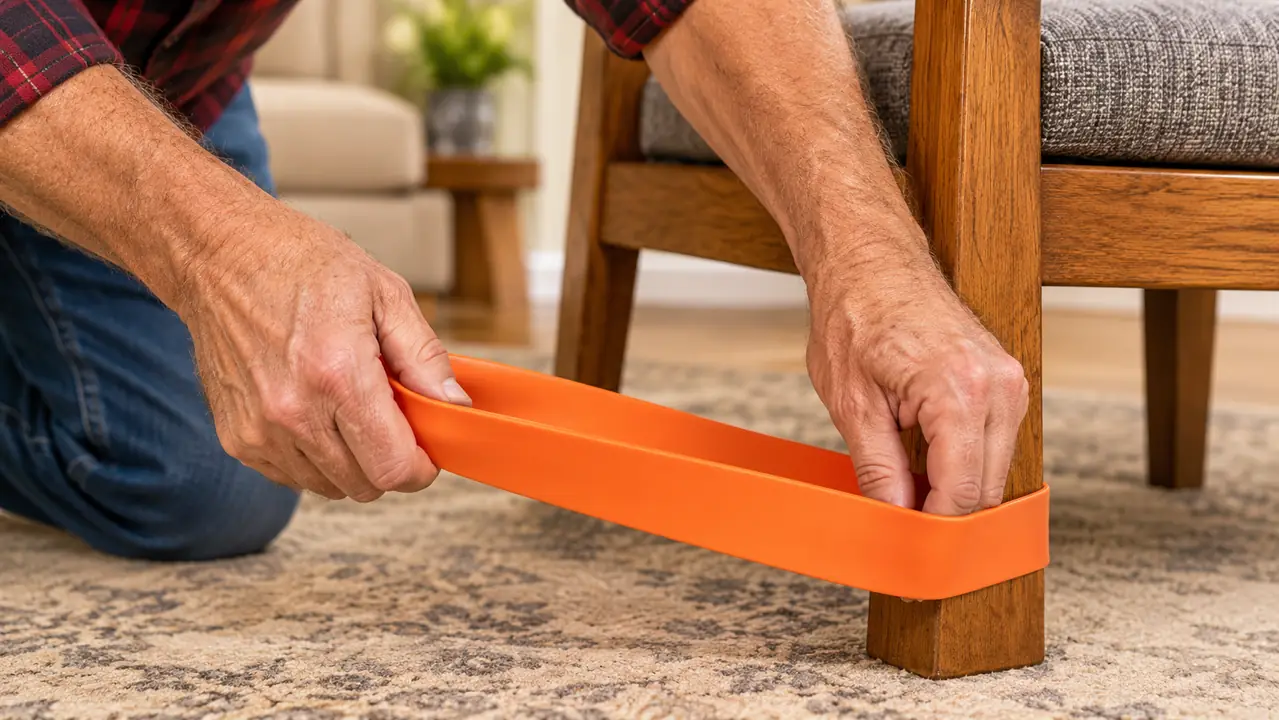
The exercises I do are the plain ones. Band around the thighs and a slow sit back to the chair. Band around the ankles and a few steps sideways along the length of the living room. Band in both hands and a slow pull apart at chest height. Band looped around the chair leg and a gentle row. Nothing that requires a demonstration. Nothing where I have to get down on the floor, because getting down is fine and getting up is the part I plan around.
My living room is nineteen feet from the front window to the hallway, and I know that because I paced it off with a tape measure the first week, wanting to know how far a set of sideways steps actually went. Eight steps one way, turn, eight steps back. That is the whole course. It sounds like nothing written down, and it is nothing, which is exactly why I could keep doing it in February when the driveway was ice and the walk after lunch was off the table.
The garage corner gets used on the days I do not want to be in the house. There is concrete out there, which is actually better for the standing work because nothing slides, and a door frame I trust for the band. I keep a second chair out there. It is not a gym. It is a corner with a chair in it, and that has been enough.
The set comes with a small illustrated booklet, and I read it. Some of the drawings are aimed at a younger person than me, and a few of the positions I looked at and thought, no. That is not a fault of the booklet. It is a reminder that a printed guide does not know your knees. I took the four or five movements that felt reasonable and I have stayed with those. Before I started, I checked with my doctor about what was sensible for me, and I would say the same to you without hesitation.
What the Five Levels Really Feel Like
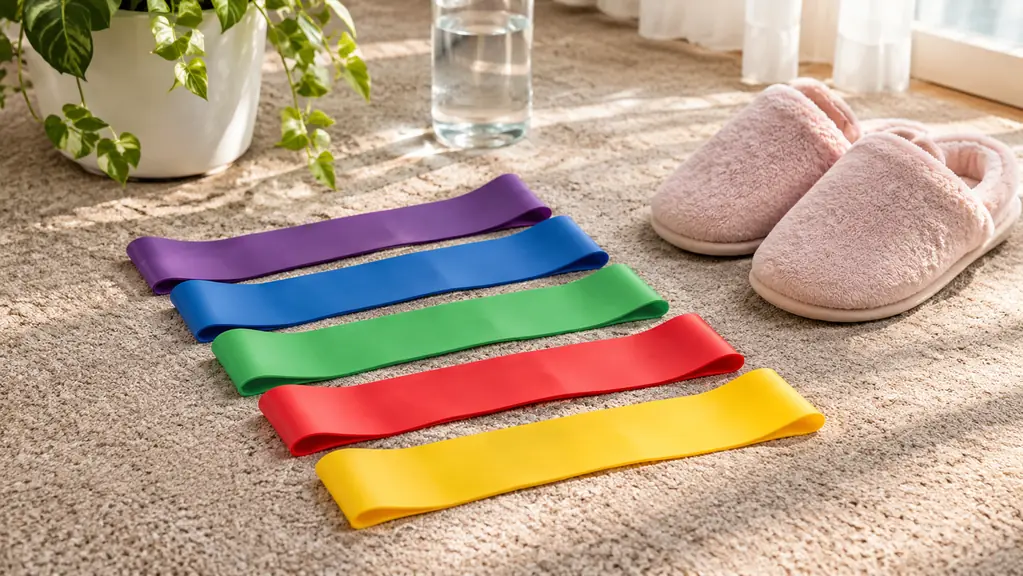
There are five bands and they are labeled by resistance, from extra light up through the heavier ones. The two lightest are the ones I reach for most, and honestly they are the ones worth the purchase on their own. Extra light is almost nothing in your hands, which is exactly what you want for shoulder work and ankle work and for the first weeks when your joints are deciding whether they trust you. Light is my everyday band. I use it for the sideways steps and for the seated work.
The heavier bands are where I part company with the enthusiasm of the product page. The jump from one level to the next is not even. There are gaps in the progression that a younger person with more strength would not notice and that I noticed immediately. The heaviest band in the set is more resistance than I can use well, so it lives in the garage and gets used for one thing only, which is sitting in a drawer looking expensive. I am not sorry I have it. I am saying do not buy this set expecting a smooth ladder from easy to hard, because it is closer to a staircase with two tall steps in the middle.
I found that out the hard way on a Tuesday morning in March. I had been using the light band for the seated row for a couple of weeks and decided I was ready to move up. I got the middle band around the chair leg, sat down, pulled once, and felt my lower back answer back in a way I did not care for. Nothing tore. Nothing swelled. But I put that band away, went back to the light one, and stayed there for another month, and I am glad I did.
For someone at my stage, that unevenness is a minor annoyance rather than a deal breaker, because the two light bands cover most of what I do. For somebody coming back from a long layoff or working a shoulder back to health under a therapist's instructions, my guess is that the lightest band will be the one that matters and the other four will wait in the bag.
The two lightest bands are worth the whole set. The heaviest three are for somebody younger than me, and I have made my peace with that.
The Three Things Nobody Tells You
First, flat loop bands roll. Not always, and not dramatically, but when you are standing on one end and pulling, the band has a habit of curling into a tube and finding the soft part of your leg on the way back. It stings. It has happened to me twice, both times with bare legs, and both times I said a word Dot pretended not to hear. Long trousers or a pair of light sweatpants solve it. So does checking that the band is lying flat before you pull.
Second, they are latex. That detail is in the product specifications and it is easy to skim past. If you have ever had a reaction to latex gloves or a latex mattress topper, these are the wrong bands for you and no amount of clever anchoring fixes it. There is also a rubber smell when the bag is first opened. It fades over a couple of weeks and it is not unpleasant exactly, just present, like a new bicycle inner tube.
Third, and this is the one that matters most, loop bands wear out. They are not a piece of furniture you buy once. Latex picks up nicks. It gets cloudy patches where it has been stretched a thousand times. A band with a nick in it will eventually let go, and when a band lets go under tension it comes back at you quickly. I check mine before every session now, holding each one up to the window and running it through my hands, and I retire any band with a cut or a rough spot. I have retired one so far, the light one, after about five months of near daily use. That is not a complaint about the quality so much as a fact about what these are made of.
It went in the kitchen trash on a Saturday. I had held it up to the window that morning and seen a pale line about an inch long near one end, the kind of place where the band had been catching on the corner of the chair leg every time I looped it. I had been looping it over that same corner for months without thinking about it. Now I alternate corners and I check the ends first, because the ends are where mine have gone.
The Grip Problem, and How I Work Around It
My hands are not what they were. Holding a flat band and pulling it apart means the band has to stay put between your thumb and fingers, and when your grip is ordinary rather than strong, it slips. The first week I kept losing the band mid pull, which is not dangerous, just irritating, and it makes slow controlled movement hard when the thing keeps creeping.
What fixed it for me was anchoring rather than gripping. Around the chair leg, around the door frame out in the garage, looped over the sturdy arm of the chair, the band does the holding and I do the pulling. For the chest pulls, I wrap the band once around each hand so it has something to bite on. A folded hand towel around the band helps too if your palms are dry like mine. None of that is in the booklet. It is the sort of thing you work out in your own living room, and I would rather tell you now than have you discover it halfway through a set.
Before I got there I tried a pair of gardening gloves with the rubber palms. They worked, in the sense that the band stopped slipping, but my hands got hot inside ten minutes and I felt ridiculous standing in my own living room in gloves. The towel was better. The anchoring was better still.
The other adjustment is placement. The bands live over the arm of the chair, not folded in the bag in a drawer. If it takes two minutes to get the equipment out, I will not get the equipment out. Five bands in plain sight where I have to look at them while I drink my coffee is the entire trick, and the little carry bag is better suited to a suitcase than to a daily habit.
What Changed, in Plain Terms
I want to be careful here, because I am 78 and I am not going to tell you that a bag of rubber bands changed my life. What I can tell you is what I notice. Standing up out of the armchair is a little smoother than it was. The sideways steps with the band around my ankles have made the walk down the hallway feel more planted, and that matters to me because falling is the thing I think about. My knees still complain on stairs. That has not changed and I did not expect it to.
Dot walks with me most afternoons and she says I get out of the chair differently than I did in the spring, less like a man unfolding a map. That is a small compliment from somebody who has watched me do it for fifty years, and I will take it. It is also the entire size of the claim I am making. The bands make a small daily improvement possible. They do not rebuild a knee.
There is one more test I use, and it is the hallway. I walk it without thinking about it and count the steps where I used to touch the wall. Back in the winter it was four touches between the living room and the kitchen. It is two now, and on a good morning one. A physical therapist would laugh at that as a measure, and I know it is not a study. It is just the number I happen to have, and it is the number that gets me out of the chair on a morning I would rather not.
The honest summary is that the bands let me do a little more than nothing, in my own living room, in the time it takes to drink a cup of coffee. If you are looking for something that will repair your joints, no set of bands will do that and nobody should tell you otherwise. If you are looking for something small and steady you can do every day without leaving the house, these are a reasonable place to start, with your doctor's blessing and your physical therapist's instructions if you have one.
What I Liked
- Two genuinely gentle levels that work for stiff shoulders and ankles
- Flat loop design anchors around a chair leg or door frame, so a weak grip is not a barrier
- The whole set weighs about three and a half ounces and fits in the cloth bag, so it can live in a living room instead of a closet
- The illustrated booklet gives you a starting point rather than a blank page
- The latex held up to near daily use, with one band retired in five months
Where It Falls Short
- The jumps between resistance levels are uneven, with the biggest gaps in the heavier bands
- Flat bands roll and snap against bare legs when they are not lying flat
- Latex, which rules them out completely if you have a sensitivity
- They wear out, so checking for nicks before every session is not optional
- No anchor strap in the bag, so you improvise with furniture
Who This Is For
This is for the person who wants ten or twenty minutes of movement at home and does not want a rack of equipment in the spare room. It suits somebody with stiff mornings, a shoulder that needs gentle work, or knees that prefer small controlled movement to a walk in the cold. It suits anyone who has been told by a doctor or a therapist to keep moving and needs something to keep moving with. It suits the person who, like me, will actually do it if the equipment is already on the floor and will not do it if it is filed away. The Fit Simplify set is small, quiet, and unglamorous, which is what a daily habit needs to be.
Who Should Skip It
Skip it if you have a latex sensitivity, full stop. Skip it if you want a smooth progression of resistance from very easy to very hard, because this set has gaps in it. Skip it if you need a system with an anchor and a printed program, because you will be improvising and you should know that going in. And skip it if you are looking for a repair rather than a habit. A band does not fix a knee. If your doctor has given you specific instructions, follow those and not a review from a retired shop teacher in Connecticut. If you are in physical therapy, your therapist's guidance beats anything on this page.
Five Bands, One Armchair, Twenty Minutes
This is the set on my living room floor. If your version of daily movement is small and at home, it will get you started. Check with your doctor first, then start where you can start.
Amazon Check Today's Price on Amazon →