
My knees started complaining on the stairs sometime around my seventy-third birthday, and my first instinct was the same as most men my age: ignore it and hope it goes away. It did not go away. It got quieter in the summer and louder in the cold, until I found myself planning the day around which staircase I could avoid. A friend who had been through physical therapy for the same complaint told me the worst thing I could do was stop moving. So I did not join a gym. I bought a pair of adjustable ankle weights and started using them on the living room carpet, twenty minutes after my morning coffee.
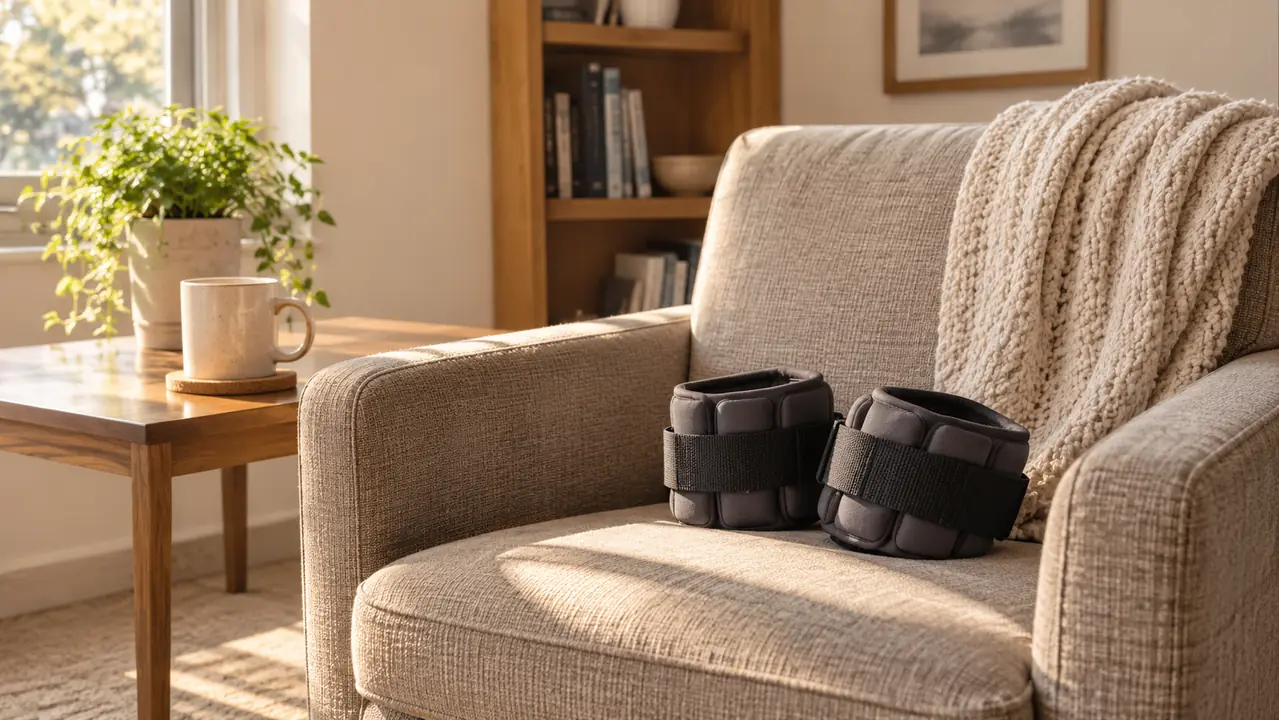
The pair I use is the Sportneer adjustable ankle weights. Each single weight adjusts from one pound to five, which means a pair runs from two pounds to ten. That adjustability is the entire reason this works for a body my age. You do not start at five. You start at one, maybe two, and you stay there until your legs tell you they are bored. Before I go further: I am not a doctor and I am not a physical therapist. I am a retired shop teacher with two complaining knees and a stiff lower back in the mornings. Talk to your doctor or your PT before you start anything new, especially if you have had a fall, a replacement, or a diagnosis with a name.
The pair that lets you start at one pound per leg instead of five
Each side adjusts from 1 to 5 lbs by adding or pulling the sand packs, so you can begin lighter than a fixed-weight set will ever allow and add a pound only when the last one stops feeling like anything.
Amazon Check Today's Price on Amazon →Step 1: Get cleared, then find your honest starting point
Before I strapped anything to my ankles, I sat down with my doctor and asked one question: is there any reason I should not add resistance to my legs? For me the answer was no, with the usual caveat about stopping if anything sharp shows up. For you it might be different, and that is fine. Fifteen minutes of conversation is cheap next to a setback that costs you a season.
Then I did an honest inventory in my own living room. I sat in the armchair, straightened one leg out in front of me, and held it there while I counted to ten. It shook somewhere around seven. That told me more than any chart could: my legs were strong enough to carry me around the house and not much more. So I started at one pound on each ankle, which for the first week felt like strapping on a pair of socks.
Your starting point might be two pounds. It might be no weight at all for two weeks while you learn the movement. Both are correct. The wrong answer is the one I hear from men my age at the diner, which is starting at ten because it seemed like a reasonable number.
Step 2: Fit the straps properly before you ever add weight
The Sportneer pair is built to fit an ankle between 7.5 and 12.5 inches around, and it closes with hook and loop straps. That matters more than it sounds. Straps I can manage with hands that have some arthritis in them. Buckles and laces I cannot, especially first thing in the morning before the coffee lands.
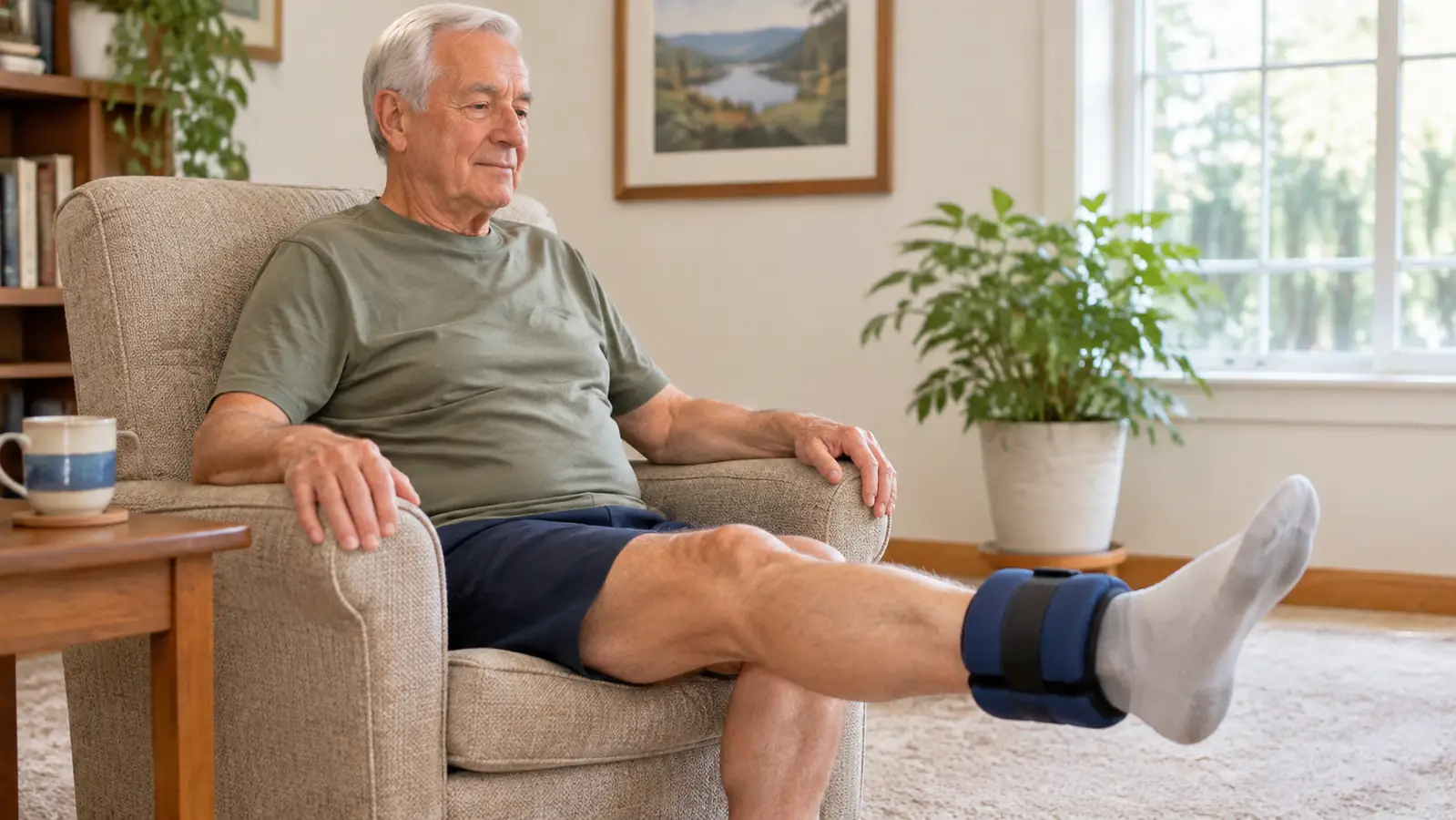
On the first morning I tried this, I did it standing up in the kitchen with the strap half fastened, one hand on nothing, and I got the weight onto my left ankle and immediately felt the whole business slide down toward my heel. Twenty minutes of fussing later I had it right. So here is the version I would hand to a friend: sit down in a chair with arms, put the ankle across your opposite knee so it is up in front of you where you can see it, and work the strap from the outside in. On the second morning it took me forty seconds. By the end of two weeks I was doing it without looking, which matters, because a routine you have to think about is a routine that gets skipped.
Sit down to put them on. Not leaning against a wall, not balancing on one foot in the kitchen. Sit in a chair, rest the ankle on the opposite knee, and fasten the strap so the weight sits just above the ankle bone and below the calf. Snug, not tight. If you can slide two fingers under the strap, that is about right. If your toes go cold or your foot tingles, it is too tight, so loosen it and start over.
Then, and this is the part I got wrong for a month, take the sand packs out before the first session. The weights are removable, which is the whole point of the design. Each side runs from one to five pounds by adding or pulling those packs. On day one, one pack. Maybe none.
Step 3: Begin seated, where falling is not on the table
Everything in the first two weeks happens seated, because seated work takes falling out of the equation entirely. I do three movements, and I do them slow enough that it looks like I am not doing much.
Seated leg extensions: sit tall in the armchair, straighten one leg until it is level with your hip if it will go that far, hold for a two count, then lower it over three seconds. Eight to ten on each side. The slow lowering is where the work is. Anyone can fling a leg up. Seated marching: lift one knee toward your chest, set the foot down, lift the other. Twenty steps total. That one warms the hips and gets the blood moving before I do anything else.
I tried a dining chair first, and I want to save you the two weeks I spent on it. A dining chair has a straight back and a hard seat, and after the third session my lower back was complaining louder than my knees ever had. The armchair works because the seat is deep enough that my hips sit behind my knees and the arms give me something to push against when I need it. If your living room chair is low and soft, sit forward on the front half of the seat and keep both feet flat on the floor. That one change quieted the back complaint for me inside a week.
Two sets of each, three days a week, is plenty to start. If you can talk in full sentences while you do it, you are in the right range. If you are holding your breath, drop a pound or drop a set. And if your knees complain during the movement itself rather than afterward, stop and ask your PT about it, because that is a different conversation than soreness.
One pound per ankle felt like nothing for eight days. That was the plan. By week six it felt like work, and my knees had stopped arguing with me on the stairs.

Step 4: Move to standing work with something solid within arm's reach
Once the seated work feels easy two weeks running, stand up. But stand near something that will not move when you lean on it. My living room has a sturdy armchair. My garage has a workbench bolted to the wall. A kitchen counter works. A folding TV tray does not.
The first standing session I did was in the garage in November, because the garage has the workbench and I figured the hard floor would be better than carpet. It was not. Forty years of standing on concrete in a shop means my knees file a complaint about it, and doing balance work on that slab was the wrong idea. The standing work happens on carpet now, in the living room, with the armchair at my left hand. The garage corner still gets the warm-up march on a decent day, but the lifting and the balancing happen where the footing is forgiving. At my age that is not a small detail. A tile bathroom floor or a concrete slab is the wrong place to find out your hip is less reliable than you thought.
Standing leg lifts to the side: hold the counter with one hand, lift the outside leg out about a foot, hold, lower. Ten per side. Standing leg lifts behind you, the same way, keeping the motion small and the back straight rather than arched. Then march in place, lifting the knees no higher than the seated version. It takes about six minutes for the whole round.
The balance work is half of what you are getting here. The weight on your ankle makes the working leg push harder, and standing on the other leg makes everything from your foot to your hip steady itself. That steadying is the part that keeps a person upright on an icy driveway in February. Do not rush it, and do not close your eyes to make it harder. That is a young person's trick.
Step 5: Add a pound before you add a minute
Here is the rule I follow and the only one I would give anybody: add weight before you add time. When ten clean repetitions start to feel like six, add one sand pack, which is one pound per side. Drop back to eight reps and let it be hard again. Two weeks later, if it is easy, add another.
What you do not do is jump from two pounds to five because you feel good on a Tuesday. I did exactly that in March, the week the forsythia came out and I felt like a man of fifty. I went from two pounds a side to five on a Tuesday morning and did the full twenty minutes without stopping. By Thursday my right knee was swollen and warm and I was taking the stairs one at a time again. I skipped four days, started back at one pound, and it took until the middle of April to get back to where I had been in February. Ten weeks of slow progress traded for one good mood.
The Sportneer weights now live in a basket beside the armchair, which is a small thing that makes a large difference, because gear in a closet does not get used.
Back off for a few days if any of these show up: a joint that is swollen and warm to the touch, pain that wakes you at night, or a limp you did not have before. Then restart a pound lighter. That is not failure. That is the method working. Twenty minutes, three or four mornings a week, is what I do now, and some weeks it is two. The point is that it is still happening ten months later, not that any single session was impressive.
What Else Helps
Ankle weights are one tool, not a program. The rest of what has helped me is unglamorous and free. A walk after lunch, every day, rain or shine, with my wife Dot setting a pace that keeps me honest. Standing up out of a chair ten times without using my hands, which I do while the coffee is brewing. A few quiet minutes of slow breathing before bed. And a plain paper calendar on the garage wall where I put a check mark on the days I moved, because at seventy-eight the check marks are what keep it going when motivation does not show up.
The Sportneer pair did one specific job for me: it let me add resistance to a leg without adding impact to a knee. Neoprene over iron sand, hook and loop straps, sand packs you can pull out one at a time. Simple enough that I can run it without thinking and honest enough that it tells me when I have done too much. That is why it is still in the basket by the chair. Everything else is just showing up, and showing up is the part nobody can sell you.
One pair, one pound at a time
Each side adjusts from 1 to 5 lbs, fits an ankle 7.5 to 12.5 inches around, and closes with hook and loop straps that stiff hands can manage on their own.
Amazon Check Today's Price on Amazon →