
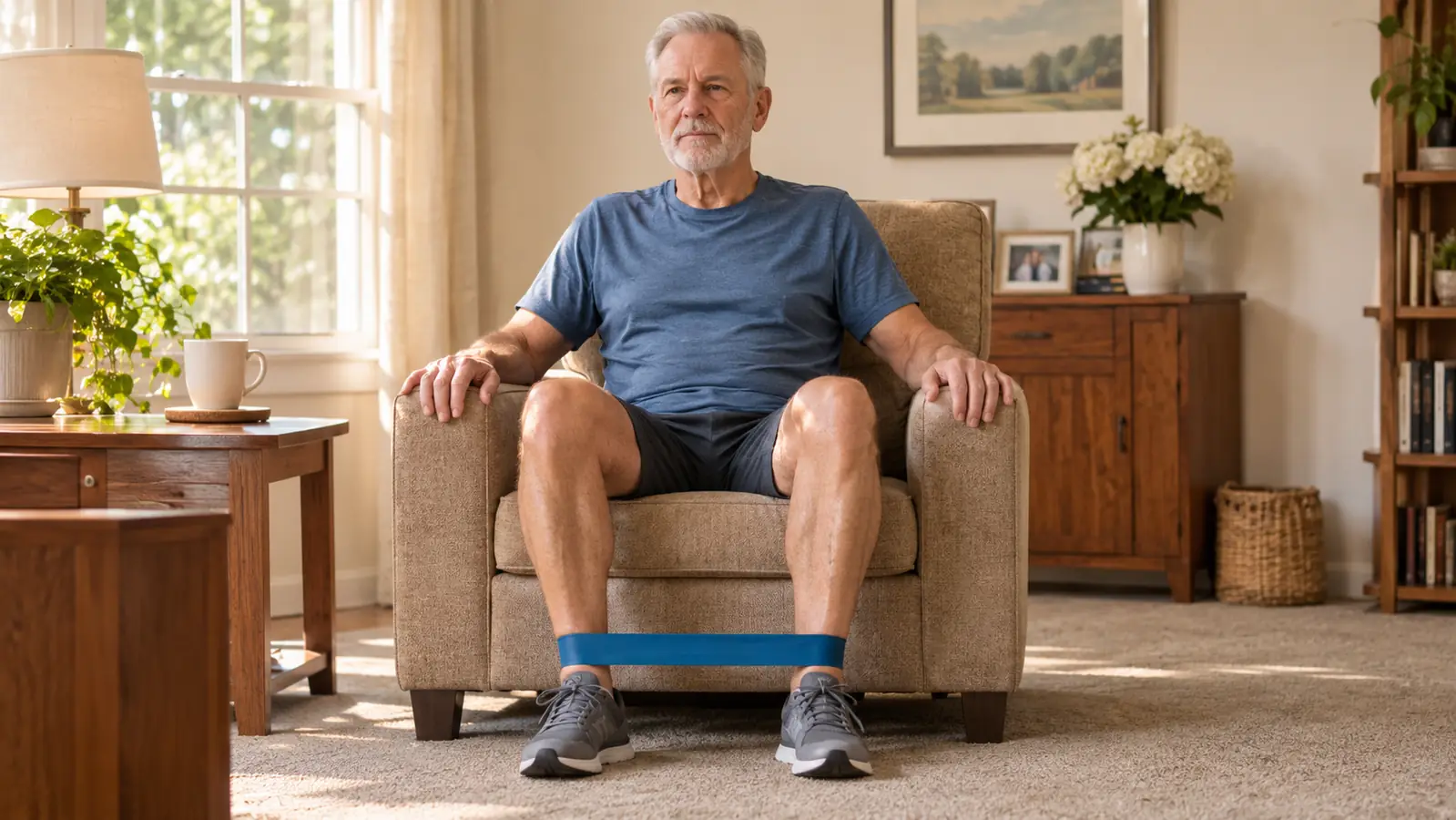
My knees started voting on things I used to do without thinking about. Stairs. Cold mornings. Getting up out of the armchair after the evening news. Nothing dramatic, just a steady quiet no. I am 78, I live in a one story ranch house in Wethersfield, and I have no interest in pretending this reverses itself on its own. What I wanted was a way to rebuild leg strength sitting down, in my own living room, without a gym membership or a trainer standing over me counting out loud.
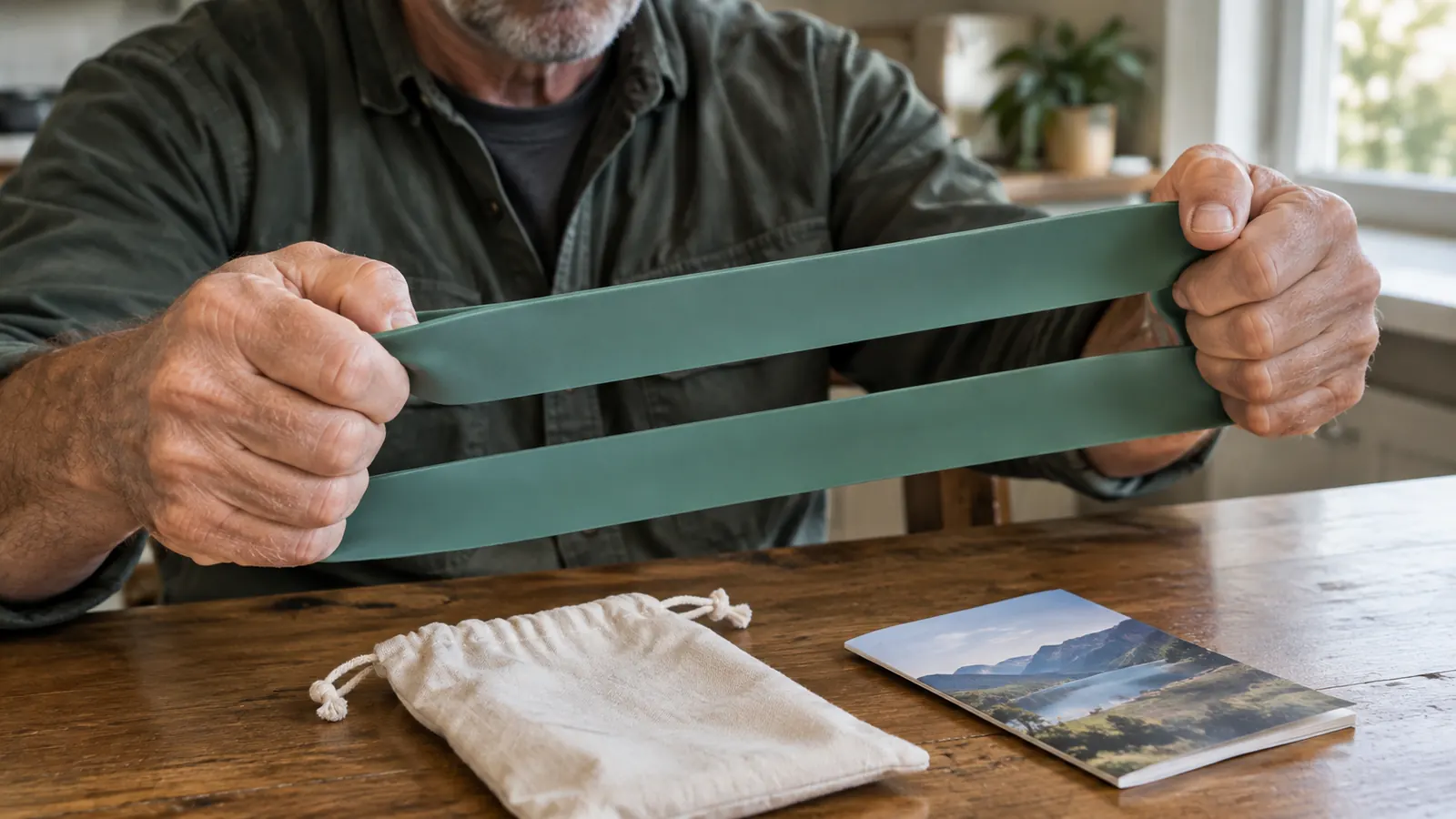
So I tried the obvious thing first. I walked more. Walking is good, and I still take a short loop after lunch with Dot, but it did not rebuild the muscles that lift me out of a chair. Then I dug a set of flat loop bands out of the closet, the Fit Simplify set of five, and gave myself twenty minutes every morning after coffee. That was the whole plan. No schedule taped to the refrigerator, no promises. I am writing this because the plan worked well enough that my knees stopped commenting on the stairs, and because most of what I found online was written for people half my age sitting on a gym floor. The Fit Simplify set comes with a printed instruction booklet and a small carry bag, and the booklet is honestly where I started. If you want the longer version of how the set has held up, I wrote that up separately, but the routine is here.
Twenty minutes, one chair, and a set of bands that lives in a drawer
Five resistance levels, a carry bag, and an illustrated booklet you can actually follow. I spent two weeks on the lightest band before I moved up, and I would do it the same way again.
Amazon Check Today's Price on Amazon →Five Moves, One Chair
Nothing on this list requires kneeling, lying on the floor, or getting back up off the carpet. You need a chair with arms, carpet or a rug under it so the feet do not slide, and a wall or counter within reach for the first week or two. Do the whole circuit, rest a day, do it again. Three sessions a week is what I managed, and it was enough.
Step 1: Choose the Lightest Band and a Chair That Will Not Move
The set arrives with five bands at five resistance levels and a booklet of illustrated exercises. My advice is to ignore four of them for the first two weeks. Start with the extra light band, the one that feels almost insulting, and let your knees and hips get used to the idea that they are being asked to work again. The bands are latex, about 12 inches long and 3 inches wide and a quarter inch thick, which means they grip fabric and skin well and they will absolutely find the one spot on your calf where they can roll into a rope. That is normal. Smooth it flat and keep going.
The chair matters more than the band. Use a firm armchair or a straight backed dining chair with the seat at a height where your feet rest flat on the floor and your knees sit at about a right angle. No rolling desk chair, no folding chair that shifts when you lean, no soft sofa that swallows you. Put it on carpet if you have it. If your chair sits on bare floor, put a rubber mat or a folded towel under the front legs so the whole thing does not scoot when you pull against the band.
Before every session, run the band through your hands and look for nicks, thin spots, or a tear starting at the edge. Latex does not last forever, and it does not announce itself before it goes. Keep the bands out of direct sun and out of a hot car. The set weighs almost nothing and folds into the carry bag, so if you travel to see family, the routine goes with you. That was the thing that kept me consistent through a week away at my daughter's place.
Step 2: Seated Leg Extensions
Sit tall, back against the chair, both feet flat. Loop the band around both ankles. Slide forward an inch or two so your heels are just in front of the seat edge. Now straighten one leg out in front of you, slow, while the other foot stays planted and holds the band. You will feel it in the front of the thigh, above the knee. That is the muscle that carries most of the load when you stand up.
Two seconds out, three seconds back. Do not snap the leg straight and drop it. The slow return is where most of the work happens, and it is also where most people quit paying attention. Eight to twelve repetitions on each leg is a reasonable set, and two sets is plenty for the first month. If you cannot get to eight, the band is too heavy or the chair is too low. Fix the setup before you decide your legs are the problem.
Keep breathing. I say that because I caught myself holding my breath for the first two weeks, turning a gentle exercise into a small contest. If your knee complains with a sharp pain rather than a tired ache, stop, shorten the range, and bring it up with your doctor or physical therapist before you push through it. I am not a medical man and I am not going to pretend otherwise. A dull working ache in the muscle is the point. A stab inside the joint is a signal.
Step 3: Seated Knee Press
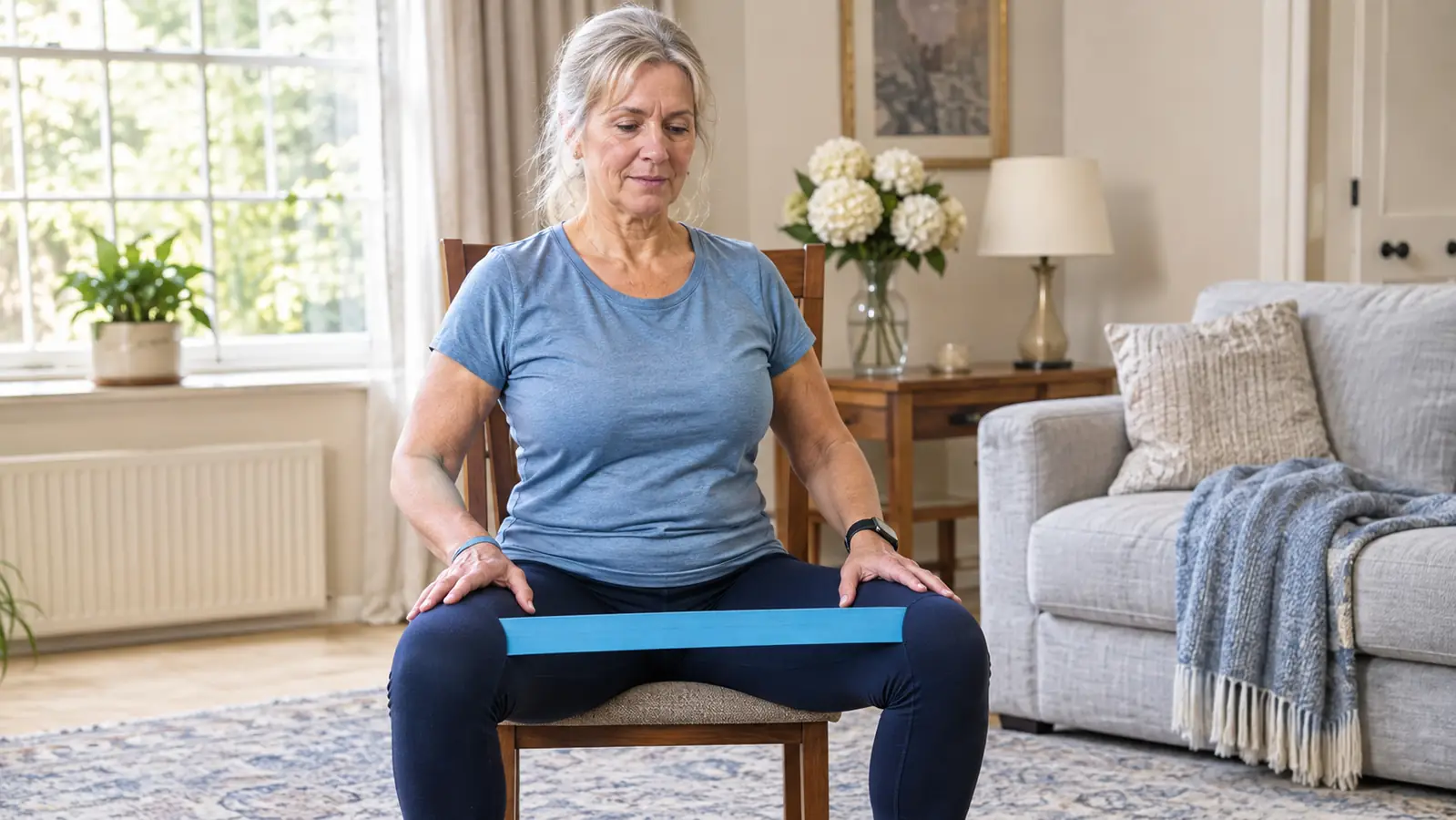
Slide the band up so it sits just above your knees, around both thighs. Feet flat, shoulder width. Press your knees apart against the band, slow, and hold for two seconds at the widest point you can reach without sliding forward on the seat. Then let them come back together under control. Twelve to fifteen of those, two sets. You will feel it in the sides of your hips, which is a place most of us stop using somewhere around age sixty.
This is the move I would keep if I could only keep one. Those side hip muscles are what keep you from wobbling when you turn in the kitchen or step off a curb. They do not get strong from walking on flat pavement in a straight line, and they are the first thing to go quiet when you spend a winter in an armchair. My balance is not what it was at fifty and it never will be, but it is better than it was two years ago, and this is the exercise I credit for it.
One caution. Do not lean back and use the chair to cheat the press. Sit tall, chin level, hands resting on your thighs. If the band keeps sliding up toward your hip, you are pushing with the wrong part of the leg. Nudge it back down above the knee and start again. The kettle can wait. This is twenty minutes that belongs to you.
Step 4: Seated Ankle Press
Loop the band around the ball of one foot, cross the ends, and anchor the loop under the other foot. Straighten the working leg slightly and press the foot forward and down, like easing off a gas pedal, then let it come back. Fifteen to twenty slow reps per side, one or two sets. It looks like nothing. It is the reason I can stand on my toes to reach the top shelf in the garage again, and it is the reason my ankles do not fold on the uneven part of the driveway.
Calves and ankles are the part of the leg nobody thinks about until a stumble. I do this one last in the circuit because it is the least taxing and it lets me finish on a good note. Keep the movement small and controlled. If the foot cramps, stop, point and flex the foot a few times without the band, and drink some water. Cramps in the first week are common and they settle down.
Anchoring takes a little fiddling the first time. Sit with both feet flat, band around the ball of the right foot, and trap the other end of the loop under your left heel. Press the right foot forward until you feel the band tighten, then work in that range. Nothing about this should require you to hold your breath or grip the chair arms, and if it does, the band is one level too heavy.
Step 5: Seated Hamstring Pull
Loop the band around one ankle and hook the other end around the front leg of your chair. Pull that heel back and under the seat, slow, and squeeze at the back of the thigh for a beat before letting it return. Ten to twelve on each side. This is the muscle that lets you slow down as you sit, which is the half of standing up that nobody practices and everybody needs. If you have ever dropped into a chair harder than you meant to, this is your exercise.
By the time I get here, my legs are warm and the band feels lighter than it did at the start. That is the point of the order. Quads first, hips second, calves third, hamstrings last. It takes me about eighteen minutes with a sip of water between steps, and Dot can tell you I am not a man who lingers over exercise. I do the circuit Monday, Wednesday, and Friday, and on the other days I walk and leave the bands in the drawer.
When twelve reps feels easy two sessions in a row, move up one resistance level. Not two. The set has five levels and there is no prize for reaching the heavy band by March. I moved up once in eight weeks and I was in no hurry about it. If you go up and the movement gets sloppy, or your knee starts talking to you the next morning, drop back down for another two weeks. The band is a tool, not a scoreboard.
What Else Helps
The bands did most of the work, but three other things mattered. First, I started practicing the actual skill, which is standing up out of the chair without pushing off the arms. Five slow stands, a few times a day, arms crossed or hands on your thighs. That is the real test of everything the bands are building, and it tells you the truth faster than any exercise does. Second, I kept the after lunch walk with Dot. Strength and walking are not competing hobbies. Third, I wrote the numbers on a three by five card. Date, band level, reps. It sounds like bookkeeping, and it is, and it is also the only reason I know that I have improved rather than imagining it.
Add some balance work at the kitchen counter, one hand on the countertop at all times, standing on one foot for ten seconds and then the other. Do it while the coffee brews. Do not do it in the middle of the room with nothing to grab. I have good balance for a man my age and I still keep a hand on the counter, because a fall would cost me more than any of this gains.
And before you start any of it, have the conversation. Check with your doctor or your physical therapist, especially if a knee swells, if you have had a fall, or if you have been told you have a joint problem with a name attached to it. Bands are gentle but they are not nothing, and a twenty minute routine is not a substitute for a diagnosis. The instruction booklet that comes with the Fit Simplify set also has dozens of illustrated variations beyond these five, if you want more to choose from once the basics get easy.
Eight weeks of three short sessions a week, and I stand up out of the armchair without shoving off the arms. That is the only scoreboard I care about.
Start with the two lightest bands and a chair that will not move
Five levels mean you will not run out of room to grow, and the printed booklet gives you more variations than the five moves above. Twenty minutes after coffee. That is the entire commitment.
Amazon Check Today's Price on Amazon →