
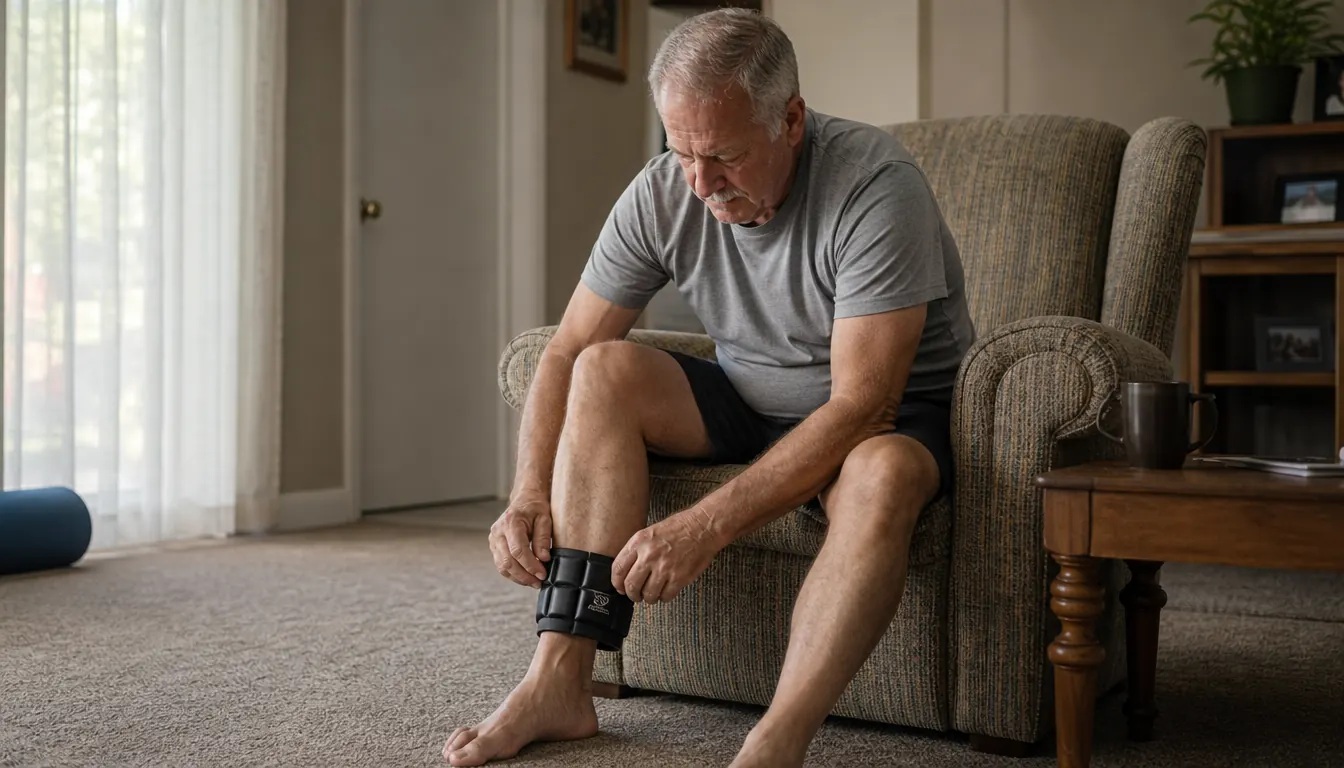
For two years I used a pair of one-pound weights that came bundled with something else, and I told myself that was plenty. My knees complained on the stairs, my lower back stayed stiff until noon, and I assumed that was simply the price of being 78. What changed was not a burst of ambition. It was a remark my wife Dot brought home from her own checkup, something about how a little resistance on the legs during walking does more for an older body than another ten minutes of stretching. I asked my doctor before I did anything. Then I bought a pair of Sportneer adjustable ankle weights and used them five mornings a week for four months before sitting down to write this.
This is the honest version. Not the version where the product is wonderful in every way and the reviewer mentions one small flaw so he seems fair. There is plenty here I use and like, and there are two things I would change tomorrow if I could. You should hear both before you decide anything.
The Quick Verdict
Adjustable from 1 to 5 pounds per side and it stays put during slow indoor walking. The strap edge is the weak point, and the fit range shuts out very thin ankles.
Amazon Check Today's Price →The pair I was still wearing after four months of morning laps
Adjustable from one to five pounds per side, hook and loop closure, neoprene over iron sand. Start at the bottom of the range and add a pound when a week feels easy.
Amazon Check Today's Price on Amazon →What Nobody Tells You Before You Buy Ankle Weights
The listing makes this look like a decision about weight. It is not. It is a decision about the strap, and the strap is the one part you cannot judge from a photograph. Sportneer builds these with a hook and loop closure, which is the right call for a stiff-handed man of my age, because there are no buckles to line up and nothing to pinch. But a closure only works if the strap runs out long enough to reach, and the listing puts the fit at ankles from 7.5 to 12.5 inches. That is a wide window and it covers me. It does not cover everybody.
Before this pair I tried what was already in the house. A buckle-style weight from a drawer, bought years ago for something I no longer remember, with a metal clasp and a leather tab. It weighed two pounds and it would not stay where I put it. The buckle had to line up exactly and my fingers are not what they were, so I would work at it for a minute standing in socks with one hand on the chair, and it would loosen after ten steps anyway. I gave it a week. Then it went back in the drawer and stayed there until I finally threw it out in the spring. The new strap closed on the first try, and that told me more about whether I would keep using these than any of the weight numbers did.
My ankles are thick for a man my size, nearer the top of that window than the bottom, and the strap still has a few inches of overlap when it is snug. Dot is the opposite. On her the strap closes with almost nothing to spare, and the tail has to be tucked or it taps against her heel while she walks. She wore them twice and handed them back. If you are buying for someone narrow through the ankle, measure first and be honest about the number you get.
The other thing nobody says out loud is that iron sand inside a neoprene cover does not stay where it started. It settles toward the lower edge over a few weeks, so the load hangs a touch heavier at one end than the other. That is not a defect and it has not changed how I use them. It is a small annoyance, and you should know it is coming rather than discover it in month two and wonder what you did wrong.
How I've Used Them in My Living Room
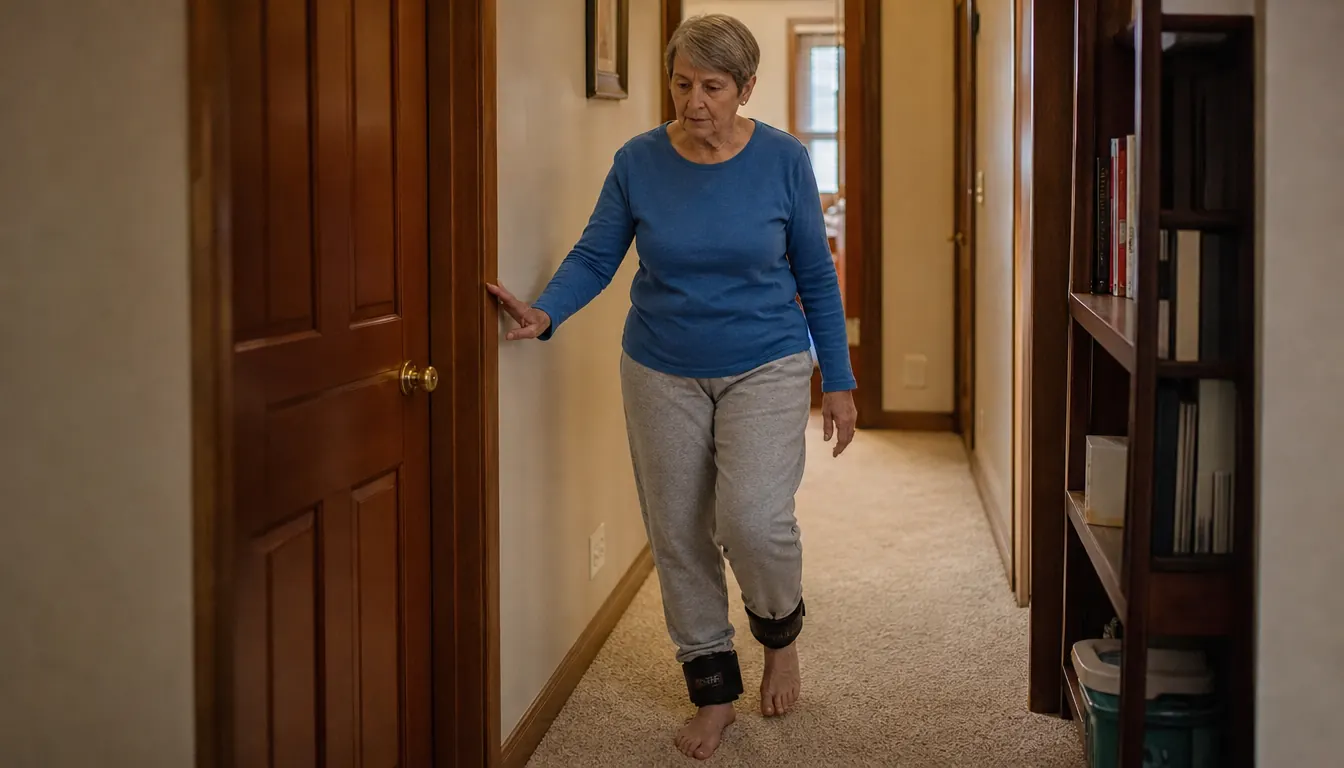
My routine is twenty minutes after coffee, on the carpet in the living room, with the armchair within reach for balance work. I strap them on, one at each ankle, and do what my physical therapist showed me: slow marches in place, standing leg lifts out to the side while I hold the chair back, a set of sit-to-stands, then a walk to the kitchen and back. The whole thing takes less time than the morning news, which is the only reason it has survived four months.
I measured the space before I started, which sounds fussy and is not. From the front edge of the armchair to the window wall is nine feet, and that is enough for six slow marches in place and a turn. I keep a folded towel on the carpet to mark the spot for the marching, and the chair back is where my left hand goes for the side lifts. On the second Tuesday in March I tried doing the marches without holding anything, and I made it through four before I decided that was a foolish way to find out whether my balance had improved. Now I hold the chair for the marches too. Nobody is watching, and I would rather be boring than on the floor.
Where they earn their keep is the walking. On a bare floor I can hear the sand shift with each step. On carpet they are quiet, and the strap does not creep down over my heel the way my old one-pound pair did. That matters more than the weight does. A weight that slides is a weight you eventually stop putting on, and I have a closet shelf full of evidence for that.
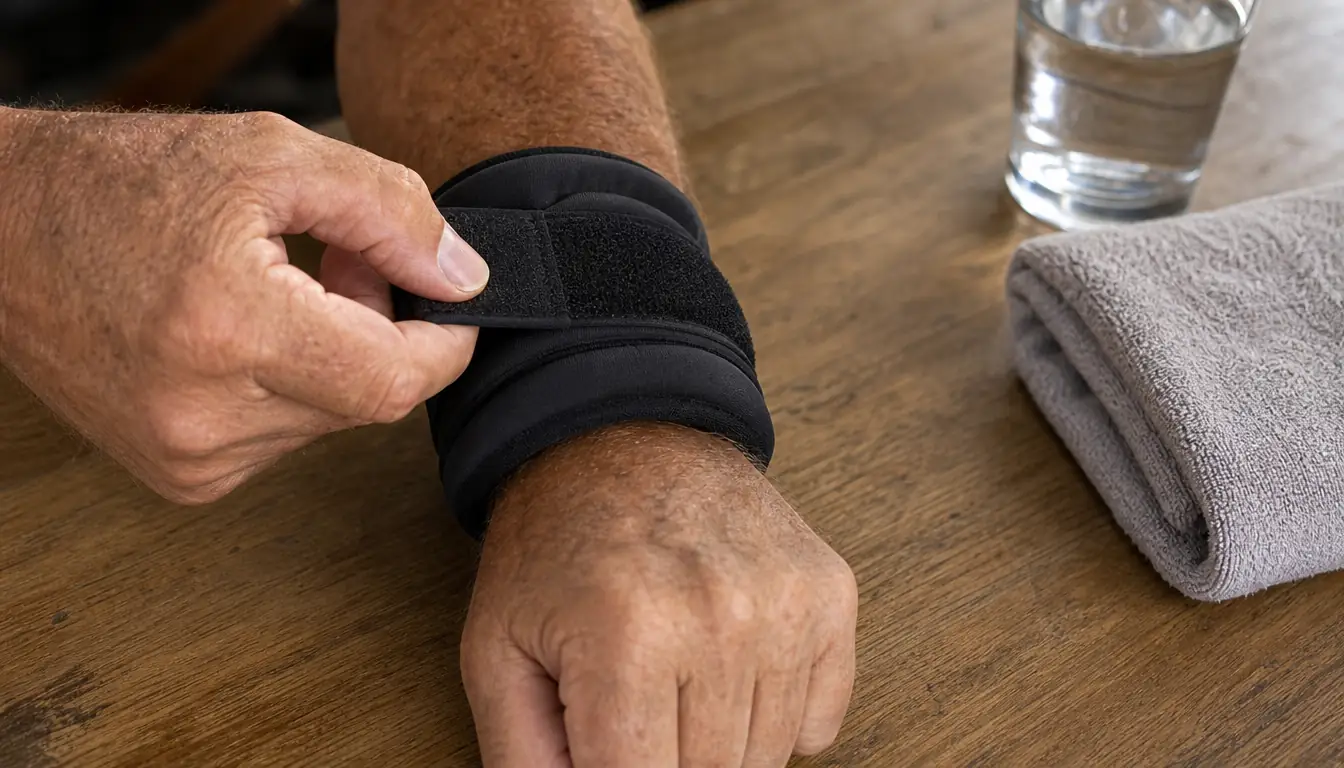
I have also worn one on a wrist for a few arm movements, and the listing does say ankle or wrist. It works well enough there, though a wrist is a shorter distance around and the strap leaves more slack to manage. There is a separate comparison of ankle and wrist loading on this site if you are deciding which end of the body needs the work, and I would read it before you buy two pairs of anything.
The Adjustment System, Honestly
Each weight adjusts from one to five pounds, and a pair runs from two to ten. The change happens by adding or removing the filled weights, not by turning anything, and it takes about a minute with both hands. For someone with arthritis in the fingers, budget the minute. It is not difficult, but it is not the sort of thing you want to do in a hurry with one foot off the floor.
Here is what that minute actually looks like. I sit on the armchair with both weights across my knees and set them side by side, then work each one up a pound at a time, saying the number out loud so I do not lose track of where I am. Three pounds per side is my working setting and it stays there for two weeks at a stretch. When Dot borrowed them for a week in June she wanted two, so I reset both before she left and reset them again when they came back. It is not complicated and it is not hard on the hands, but it is the sort of small bookkeeping a tired man skips, and skipping it is how you end up walking a mile with one side heavier than the other without noticing until your hip mentions it that night.
I started at one pound per side and stayed there for two weeks. That sounds like nothing and it is not nothing when your knees have opinions about your decisions. The jump from one to two was noticeable in my hip flexors the next morning. By month three I was at three pounds per side for the marching and one pound for the sit-to-stands, and that is where I have stayed. The top of the range, five per side, I have never needed.
Here is the honest limit. Ten pounds total is not a strength program for a healthy 40-year-old. It is a walking and rehab tool. If your goal is serious loading for bone density, you will outgrow these inside a season, and you should plan for that rather than feel let down by a product that never claimed otherwise.
Where They Surprised Me
The stitching has held. Four months, five mornings a week, and the seam where the strap meets the body of the weight has not frayed or pulled. I expected that to be the first thing to go, and I was wrong. The neoprene has picked up a faint crease where it bends over the ankle bone. That is cosmetic and it does not bother me.
They also wipe clean, which I did not think about until the first humid week of summer. A damp cloth, a minute to air dry, and they go back in the basket beside the chair. No smell, no discoloration so far, no reason to think about them between sessions.
And the closure holds. I have had straps on other gear let go mid-movement, which is a fall waiting to happen when you are 78 and standing in socks. These have not let go once, including the morning in May when I put them on over a pair of thicker wool socks and expected the grip to suffer. It did not. That is not a small thing to me. That is the whole ballgame, and everything else on this page is secondary to it.
Where They Let Me Down
The edge of the strap is the problem. The trim is firm, reinforced as the listing says, and on a longer session it presses into the front of my ankle. At twenty minutes I notice it around minute fifteen. At forty minutes I had a red line and I took them off. A softer binding or a rounded edge would fix it, and I hope a later version has one.
The long walk was on a Saturday at the end of April, sixty-some degrees, and I decided I would go around the block instead of to the kitchen and back. That is roughly a quarter mile with a slight rise at the corner. I made it about halfway before I felt the edge working at the front of my ankle. I finished the loop because turning around felt like admitting something, and by the time I reached the driveway there was a red line across the front of each ankle and it stung in the shower. I tried a thicker sock the next week and that helped a little. A folded bandanna under the strap helped more, and I used that for a month before I decided the whole business was more fuss than the walk was worth. Now they stay indoors, where they belong.
The fit range is narrower in practice than it sounds on the page. Sportneer says 7.5 to 12.5 inches around the ankle, and they mean it. Under 7.5 inches, which happens more than you would guess in older women who have lost some muscle, you will be tucking a long tail or you will not get them snug. Measure before you order. A cloth tape, one loop, ten seconds, done.
And the sand settling is real. It has not hurt anything, but at the higher settings I can feel where the load sits, and I find myself tugging them straight at the start of a set. If you need your gear to disappear on your body, these are not that. If you can tolerate a small fuss at the start, they are fine.
What I Liked
- Adjusts from 1 to 5 pounds per side, so you can start light and stay light
- Hook and loop closure is manageable with stiff hands
- Stitching and closure held up over four months of near-daily use
- Neoprene wipes clean with a damp cloth and air dries quickly
- Quiet on carpet, no clanking during indoor walking
Where It Falls Short
- Strap edge presses into the ankle on sessions longer than about twenty minutes
- Fit window of 7.5 to 12.5 inches leaves thin ankles with excess tail
- Iron sand settles toward the lower edge over time
- Ten pounds total is not enough for anyone chasing real strength loading
Four months, five mornings a week, and the seams have held. The strap edge has left a mark on my ankle twice. I would still buy them again.
Care, Fit, and What the Listing Buries
Measure the ankle or wrist at the point where the strap will sit, not across the bone that sticks out. Sportneer asks you to confirm fit before buying, and they are right to. The 7.5 to 12.5 inch window is the single most useful number on that page and it sits below the weight specifications, which is backwards. Weight is the easy part. Fit is where people get surprised.
Care is simple enough. Wipe with a damp cloth, let them air dry flat, keep them out of a hot car. I would not put them through a washing machine and I have not. Four months in, they look like gear that has been used and not like gear that has been abused.
One more honest note, and this one matters. These are not a treatment for anything. My knees still complain on stairs and in cold weather. What changed is that the muscles around them do a little more of the work than they did in the spring, and my standing marches feel steadier than they did in March. That is the entire claim I am making. Anything bigger than that is a conversation for you and your doctor, not for a review written by a retired shop teacher in Connecticut.
Who This Is For
This is for an adult who has been cleared for resistance work and wants a small, adjustable load for indoor walking, standing leg lifts, or the home version of a therapy exercise. It suits the person who wants to start at a pound and add slowly, and the person whose hands do better with a hook and loop strap than with a buckle or a tie. If you are 65 or older and your main goal is staying steady on your feet, this is a sensible tool and it will earn its place beside the armchair. It is also a good fit if you and your wife want to share one pair at different settings, though you will each need to reset it, which takes that minute I mentioned.
Who Should Skip It
Skip them if your ankle measures under 7.5 inches, if you want to load more than ten pounds total, or if you want something you can put on once and forget for an hour. Skip them if you have not asked your doctor or physical therapist about adding resistance, particularly if you have neuropathy, balance problems that have not been assessed, or a recent joint replacement. And skip them if you need gear that vanishes on your foot. This pair lets you know it is there, every single step, and that is the trade you are making.
Start at one pound and give it two weeks before you decide
That is the whole method. One pound per side, slow marching, a chair within reach. If the second week feels easy, add a pound and see how the morning after feels.
Amazon Check Today's Price on Amazon →